
Architecting for composable commerce: Decoupling frontend experiences from backend systems
Learn how decoupling your frontend from backend systems cuts IT debt, speeds releases, and breaks vendor lock-in.

Key Takeaways
- Monolithic e-commerce platforms create technical debt that blocks fast feature releases and customer experience innovation.
- Decoupling frontend from backend through composable commerce eliminates vendor lock-in and reduces system failure risk.
- API-first integration and a strangler fig migration pattern allow safe, phased transition without operational disruption.
- Composable architecture cuts infrastructure costs, speeds time-to-market, and enables scalable personalisation at enterprise scale.
Monolithic e-commerce platforms are killing your ability to move fast. Every frontend change risks breaking backend systems, every new feature takes months to ship, and your engineering team spends more time maintaining legacy code than building what customers actually want. Composable commerce solves this by decoupling your frontend from backend services, giving you the speed and flexibility to compete.
Retail CTOs face a brutal reality: monolithic e-commerce platforms are destroying competitive velocity. Every feature release becomes a negotiation with legacy code. Every customer experience improvement risks cascading failures across your entire stack.
The technical debt isn't just slowing you down—it's actively preventing you from shipping the personalised, omnichannel experiences that drive revenue growth.
The monolith tax on innovation
Tightly coupled architectures force impossible tradeoffs. Your frontend team can't deploy a new checkout flow without coordinating with backend teams managing inventory, payments, and order processing. A single bug in the presentation layer can bring down core business operations.
This coupling creates three critical problems:
- Deployment friction: Minor UI changes require full system regression testing, turning two-day updates into two-week projects
- Vendor imprisonment: You're locked into a single platform's roadmap, forced to accept their pace of innovation and feature priorities
- Fragility at scale: System failures propagate across boundaries, making your entire commerce operation as reliable as its weakest component
The operational overhead compounds quarterly. Your engineering team spends more time managing integration complexity than building features that differentiate your brand.
Composable commerce as technical strategy
Composable commerce isn't a buzzword—it's an architectural pattern that separates customer-facing experiences from backend commerce functions through API contracts.
You decouple:
- Frontend rendering (product pages, checkout flows, content) from
- Backend services (product information management, order management systems, payment gateways, inventory)
Each component becomes independently deployable, scalable, and replaceable. Your frontend team ships customer experience improvements without touching order processing logic. Your backend team optimizes inventory management without breaking the mobile app.
This separation creates technical flexibility that translates directly to business velocity.
Why API-first architecture wins
API-first design means every backend service exposes its functionality through well-defined, versioned interfaces. Your commerce capabilities become building blocks that any frontend can consume—web, mobile, point-of-sale, voice assistant, or channels that don't exist yet.
You gain:
- Best-of-breed selection: Choose the strongest product information system, the most reliable payment processor, and the fastest checkout experience independently
- Contained blast radius: Payment gateway issues don't crash your product catalog; frontend bugs don't corrupt order data
- Parallel development: Frontend and backend teams work simultaneously without coordination overhead
The architectural shift moves you from integrated suite to composed platform. You're no longer dependent on a single vendor's vision for your entire commerce stack.
Implementation blueprint
Phase 1: Audit and map dependencies
Start with a comprehensive dependency audit. Document every integration point between your current frontend and backend systems.
Identify:
- Service boundaries: Where does product catalog end and cart logic begin? What data flows between checkout and order management?
- Data coupling: Which frontend components make direct database calls? What business logic lives in presentation code?
- Bottlenecks: What changes require cross-team coordination? Which updates trigger full system deployments?
Map your essential service domains:
- Product catalog and search
- Cart and session management
- Checkout and payment processing
- Order fulfillment and tracking
- Customer accounts and preferences
- Promotions and pricing rules
This audit reveals your strangler fig migration path—the sequence for gradually replacing monolith components without operational disruption.
Phase 2: Build the integration layer
Your integration layer becomes the contract between old and new systems. It's the technical foundation that allows gradual migration.
Implement:
API gateway: A single entry point that routes frontend requests to appropriate backend services, handles authentication, rate limiting, and request transformation. This gateway becomes your abstraction layer—frontends never call backend services directly.
Event bus: An asynchronous messaging system that allows services to publish and subscribe to business events (order placed, inventory updated, payment processed) without direct coupling. Services react to events without knowing which other services produced them.
Service registry: A catalog of available backend services, their API contracts, versioning policies, and health status. This registry enables dynamic service discovery and failover.
Your gateway and event bus enforce API governance. You version every interface, deprecate endpoints gracefully, and monitor contract violations before they become production incidents.
Phase 3: Strangler fig migration
The strangler fig pattern lets you replace the monolith incrementally. New functionality gets built in the composable architecture. Existing functionality migrates piece by piece.
Start with high-value, low-risk customer journeys:
- Product discovery: Migrate product listing and detail pages to a headless frontend consuming your product catalog API. These pages are read-heavy with minimal business logic—ideal first candidates.
- Content and marketing: Move promotional landing pages, editorial content, and campaign microsites to your new frontend framework. Marketing teams gain deployment independence without touching core commerce.
- Checkout optimization: Re-platform checkout as a standalone service with its own optimized frontend. This critical conversion path gets dedicated performance tuning without legacy constraints.
- Account management: Extract customer profile, order history, and preference management into independent services consumed by a modern account portal.
Each migration:
- Routes traffic through your API gateway to the new component
- Maintains backward compatibility with unconverted systems through adapter services
- Monitors performance and conversion metrics to validate the new implementation
- Gradually increases traffic allocation until the old component can be decommissioned
You're never running a risky big-bang migration. Each piece moves independently, validated by real customer behavior before the next transition.
Architecture anti-patterns to avoid
Distributed monolith: Splitting your monolith into services that still share databases, session state, or synchronous call chains doesn't create composability—it creates a distributed debugging nightmare. Ensure true service independence.
API gateway as logic layer: Your gateway should route and transform, not implement business rules. Keep domain logic in services, not middleware.
Premature microservice proliferation: Start with coarse-grained services aligned to business capabilities. You can decompose further as specific scaling or team boundaries demand it.
The operational and financial return
This architectural investment delivers measurable business outcomes:
Reduced time-to-market: Frontend teams ship experience improvements in days, not months. Backend optimizations deploy without frontend coordination. Engineering velocity increases 40-60% as coordination overhead drops.
Lower infrastructure costs: Independent scaling means you allocate compute resources where needed. Your product catalog scales differently than your checkout process. You're not over-provisioning an entire monolith for peak traffic in one component.
Eliminated vendor lock-in: You can replace any component—product information, order management, search, payment processing—without migrating your entire platform. Vendor pricing becomes negotiable when switching costs drop.
Reduced IT debt: Legacy technical decisions don't cascade forward. You can modernize one service domain without touching others. The cost of staying current drops dramatically.
Higher system resilience: Failures isolate to single services. Your product catalog stays available when payment processing experiences issues. Customer-facing experiences degrade gracefully rather than failing completely.
For a mid-market retailer processing $100M annually, this architectural shift typically:
- Cuts infrastructure costs 20-30% through efficient scaling
- Reduces development cycle time 50-60% by eliminating coordination overhead
- Decreases unplanned downtime 70-80% through failure isolation
- Accelerates A/B testing velocity 3-5x by enabling independent frontend deployments
The financial case isn't just cost reduction—it's revenue protection and growth acceleration. You ship competitive features faster, respond to market changes within days, and maintain uptime during component failures.
Technical readiness factors
Not every organization is ready for composable commerce. Assess your technical maturity:
API development capability: Your teams need experience designing, implementing, and maintaining RESTful or GraphQL APIs with proper versioning, documentation, and error handling.
DevOps automation: Composable architectures multiply the number of deployable units. You need mature CI/CD pipelines, infrastructure as code, and automated testing to manage complexity.
Monitoring and observability: Distributed systems require distributed tracing, centralized logging, and service health monitoring. You can't debug composable architectures with monolith tools.
Organizational alignment: Product managers and business stakeholders must understand that upfront migration investment pays back through sustained velocity gains. You need executive support for 6-12 months of parallel technical work.
If your current team lacks these capabilities, invest in building them before starting migration. Composable architecture amplifies both strong and weak engineering practices.
The CTO decision
Monolithic e-commerce platforms made sense when they were built. Technology, customer expectations, and competitive dynamics have shifted.
The question isn't whether to decouple—it's how fast you can execute the transition before your architecture becomes a competitive disadvantage.
Your frontend and backend have different scaling profiles, different change frequencies, and different team ownership. Forcing them into a single deployable unit creates friction at every boundary.
Composable commerce isn't a theoretical future state. It's a practical architectural pattern that reduces operational risk while increasing development velocity. The migration path is proven. The business case is clear.
The technical liability of waiting compounds quarterly.
Want more on
Enterprise Architecture?
Add this topic to your Custom Digest. Drop your email to get our deepest insights on this exact topic.
Ready to fast-track your business?
We combine enterprise-level technical strategy with your existing business to solve complex blockers and accelerate your growth. Let's build something remarkable.
Partner With UsUp Next
Continue your journey into Enterprise Architecture.
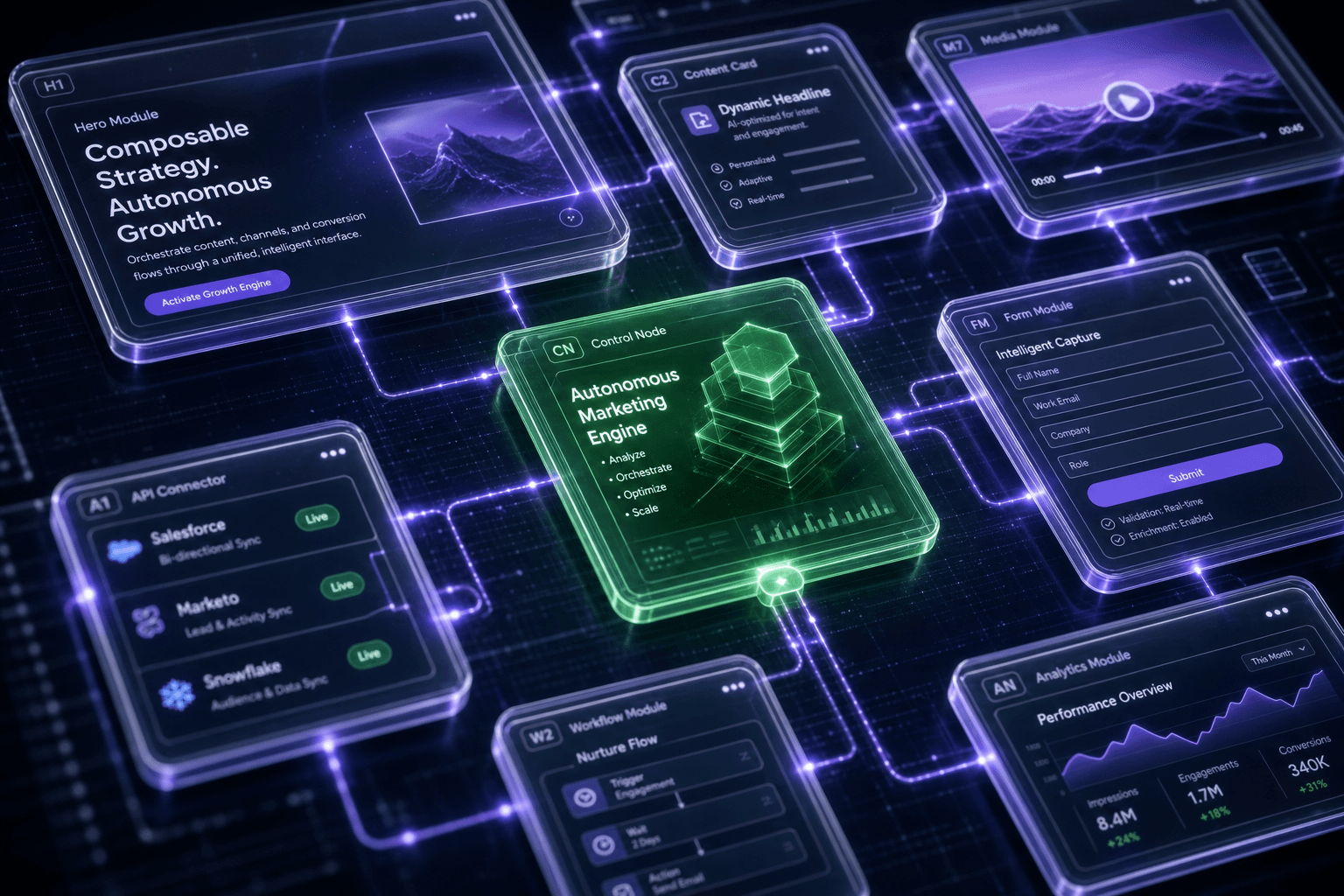
Empowering marketing teams
How API-first frontends let marketing teams launch campaigns without engineering tickets, cutting time-to-market by half.

The architecture pattern that makes personalization and compliance work
Why ranking by relevance first, then filtering for compliance, creates worse recommendations and higher audit risk than the opposite approach.

Agent containment as infrastructure
System-level containment stops rogue agents by enforcing network boundaries and resource limits, not just model-level training guardrails.