
Architecting the autonomous customer journey: Next.js and
Learn how Next.js, headless CRM, and real-time personalisation can transform your RevOps strategy and create autonomous customer journeys at scale.
Key Takeaways
- Decouple your CRM and CMS for agility.
- Real-time data integration eliminates delays.
- Empower personalized experiences without manual effort.
Your legacy systems are costing you time and customer satisfaction. By adopting a headless architecture with real-time integrations, you can create responsive and personalized customer journeys that keep pace with their needs.
Your operations team wastes thousands of hours every year on manual data synchronisation. Your customer experiences lag behind real-time behaviour. Your CRM holds rich, dynamic customer data, but by the time it reaches your website or customer portal, it's already stale.
This isn't a people problem. It's an architecture problem.
In 2026, RevOps leaders who understand the technical foundation of their stack are building something different: autonomous customer journeys that respond instantly to CRM data, without manual intervention. This means personalised pricing, targeted product recommendations, and segmented communications delivered at the exact moment your customer needs them.
The architecture is straightforward: decouple your CRM, headless CMS, and presentation layer. Connect them through a real-time integration backbone. Deploy on infrastructure that supports server-side rendering and edge computing.
Let's break down what this looks like in practice.
The technical stack: What you're building
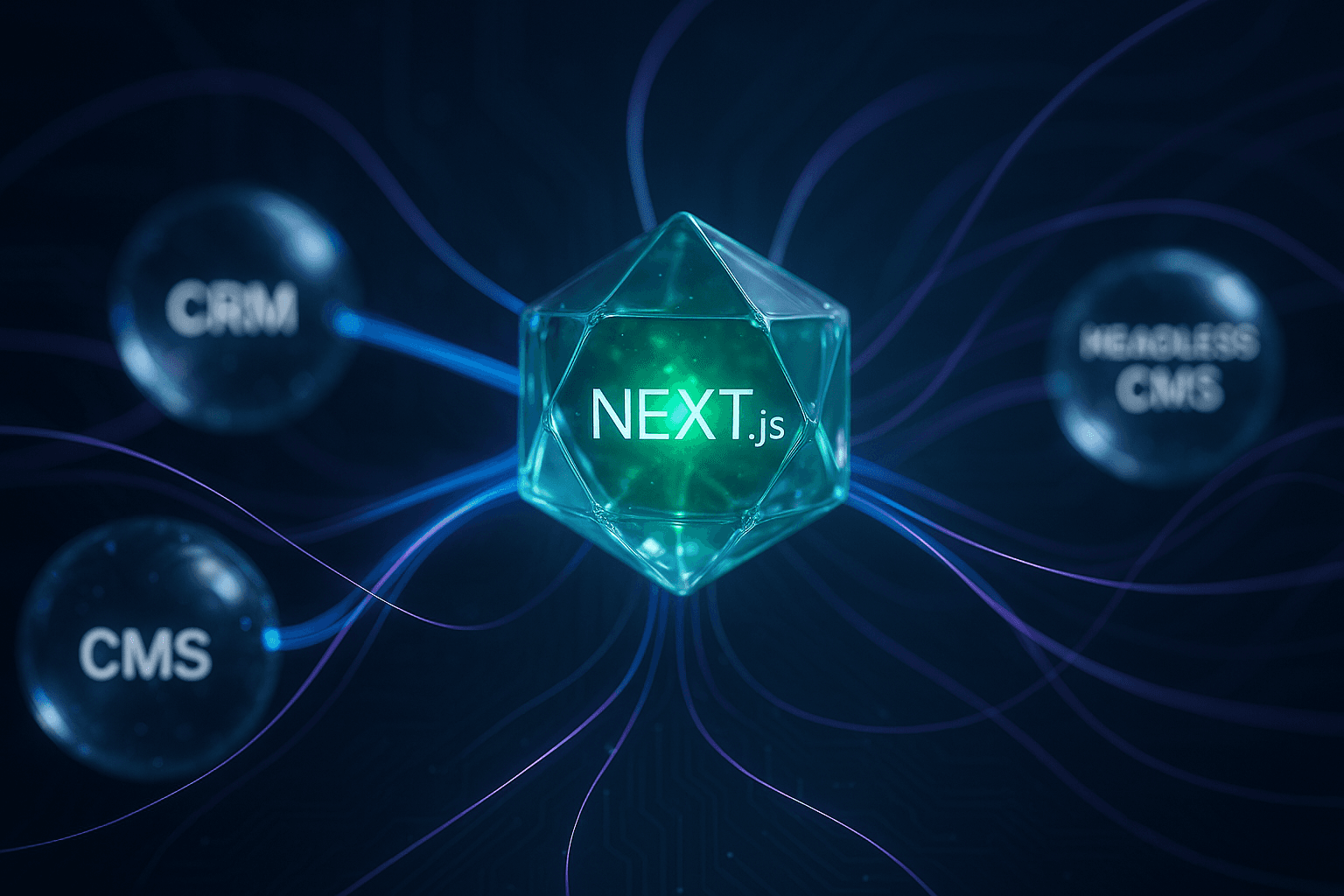
You need three distinct layers working in sync:
1. Data layer (CRM): Your customer records, behavioural data, transaction history, and engagement metrics. This is your source of truth for customer state.
2. Content layer (Headless CMS): Your marketing content, product information, and dynamic templates. This layer has no built-in presentation - it serves structured content through APIs.
3. Presentation layer (Next.js): Your customer-facing application. This renders personalised experiences by pulling data from both your CRM and headless CMS in real-time.
The integration backbone - whether you build custom API layers or use automation platforms like n8n - keeps these systems synchronised. When a customer's status changes in your CRM, that change propagates immediately to the content they see.
No batch processing. No overnight synchronisation. No manual updates.
Why traditional monolithic systems create latency
Your legacy CRM and CMS were built as all-in-one solutions. They combine data storage, business logic, content management, and presentation in tightly coupled architectures.
This creates three problems:
Synchronisation cycles: Data moves between systems on schedules, not in response to customer behaviour. A customer who upgrades their plan at 2 PM might not see personalised content until the next day.
Proprietary connectors: Pre-built integrations between platforms force you into rigid workflows. Custom personalisation logic requires expensive development or professional services.
Client-side personalisation overhead: When personalisation happens in the browser, you're shipping extra JavaScript, making API calls from the client, and creating visible delays as content adjusts.
These aren't minor inconveniences. They're architectural constraints that prevent you from delivering the experiences your customers expect.
The headless architecture: How real-time personalisation works
Here's the technical pattern that solves this:
Server-side rendering with dynamic CRM data
Next.js supports server-side rendering (SSR) and static site generation (SSG). When a customer requests a page, your Next.js application can query your CRM API directly from the server, before sending HTML to the browser.
This means:
- Personalised content is already in the initial page load
- No client-side API calls or loading spinners
- Search engines can index personalised content for different customer segments
- Your customers see tailored experiences instantly
Edge computing for zero latency
Platforms like Vercel deploy your Next.js application to edge locations around the world. Your personalisation logic runs geographically close to your customers, reducing round-trip time to your CRM APIs.
For global enterprises, this means consistent performance regardless of where your customers are located.
API-first integration backbone
Your integration layer exposes clean APIs between systems. When a sales rep updates a customer record in your CRM, a webhook triggers your integration platform. This:
- Validates the data change
- Updates relevant content in your headless CMS
- Invalidates cached pages in your Next.js application
- Ensures the customer sees updated information on their next page load
The entire process happens in seconds, not hours.
Three enterprise use cases: Real-world implementation
Dynamic pricing for B2B SaaS
Your CRM tracks product usage, contract tier, and renewal dates. Your Next.js customer dashboard queries this data on every page load.
When a customer approaches their usage limit, they see a personalised upgrade offer with pricing specific to their current plan and usage patterns. The offer updates automatically as their usage changes throughout the day.
You're not manually creating these offers. You're not running batch jobs to update pricing. The architecture handles it automatically.
Segmented sales enablement portals
Your enterprise sales team uses a Next.js-powered resource centre. When a sales rep logs in, the application checks their current pipeline in the CRM.
If they have prospects in the financial services vertical, they see case studies, objection handling guides, and pitch decks specific to that industry. If their deals are in the contract negotiation stage, they see legal templates and ROI calculators.
The content automatically adapts to where each rep needs help, based on real-time CRM data.
Proactive customer success workflows
Your financial services platform monitors customer behaviour through your CRM. When usage patterns indicate a customer is struggling with a specific feature, your Next.js customer portal automatically surfaces tutorial content, video guides, and offers to schedule a training session.
Your customer success team doesn't manually triage support tickets. The system identifies friction points and responds immediately with relevant resources.
The implementation reality: What this requires from your team
This isn't a plug-and-play solution. You're building foundational infrastructure that requires specific technical capabilities:
API strategy and data modelling: You need clean, well-documented APIs between systems. Your data models must be consistent across your CRM, CMS, and frontend. This requires architectural planning, not just connecting tools.
Modern web development expertise: Your team needs to understand React, Next.js, server-side rendering, and edge deployment. If you're currently working with traditional server-rendered applications or single-page apps without SSR, this is a significant technical shift.
Integration logic and workflow design: Building the connections between systems requires expertise in API authentication, webhook handling, error management, and data transformation. You're writing custom code, not just configuring pre-built connectors.
Deployment and infrastructure knowledge: Platforms like Vercel simplify deployment, but you still need to understand caching strategies, incremental static regeneration, and how to optimize performance at the edge.
The good news: once this foundation is in place, adding new personalisation logic becomes straightforward. You're building a system that compounds in value over time.
The strategic shift: From reactive operations to autonomous systems
Most RevOps teams spend their time on manual tasks: updating customer segments, coordinating between marketing and sales on content, reconciling data between systems.
This architecture shifts your focus. When your systems automatically synchronise and your customer experiences adapt in real-time, you stop managing operational friction. You start designing customer journeys and optimising conversion paths.
Your team becomes strategic, not tactical.
The technical investment is significant. The alternative - continuing to build on tightly coupled, latency-prone systems - is more expensive. You pay in thousands of hours of manual work, in customer experiences that feel outdated, and in missed revenue opportunities.
What comes next
If you're ready to architect this kind of system, you need a technical blueprint specific to your CRM, your customer data model, and your business processes.
You need to answer questions like:
- Which customer data points drive the most valuable personalisation?
- Where in your customer journey does real-time data create the biggest impact?
- What integration patterns minimise complexity while maximising flexibility?
- How do you handle edge cases, data conflicts, and system failures?
These aren't generic marketing questions. They're architectural decisions that shape your revenue operations for years.
Contact WrightyMedia for a technical consultation. We'll map your existing systems, identify integration points, and design an architecture that connects your CRM to your customer experience layer - without the thousands of hours of manual work.
Start marketing the right way.
Ready to fast-track your business?
We combine enterprise-level technical strategy with your existing business to solve complex blockers and accelerate your growth. Let's build something remarkable.
Partner With UsUp Next
Continue your journey into Monetisation.
Beyond SaaS bloat: Architecting leaner CRM-driven
Learn how CTOs are cutting SaaS costs by 60% through lean CRM integration layers. Build sovereign personalisation without vendor lock-in or bloat.

Beyond engineering bottlenecks: Marketing's playbook for content autonomy
Learn how Micro-frontend CMS and Next.js give marketing teams content autonomy, faster deployment, and better page performance without engineering bottlenecks.

Architecting a self-hosted LLM for RevOps data sovereignty
Learn how self-hosted open-source LLMs give RevOps teams data sovereignty, cut vendor lock-in, and boost operational control without cloud dependency.