
Architecting zero-cost CRM pipelines
Build a zero-cost CRM pipeline with Next.js and headless data layers. Cut licensing fees, control your data, and reduce CRM costs for your business.

Key Takeaways
- Say goodbye to costly per-user licenses.
- Gain total control over your customer data.
- Build tailored workflows without expensive vendor lock-in.
Are traditional CRM systems draining your budget? Discover how modern web frameworks and headless data architecture can help you build a custom CRM solution that eliminates per-user fees and gives you complete control over your customer data.
Your CRM subscription is eating your budget alive. Every new sales rep, support agent, or marketing coordinator triggers another user fee. You're paying for features you don't use, locked into a vendor's roadmap, and watching operational costs climb year after year.
There's a better way.
Modern web frameworks and headless data architecture let you build custom CRM pipelines that cost nothing per user. Zero recurring licenses. Complete control over your customer data. Interfaces built exactly for your workflows, not generic templates designed for everyone and no one.
This isn't theory. It's a practical architectural shift that turns your CRM from a recurring expense into a one-time infrastructure investment.
Why enterprise CRM costs spiral out of control
Traditional CRM platforms were designed in an era of per-seat licensing. The business model is simple: charge per user, every month, forever. As your company grows, so does your software bill.
You're paying for:
- Users who only need to view data, not create it
- Features bundled into enterprise tiers that your team never touches
- Integration add-ons to connect your CRM to other tools
- Data storage limits that force upgrades
- Professional services to customize what should be standard functionality
The composable architecture movement promised relief. You'd pick best-of-breed components and assemble them into a custom stack. But composable still means licensed. You're just spreading the subscription pain across more vendors.
The real solution is removing the subscription entirely.
The headless CRM architecture: How it works
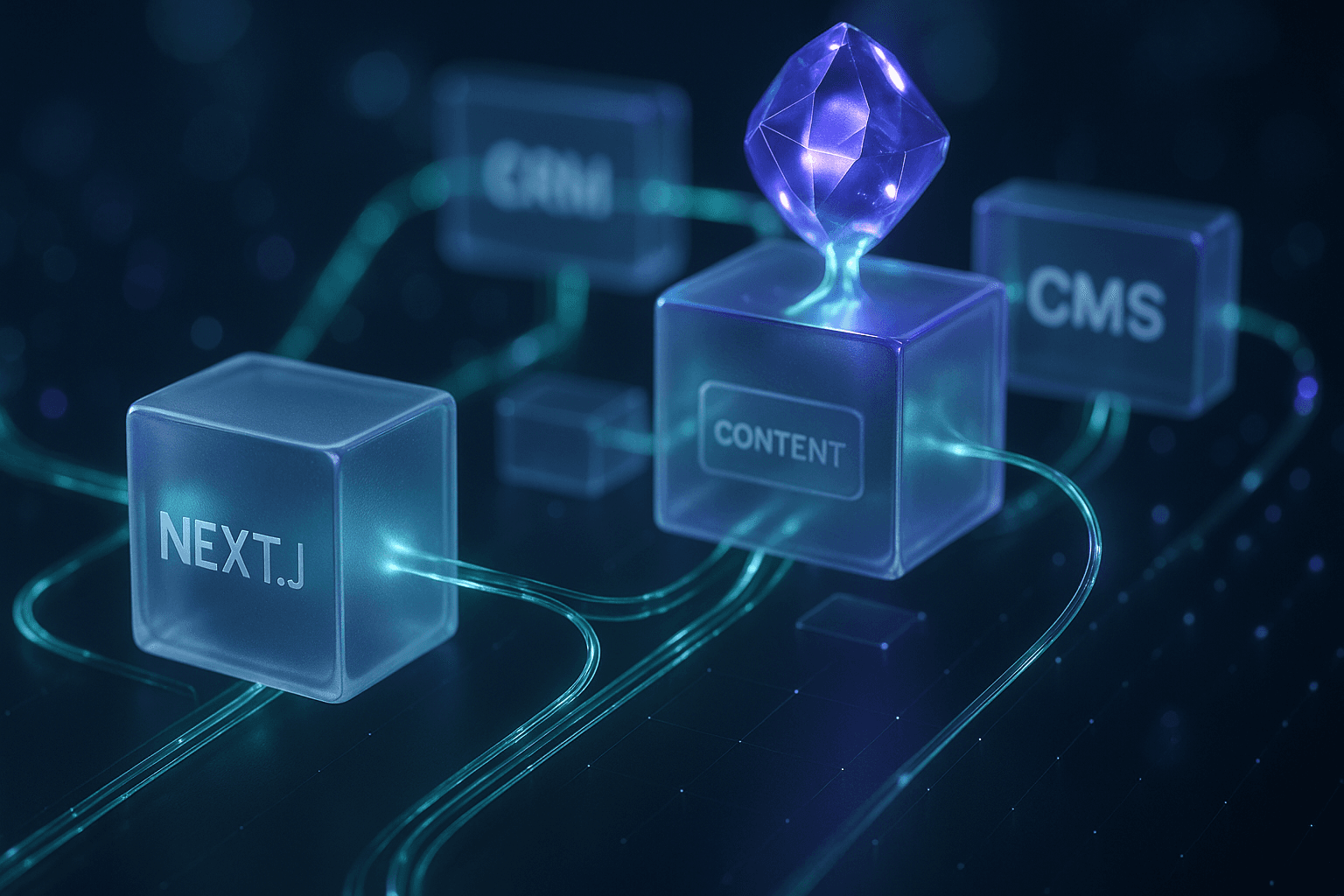
A zero-cost CRM pipeline separates three layers that traditional platforms bundle together:
Data layer: Your customer data lives in databases you control. PostgreSQL, MySQL, or purpose-built data warehouses. You own the schema, the storage, the backup strategy. No vendor decides when you've hit a contact limit or which fields you can customize.
Logic layer: Business rules, automation, and data processing happen in code you write and maintain. This is where you define lead scoring, deal stage transitions, support ticket routing, and customer segmentation. Tools like n8n can handle workflow automation without per-execution fees.
Interface layer: Next.js applications provide the front-end experience for different user roles. Sales dashboards, support portals, marketing segmentation tools - each built specifically for your team's needs. Server-side rendering keeps these interfaces fast, even with complex data queries.
This architecture eliminates licensing costs because you're building software, not renting it.
Next.js as your CRM interface framework
Next.js has become the go-to framework for building custom enterprise applications. The framework's server-side components let you query your database directly in your React components, then render the interface on the server before sending it to the browser.
This matters for CRM interfaces because:
Performance at scale: Your sales team can load dashboards with thousands of opportunities without slow client-side data fetching. The server does the heavy lifting.
Real-time data sync: Server components re-fetch data on each request. Your team always sees current information without complex state management or polling.
Role-based interfaces: You can build completely different applications for sales, support, and marketing - all pulling from the same data layer, but showing exactly what each role needs.
Progressive enhancement: Basic CRM functions work even if JavaScript fails. Forms submit, data saves, workflows continue.
You're not building a generic CRM clone. You're building exactly the interfaces your business needs, with exactly the features your team uses.
Real implementations: What this looks like in practice
Sales pipeline management without Salesforce
Your Next.js sales dashboard connects to a PostgreSQL database storing leads, opportunities, and accounts. Server components query for each sales rep's pipeline, calculate stage probabilities, and render a kanban view of their deals.
Drag-and-drop stage changes trigger database updates through API routes. Email integration happens through n8n workflows that log correspondence back to the database. Deal value calculations, forecast reporting, and territory management all live in your codebase.
No per-user cost. No artificial limits on custom fields. No waiting for Salesforce to ship the feature you need.
Support portal without Zendesk or Intercom
Customers log into a Next.js portal to submit tickets, check order status, and search documentation. Their authentication ties to your existing user database. Ticket data stores in a table you designed for your support workflow, not a generic ticketing schema.
Your support team uses a separate Next.js application to view queues, respond to tickets, and update customer records. Real-time updates happen through database triggers and server component re-renders. Escalation rules run as database functions or n8n workflows.
You decide the ticket lifecycle. You control the data retention policy. You own the entire customer interaction history.
Marketing segmentation without HubSpot
Website interactions, email engagement, and purchase history flow into your data warehouse. A Next.js admin panel lets your marketing team build segments with your actual customer attributes, not a vendor's idea of what segmentation should look like.
Email campaigns trigger through n8n workflows that query your segments and send through your chosen email service provider. Personalization logic reads customer data directly from your database. Attribution tracking writes back to the same source.
Your marketing stack becomes a set of purpose-built tools, each doing one job well, all sharing the same customer data foundation.
The real cost calculation: Development vs. subscription
Building a headless CRM pipeline requires upfront engineering investment. You need developers who understand Next.js, database design, API architecture, and business logic implementation.
A basic implementation might take:
- 4-6 weeks for data layer design and initial database setup
- 6-8 weeks for core Next.js applications (sales, support, marketing views)
- 2-4 weeks for n8n workflow automation and integration
- Ongoing: 20-40 hours per month for maintenance, new features, and optimization
Compare this to a mid-market company paying $150 per user per month for a CRM platform across 50 users. That's $90,000 per year, every year, with regular price increases.
Your development cost might run $80,000-$120,000 for the initial build, then $30,000-$50,000 annually for maintenance. You break even in 18-24 months. After that, you're saving $40,000-$60,000 per year.
The financial case gets stronger as you scale. Adding 50 more users to your custom CRM costs nothing. Adding them to a licensed platform costs another $90,000 per year.
What this approach requires from your organization
This isn't a low-code solution you can spin up in a week. Building a zero-cost CRM pipeline demands:
Engineering capability: You need developers comfortable with modern JavaScript, React, Next.js, SQL, and API design. If you don't have this in-house, you'll need to contract it or hire it.
Infrastructure ownership: Someone needs to manage your database hosting, application deployment, backup strategy, and monitoring. This is real infrastructure work.
Requirements discipline: Without a vendor's opinionated product, you have to decide what your CRM should do. This means documenting workflows, defining data models, and making hard choices about features.
Maintenance commitment: Software needs updates, bugs need fixes, and new features require development time. This is ongoing work, not a one-time project.
If your organization isn't ready for this level of ownership, a traditional CRM platform might still make sense. But if you have the technical capability, the financial and strategic benefits are significant.
Data sovereignty and vendor independence
Beyond cost savings, owning your CRM architecture gives you complete control over your customer data.
You decide:
- Where data is stored and who can access it
- How long to retain customer interaction history
- Which data points to capture and how to structure them
- How to back up and recover customer information
- When and how to migrate or transform your data model
You're not subject to a vendor's terms of service changes, price increases, or product sunset decisions. Your CRM exists as long as you maintain it, on your timeline, under your control.
This matters for compliance, data privacy regulations, and long-term business continuity. Your customer data is your most valuable asset. Owning the systems that manage it is strategic risk management.
Start marketing the right way
CRM shouldn't be a recurring line item that grows with your team. It should be infrastructure you build once and maintain efficiently.
The shift to headless architecture and modern web frameworks makes this possible. You can build customer management systems tailored to your exact workflows, with zero per-user costs, complete data ownership, and the flexibility to evolve as your business grows.
This is how you turn operational expenses into strategic assets.
If you're tired of escalating CRM subscription costs and want to explore a custom pipeline architecture, talk to WrightyMedia. We'll map out a technical roadmap that fits your business requirements and delivers long-term cost savings.
Want more on
RevOps & Strategy?
Add this topic to your Custom Digest. Drop your email to get our deepest insights on this exact topic.
Ready to fast-track your business?
We combine enterprise-level technical strategy with your existing business to solve complex blockers and accelerate your growth. Let's build something remarkable.
Partner With UsUp Next
Continue your journey into RevOps & Strategy.

Empowering marketing with headless CRM
Learn how headless CRM orchestration with Next.js transforms your marketing workflow. Build faster, personalise better, and market the right way.

Architecting sovereign CRM experiences with Next.js, headless
Build a sovereign CRM with Next.js, headless data mesh, and edge computing. Control your customer data, improve performance, and maintain compliance.
Reclaiming digital velocity: Architecting headless CRM for
Learn how headless CRM architecture with Next.js empowers marketing teams to deploy content faster, improve SEO, and drive growth without engineering delays.