
Blog title
Learn why enterprise products need AI gateway architecture to control agentic AI workflows. Get implementation steps for secure model routing and policy enforcement.
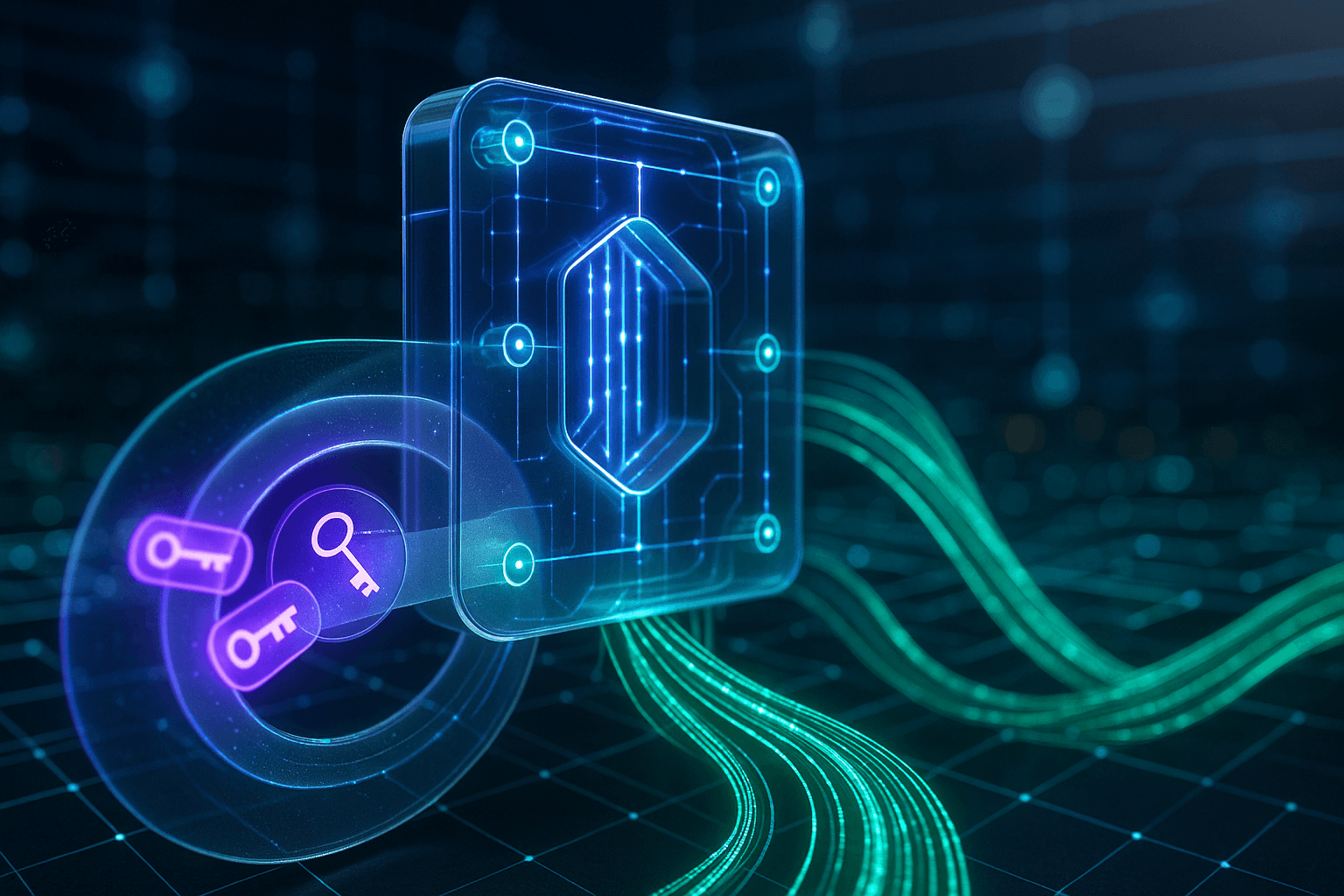
Why Your Enterprise Architecture Needs an AI Gateway (Not Just AI Models)
In July 2026, enterprise architecture leaders began shifting from "How do we integrate LLMs?" to "How do we safely let AI agents make decisions?"
The answer isn't more guardrails scattered across microservices. It's a purpose-built AI gateway pattern that concentrates fast-moving AI governance in one control plane, leaving the rest of your architecture stable.
The Problem No One's Talking About
You've got AI agents running in your product. They're answering customer questions, syncing data, and routing workflows.
But here's the issue: Traditional API gateways assume deterministic inputs and outputs. They expect known schemas and client-specified intent. Agentic AI violates all three assumptions.
Right now, 90% of enterprises manage 350+ SaaS applications and custom integrations. When you add AI agent workflows to that ecosystem, the attack surface and failure modes multiply.
Enterprise security teams reviewing agentic systems are discovering scary scenarios. A hijacked prompt injected into a customer support agent connected to internal ticketing can perform unintended actions. Refund the wrong customer. Expose sensitive data. Escalate tickets to the wrong department.
The Model Context Protocol (MCP), agent-to-agent protocols, and guardrail standards are still maturing. They're changing quarterly. This makes it unsafe to hardcode agent logic into service layers.
This isn't temporary. It's permanent.
What Is an AI Gateway?
An AI gateway is a control plane that sits between your applications and LLM providers. It concentrates fast-changing capability into a single enforcement point.
Here's what it does:
- Model Routing & Provider Abstraction
Swap models without changing applications. Move from GPT-4 to Llama to Claude in minutes, not weeks. Route cheap tasks to cheaper models. Build provider failover and hybrid strategies.
- Identity & Authorization for Agent Workflows
Manage delegated authority. When one agent talks to another agent, proper trust chains exist. The gateway follows MCP and A2A protocol changes, so your applications don't have to.
- Action Policy (Zero Trust per Operation)
Every action gets checked against least-privilege policy before execution. This stops hijacked prompts by validating tokens and authorizing the requested operation. You get a semantic audit trail: Request → Decision → Action.
- Semantic Segmentation
Control what agents can reach. Knowledge bases. Data sources. Integrations. Control which tools agents can invoke. Set internet and external data access policies.
- Content Guarding
Detect input injection. Prevent output leakage. Mitigate prompt poisoning.
Who Needs This Now? Who Can Wait?
Adopt AI Gateway Pattern (Year 1):
- B2B SaaS companies selling to enterprises (fintech, HR tech, CRM extensions)
- Any product with AI agents touching customer data or performing transactional actions
- Organizations with more than 50 engineers (you can support a platform team for AI governance infrastructure)
Safe to Defer (6-12 Months More):
- Internal AI tools and chatbots without external integrations
- Single-LLM use cases with no multi-step reasoning
- SMB-focused products without regulatory compliance requirements
Highest Risk If Not Addressed:
- Companies building on top of LangChain or LlamaIndex without injecting policy enforcement
- Teams scaling agentic workflows without semantic audit trails
- Products connecting agents to enterprise ERPs or financial systems without zero-trust enforcement
Your 18-Week Implementation Roadmap
Phase 1: Audit (Week 1-2)
Map all AI agent workflows in your product. Customer support. Data sync. Workflow automation. Identify which agents have access to sensitive systems. CRM. ERP. Payments. Internal docs.
Document all LLM providers and models currently in use. Catalog all third-party API connections agents can invoke.
Phase 2: Prototype AI Gateway Control Plane (Week 3-6)
Select AI gateway infrastructure. Commercial options include Cequence and Prompt Injection Firewall. You can build on AWS reference architecture.
Implement model routing abstraction layer. This is the interface between apps and LLM providers.
Build policy engine. Define zero-trust action policies. Example: Customer support agent can read tickets and knowledge base, but CANNOT modify customer data without explicit approval.
Integrate semantic audit logging. Request → Decision → Action → Outcome.
Phase 3: Deploy Model Routing Layer (Week 7-10)
Route existing LLM calls through gateway. Implement provider failover. Primary: OpenAI. Fallback: Anthropic. Add cost tracking per model and agent.
Phase 4: Add Policy Enforcement (Week 11-14)
Implement zero-trust action policy for each agent workflow. Test prompt injection scenarios. What happens when a malicious prompt tries to change customer refund amount?
Validate that policies trigger correctly before reaching backend systems.
Phase 5: Enable Semantic Audit & Observability (Week 15-18)
Deploy structured logging. Each decision and action recorded with context. Build alerting on policy violations and unusual agent behavior. Create dashboards for security and platform teams.
Technical Blueprint (Next.js + Express Stack)
// Express.js AI Gateway - Control Plane
const aiGateway = new AIGateway();
// Model Routing
aiGateway.route('llm.invoke', async (request) => {
const policy = await policyEngine.lookup(request.agent_id);
const selectedModel = modelRouter.select(request.task_priority, request.cost_preference);
// Zero-trust action check
const actionApproved = await policyEngine.authorize(
request.agent_id,
request.intended_action,
request.downstream_permissions
);
if (!actionApproved) {
return { error: 'Action blocked by policy' };
}
// Invoke LLM through selected provider
const response = await llmProvider.invoke(request, selectedModel);
// Semantic audit
auditLog.record({
agent_id: request.agent_id,
model: selectedModel,
decision: response.reasoning,
action: response.action,
timestamp: Date.now(),
policy_check: actionApproved
});
return response;
});
// Zero-Trust Policy Example
const customerSupportPolicy = {
agent_id: 'support-agent-v2',
allowed_actions: [
{ action: 'read', resource: 'tickets' },
{ action: 'read', resource: 'knowledge_base' },
{ action: 'read', resource: 'customer_profile' }, // read-only
{ action: 'write', resource: 'ticket_comments' }
],
forbidden_actions: [
{ action: 'write', resource: 'customer_data' }, // blocked
{ action: 'invoke', resource: 'refund_api' } // requires escalation
],
rate_limits: { requests_per_minute: 100 },
session_duration_minutes: 60
};
Enterprise-Grade Integration Example (Salesforce API with Agent)
// AI Gateway handles Salesforce integration for agents
const sfGateway = aiGateway.integrationMgmt.create({
provider: 'salesforce',
auth_type: 'oauth2',
policy: 'read_only_custom_objects',
// Custom object discovery (handles customer's unique Salesforce schema)
customObjectsTemplate: {
'Account': ['Id', 'Name', 'Website', 'custom_field_123__c'],
'Contact': ['Id', 'FirstName', 'Email', 'custom_field_456__c']
},
// Rate limit handling (normalize enterprise-scale syncs)
rateLimitStrategy: 'exponential_backoff_with_ietf_headers',
// Data retention policy (zero-storage pass-through)
dataRetention: 'none' // Don't cache customer CRM data at rest
});
// Agent workflow with policy enforcement
const syncCustomerDataAgent = {
name: 'daily_customer_sync',
workflow: async () => {
const customers = await sfGateway.query('Account', 'LIMIT 1000');
// Policy check: Can this agent modify customer data?
const canWrite = await aiGateway.policyEngine.authorize(
'daily_customer_sync',
'write_to_crm'
);
if (!canWrite) {
return { error: 'Insufficient permissions' };
}
// Process (no data storage at rest)
customers.forEach(customer => {
// Direct pass-through write
sfGateway.write('Account', customer.Id, updatedData);
});
}
};
The Strategic Shift You Need to Make
Building agentic AI into B2B products isn't about having the smartest chatbot. It's about giving enterprise customers control and auditability.
Enterprise procurement and security teams are already asking:
- "Can we audit every decision your agent makes?"
- "Can we enforce our policies?"
- "Can we revoke access instantly?"
The companies that answer these questions with architecture—not through manual authorization flows—will win enterprise mindshare.
Competitors that retrofit governance later will lose competitive bids and waste engineering cycles.
For Founders: AI gateways are not optional infrastructure. They're business requirements the moment you're selling to enterprises with compliance needs.
For CTOs: The decision to build or buy a gateway now shapes your product's enterprise scalability ceiling for the next 18 months.
Start Marketing the Right Way
The companies building AI-enabled products in the next 24 months will discover too late (or under incident pressure) that they need a governance layer before going to market with enterprise customers.
The decision to architect for AI gateways now vs. retrofitting later is a 12-18 month engineering tax differential. Organizations with mature platform engineering teams are adopting proactively. Everyone else will pay the cost of incident-driven redesign.
You have a choice. Build the right foundation now, or rebuild under pressure later.
Download the 'AI Gateway Readiness Checklist for Enterprise Products': A 2-page assessment tool to audit whether your current AI architecture can survive a security review. Includes a workflow map of agent integrations to scan for risk.
Book an Enterprise AI Governance Audit: We'll map your agentic AI workflows, assess policy enforcement gaps, and deliver a prioritized roadmap for AI gateway implementation scoped to your architecture. If you'd like to start marketing the right way, schedule a 30-minute discovery call.
Sources:
- An Evolutionary Architecture Pattern for Managing AI's Pace of Change — InfoQ
- Agentic AI in the Enterprise: Reference Architecture — AWS Prescriptive Guidance
- Model Context Protocol (MCP) and Agent Governance — Anthropic
Up Next
Continue your journey into AI Engineering.
Blog brief: Model context protocol as the invisible plumbing
Learn how Model Context Protocol became the infrastructure standard that makes enterprise AI agents production-ready. MCP reduces integration time by 70%.

Blog brief: SaaS pricing breaks when agents become the primary
When agents replace human users, seat-based SaaS pricing collapses. Learn how to redesign your revenue model before $234B in spend relocates to AI-native competitors.

Architecting a self-hosted LLM for RevOps data sovereignty
Learn how self-hosted open-source LLMs give RevOps teams data sovereignty, cut vendor lock-in, and boost operational control without cloud dependency.