
The evolution of automation: Workflows vs. AI agents – choosing the right tool for your business
Learn the key differences between traditional workflows and AI agents in automation. Discover how each system impacts business efficiency and when to use them for optimal results.
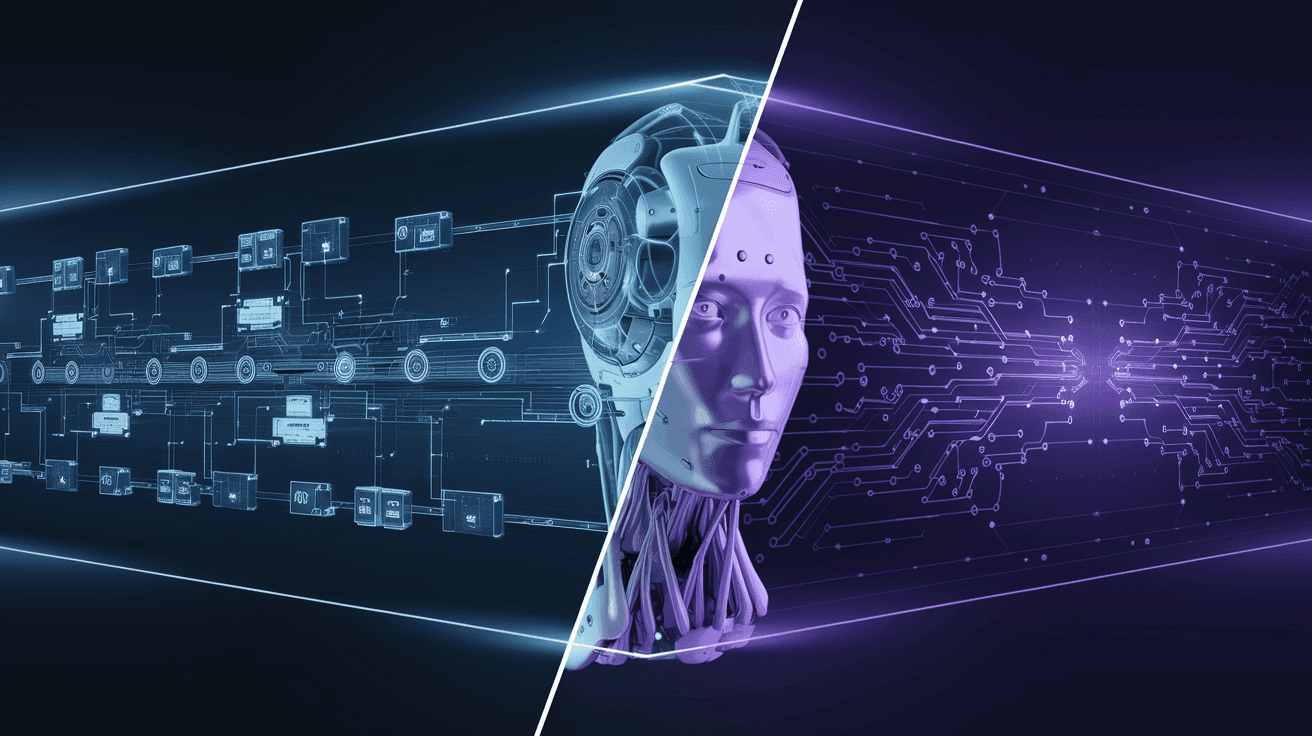
Key Takeaways
- Traditional workflows ensure consistency and reliability.
- AI agents provide flexibility and smart decision-making.
- Choosing the right tool is key to operational success.
Key Statistic:Embrace the automation evolution.
Automation is rapidly evolving, with traditional workflows and AI agents representing a critical choice for businesses. Understanding their differences can empower your operations, offering unique advantages for adaptability and efficiency in an ever-changing market.
The evolution of automation: Understanding workflows vs AI agents
Automation is changing fast, and you need to know the difference between old and new methods to make smart business choices. Right now, a big split between traditional workflows and AI agents is reshaping how companies handle their tasks.
Think of workflows as your trusted but rigid assistant who follows exact steps, while AI agents are like intelligent team members who can think independently. This difference isn't just technical talk – it affects how well your business can adapt and grow in today's fast-moving market.
Which option works better for your needs? The truth is, both have their place, but understanding when to use each one can give you a real advantage. Let's examine what makes these tools different and why they matter for your business's success.
Want to start marketing the right way? Understanding these automation tools is your first step toward more intelligent, efficient operations.
What workflows offer:
- Fixed processes
- Predictable results
- Clear step-by-step actions
What AI agents bring:
- Smart decision-making
- Flexible responses
- Self-directed actions
This knowledge gap between workflows and AI agents often holds businesses back. By the end of this article, you'll know exactly which tool fits your needs.
Traditional workflows: The foundation of automation
Workflow automation forms the backbone of many business processes today. These systems follow set rules and predefined paths to complete tasks systematically.
How traditional workflows work
- They process tasks in a sequential order
- Each step triggers the following based on preset conditions
- Actions happen only when specific inputs are received
- Results are predictable and consistent
Traditional workflows shine in structured environments where processes need to stay consistent. Think of them as a reliable assembly line for your digital tasks. They take your input, process it through predetermined steps, and produce expected outputs.
Benefits of workflow systems
- Reduced manual work
- Fewer human errors
- Consistent results
- Clear audit trails
- Easy to understand and maintain
A good example is content approval workflows. An article moves from writer to editor to publisher, with each step requiring specific actions before moving forward. The process stays the same every time, making it reliable and trackable.
Practical applications
Marketing teams use workflows to:
- Schedule social media posts
- Send automated email campaigns
- Process customer feedback forms
- Generate regular reports
While workflows might seem basic compared to AI agents, they remain valuable for tasks that need consistency and control. Their predictability makes them perfect for processes where variation could cause problems.
Traditional workflows' key strength is their reliability. You know what will happen at each step, making them ideal for compliance-sensitive operations or processes requiring strict oversight.
Want to start marketing the right way? Understanding when to use traditional workflows vs. newer technologies is crucial for your success.
AI agents: The next generation of automation
AI agents bring a new level of intelligence to automation. These digital workers go beyond simple task execution, using advanced AI to make decisions and adapt to new situations.
How AI agents work
- They process information in real-time
- They learn from each interaction
- They make independent decisions
- They communicate with other AI agents
- They adjust their actions based on outcomes
An AI agent acts like an intelligent assistant that doesn't need step-by-step instructions. Think of it as having a team of digital experts who know their jobs and can work together without constant supervision.
The orchestrator advantage
The orchestrator model takes AI agents to the next level. This system:
- Manages multiple AI agents at once
- Breaks down complex tasks automatically
- Assigns work to specialised agents
- Combines results into meaningful outputs
- Monitors performance and adjusts strategies
For example, when processing customer feedback, an orchestrator can:
- Read incoming messages
- Sort them by topic
- Send relevant data to different specialist agents
- Compile responses
- Track resolution rates
This happens automatically, without manual triggers or oversight.
Real-world impact
AI agents are changing how businesses handle complex tasks. A customer service system using AI agents can:
- Answer questions 24/7
- Route complex issues to human agents
- Update customer records automatically
- Identify trending problems
- Suggest solutions based on past successes
These capabilities show why AI agents represent the future of automation. They don't just follow rules – they think, learn, and improve over time.
Want to start marketing the right way? Understanding the power of AI agents is your first step toward more intelligent automation.
Key differences and distinctions
The gap between workflows and AI agents is based on five key factors that shape their effectiveness in different situations.
Operation style
Workflows need your input to start and follow set rules. You click a button or submit data, and the workflow begins. AI agents work independently, spotting opportunities and starting tasks without waiting for commands.
Decision making
- Workflows stick to preset paths you create
- AI agents adjust their approach based on new information
- Workflows can't handle unexpected situations
- AI agents learn and improve their responses over time
User requirements
Traditional workflows depend on you to define every step and trigger actions. AI agents need initial setup but work independently, making choices and taking action.
Data processing
Here's how each handles information:
- Workflows process data in a fixed order
- AI agents analyse data from multiple angles
- Workflows can't connect unrelated information
- AI agents spot patterns across different data types
Growth potential
Workflows stay the same unless you update them manually. AI agents grow more competent with each task, expanding their capabilities through experience. AI agents handle more complex jobs over time while workflows maintain their original limits.
Start marketing the right way by choosing the automation tool that matches your needs. Consider how much independence and growth potential you want in your systems.
Practical applications and use cases
Let's look at real examples of how workflows and AI agents perform in different business settings.
Workflow success stories
Customer support ticketing
A major tech company uses workflow automation to route support tickets. When customers submit issues, the system automatically categorises and assigns them based on preset rules. This process handles 5,000+ tickets daily with 99% accuracy.
Invoice processing
An accounting firm automates invoice handling with workflows. The system captures data, matches purchase orders, and routes for approval. Processing time dropped from 3 days to 4 hours per invoice.
AI agent implementations
Sales intelligence
A B2B company uses AI agents to analyse customer interactions. The agents:
- Monitor communication patterns
- Predict buying signals
- Suggest personalised outreach timing
- Create targeted content recommendations
This system increased sales conversion rates by 35%.
Performance comparison
Manufacturing plant example:
- Traditional Workflow:
- Follows fixed maintenance schedules
- Responds to predetermined triggers
- Requires manual updates to processes
AI agent system:
- Predicts equipment failures
- Adjusts maintenance timing automatically
- Creates custom repair procedures
- Learns from past performance
The AI agent approach reduced downtime by 47% compared to traditional workflows.
These examples show how each system fits different business needs. Workflows excel at consistent, rule-based tasks, while AI agents better handle complex, changing situations. Contact us to start marketing the right way with the automation solution that matches your needs.
Future implications for business
The shift from workflows to AI agents brings significant changes to business operations. Let's look at what this means for your company.
Business impact and ROI
- Reduced operational costs through intelligent automation
- Faster problem-solving with self-learning systems
- Better resource management through predictive analysis
- Higher accuracy in complex decision-making
Companies switching to AI agents see up to 30% improvement in process efficiency. This boost comes from removing manual triggers and letting AI handle routine decisions.
Implementation challenges
The move to AI agents needs careful planning. Your business will need:
- Updated tech infrastructure
- Staff training programs
- New security measures
- Clear governance rules
The initial setup costs more than traditional workflows. But the long-term savings make it worth the investment.
Getting started tips
Start small with these steps:
- Pick one process for AI automation
- Test and measure results
- Train your team
- Scale up gradually
Remember: AI agents work best when they complement your existing systems. Mix workflows and AI agents based on your needs to start marketing the right way.
The future of business automation lies in finding the right balance. Smart companies are already testing AI agents in controlled environments. Your organisation's success depends on making this transition quickly.
What purpose do AI and workflows serve?
Workflows and AI agents serve different needs in modern automation. Workflows work best when you need reliable, repeatable processes with clear steps. They're like a recipe - you follow the same steps each time to get the same result.
AI agents bring something new to the table. They can think independently, make decisions, and change their approach based on new information. Picture them as intelligent assistants who can figure things out without constant direction.
Your choice between workflows and AI agents depends on your goal. Need consistent, structured outputs? Workflows might be your answer. Looking for innovative, adaptive solutions that can handle complex tasks? AI agents could be the right pick.
Start marketing the right way by picking the tool that matches your needs. Share your thoughts below: Are you using workflows or AI agents? What results are you seeing?
Discussion Points
Let's look at what professionals say about workflows and AI agents in real-world settings.
Key Implementation Findings
- Companies using workflows report high reliability for routine tasks
- AI agent users praise the technology's ability to handle complex, variable scenarios
- Mixed-use cases show both tools can work together effectively
Best Results by Industry
Manufacturing: Workflows shine in production line automation where processes need strict consistency.
Healthcare: AI agents excel in patient care coordination, adapting to unique cases and changing priorities.
Marketing: A mix of both tools works best - workflows for content scheduling and AI agents for personalisation.
Questions to Consider
Have you tested both systems in your operations? What results did you see? Are you getting the most from your current automation setup?
If you're ready to start marketing the right way, let's talk about which automation approach fits your needs.
Want more on
Automation?
Add this topic to your Custom Digest. Drop your email to get our deepest insights on this exact topic.
Ready to fast-track your business?
We combine enterprise-level technical strategy with your existing business to solve complex blockers and accelerate your growth. Let's build something remarkable.
Partner With UsWritten By

Gavin Alexander
Senior Marketeer
As the founder of WrightyMedia, Gavin has spent years at the intersection of marketing and technology. Seeing firsthand how chaotic technology rollouts can be, he designed a system that brings enterprise-level infrastructure to independent businesses. He writes extensively about industry trends, technical leverage, and workflow optimisation.
Up Next
Continue your journey into Automation.

Marketing jobs in the AI age: What’s changing?
Marketing is evolving fast. Discover how AI is transforming roles and reshaping the industry in our latest blog.

Beyond the Data Moat: Architecting Decentralised Data Ownership for Enterprise AI Agility
A strategic briefing on how to navigate 'Beyond the Data Moat' as an independent artist.

Why legacy CMS architectures break under AI-generated video
Learn how Next.js, Canvas, and GSAP deliver 60fps scroll-bound video on modern web architectures. Legacy CMS platforms drop to 24fps under heavy load.