
Unifying operational data to break through enterprise growth ceilings
Learn how breaking down data silos between HubSpot, Salesforce, and Zendesk unifies reporting and eliminates bottlenecks in enterprise operations.

Key Takeaways
- Siloed departmental software creates unpredictable revenue because data never flows between marketing, sales and customer success.
- AI-driven API integration turns disconnected tools into a unified system that scales without adding engineering resources.
- Unified data enables accurate forecasting because every customer interaction is measured and visible across your entire organisation.
- Automation platforms like n8n let operations teams build their own workflows without waiting for developer cycles.
Your operational data lives in silos because each department bought its own software. Marketing runs HubSpot, sales uses Salesforce, and customer success tracks everything in Zendesk. This fragmentation kills visibility, slows decisions, and makes scaling your infrastructure a nightmare.
Your company has hit a predictable wall. Marketing runs HubSpot. Sales lives in Salesforce. Customer success operates in Zendesk. Each department defends its territory, and every handoff between systems creates friction, dropped data, and lost revenue.
This isn't a process problem. It's an architecture problem.
Siloed operational data creates three cascading failures that cap your growth:
- Customer records fragment across platforms, making accurate attribution impossible
- Manual data entry consumes engineering cycles that should build product
- Cross-functional reporting requires duct-tape integration that breaks during scale events
Enterprise CTOs face a binary choice: continue patching legacy systems with brittle point-to-point integrations, or rebuild the foundation with unified API-driven architecture.
The second path requires rethinking how operational data flows through your organization.
Why departmental software silos kill scalability
Most enterprise software stacks evolved through acquisition and department-level purchasing decisions. Marketing bought the tool they needed. Sales did the same. No one architected the whole system.
The result: data lives in dozens of disconnected databases. Each platform has its own customer ID, its own field naming conventions, and its own API limitations.
When a prospect converts to a customer, that transition requires manual handoffs or custom middleware. The handoff points create three problems:
Data decay: Every manual step introduces error rates between 1-4%. Across thousands of customer records, this compounds into unusable data.
Attribution blindness: You can't measure what drove a sale when customer journey data lives in five separate systems with no shared timeline.
Engineering bottleneck: Your developers spend 30-40% of their time building and maintaining integrations instead of shipping product features.
These aren't minor inefficiencies. They directly limit how fast you can grow because your operational infrastructure can't keep pace with demand.
The unified data architecture: API-first design for predictable scale
A unified data architecture replaces point-to-point integrations with a central data layer that orchestrates information flow across all systems.
Instead of building custom connectors between each pair of tools, you create a single source of truth that pushes and pulls data through standardized APIs.
The core components:
Central customer database: One canonical record for each customer, with a persistent ID that maps across all platforms. Every system reads from and writes to this record.
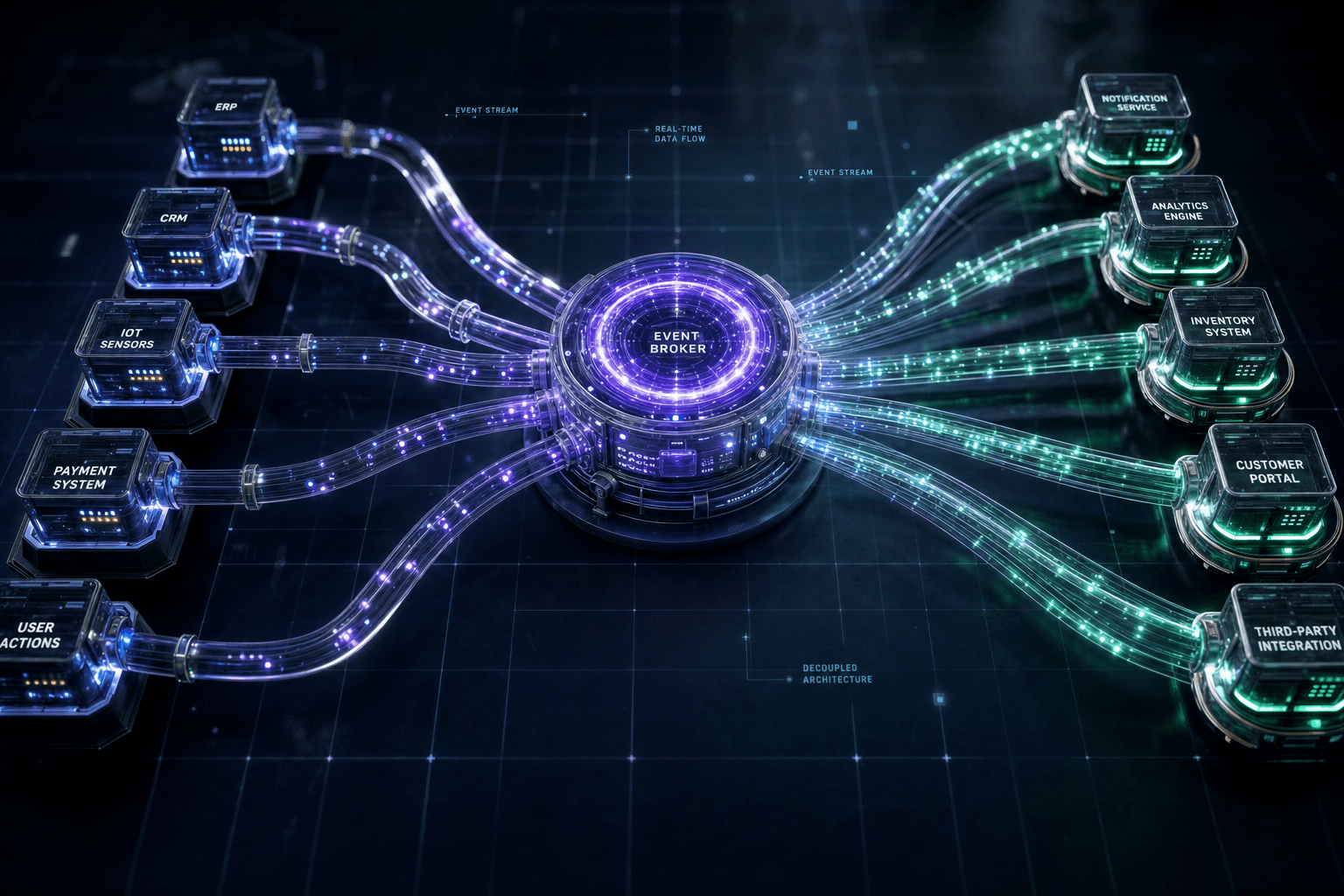
Event bus architecture: Customer actions (form submission, demo booking, contract signature) trigger events that flow through a central pipeline. Each event updates relevant systems in real time.
Automation layer: Business logic sits in a workflow automation platform (like n8n) that routes data, transforms formats, and triggers actions based on rules you define.
API gateway: All system connections flow through a managed gateway that handles authentication, rate limiting, and error handling.
This architecture shifts your integration strategy from brittle custom code to maintainable configuration.
Building the automation layer: n8n as operational command center
n8n provides the workflow automation infrastructure that makes unified architecture practical at enterprise scale.
Instead of writing custom integration code for every system connection, you build visual workflows that move data between platforms, apply transformation logic, and trigger actions based on business rules.
Here's how this works in practice:
Workflow example: Lead to customer pipeline
- Inbound lead hits your Next.js application: Form submission captures email, company, and requirements
- n8n workflow triggers: Webhook receives the submission and starts the automation
- Data enrichment: Workflow calls Clearbit API to append firmographic data (company size, industry, tech stack)
- Lead scoring logic: Custom function node applies your ICP criteria and assigns a score
- Conditional routing:
- High-value leads (score > 80) create a Salesforce opportunity and notify sales via Slack
- Mid-tier leads (40-80) enter HubSpot nurture sequence
- Low-fit leads (< 40) add to newsletter list only
- Analytics tracking: Every decision point logs to your data warehouse for attribution analysis
This entire pipeline runs in milliseconds with zero manual intervention. The workflow handles 10 leads or 10,000 with the same reliability.
AI-powered decision logic
The real power emerges when you add AI decision nodes to your workflows.
Instead of rigid if-then rules, you can route data based on semantic analysis:
- Analyze inbound support tickets and route to appropriate team based on content, not just keywords
- Score lead quality using ML models trained on your historical conversion data
- Detect customer churn risk by analyzing usage patterns and engagement signals
- Generate personalized follow-up content based on conversation history
These AI nodes connect to OpenAI, Anthropic, or your own hosted models through the same visual interface. No separate ML infrastructure required.
Technical implementation: The stack
Building this architecture requires four infrastructure layers:
Data layer
PostgreSQL as system of record: Store canonical customer data, event history, and workflow state. Use row-level security for multi-tenant isolation.
Redis for real-time state: Cache frequently accessed data and manage workflow locks to prevent race conditions.
Application layer
Next.js for customer-facing interfaces: API routes handle webhooks and form submissions. Server-side rendering ensures SEO performance.
n8n as workflow engine: Self-hosted instance manages all automation logic. Runs in Docker containers with horizontal scaling.
Integration layer
Kong or Tyk as API gateway: Rate limiting, authentication, and request transformation for all external API calls.
Message queue (RabbitMQ or SQS): Decouple services and ensure reliable event delivery even during traffic spikes.
Observability layer
DataDog or New Relic for monitoring: Track workflow execution times, error rates, and system health.
Segment or RudderStack for event tracking: Capture every customer interaction for attribution analysis.
This stack provides the reliability and observability required for mission-critical business processes.
Migration strategy: Moving from siloed to unified without operational disruption
You can't rip out your entire operational stack overnight. The migration requires a phased approach that maintains business continuity.
Phase 1: Establish central database (Weeks 1-4)
Create your PostgreSQL customer database and build sync scripts that pull existing data from each platform. Start with one-way sync (read only) to validate data quality.
Phase 2: Build shadow workflows (Weeks 5-8)
Create n8n workflows that mirror existing processes but don't control production data. Run them in parallel with current systems to validate logic and catch edge cases.
Phase 3: Cutover high-volume processes (Weeks 9-12)
Move your highest-volume, lowest-risk processes to the new architecture first. Lead capture and email automation are good starting points. Monitor error rates closely.
Phase 4: Migrate complex workflows (Weeks 13-20)
Move customer onboarding, billing, and support workflows. These require more sophisticated logic and careful testing.
Phase 5: Decommission legacy integrations (Weeks 21+)
Once all workflows run on the new architecture, remove old point-to-point integrations. This reduces technical debt and ongoing maintenance burden.
Each phase should include rollback plans and clear success metrics.
Measuring the business impact
Unified architecture isn't a technology project. It's a growth infrastructure project. Measure success in business terms:
Time to revenue: How long from first touch to closed deal? Unified data typically cuts this by 25-40% by eliminating handoff delays.
Attribution accuracy: What percentage of revenue can you trace to specific marketing activities? Unified event tracking should push this above 90%.
Engineering velocity: How many features does your team ship per quarter? Removing integration maintenance should free 30-40% more capacity.
Data accuracy: What percentage of customer records contain complete, accurate information? Automated data flow typically improves this from 60-70% to 95%+.
Cost per integration: What does each new platform connection cost in engineering time? Unified architecture reduces this from weeks of custom development to hours of workflow configuration.
These metrics directly correlate to revenue growth and operational efficiency.
Common implementation failures and how to avoid them
Most unified architecture projects fail for predictable reasons:
Trying to build everything custom: Don't write your own workflow engine. Use battle-tested platforms like n8n and focus engineering effort on business logic.
Ignoring data governance: Unified data creates new privacy and security requirements. Implement field-level encryption, access controls, and audit logging from day one.
Underestimating data quality work: Your existing data is messy. Budget significant time for deduplication, normalization, and validation before migration.
Skipping the observability layer: You can't fix what you can't see. Comprehensive monitoring and alerting are non-negotiable for production workflows.
Over-engineering the first version: Start with simple workflows that solve real pain points. Add sophistication after you've proven the architecture works.
The most successful implementations start small, prove value quickly, and scale systematically.
The path forward
Siloed operational data isn't a permanent constraint. It's an architecture decision you can reverse.
Unified API-driven infrastructure eliminates the growth ceiling created by disconnected systems. It gives you accurate attribution, removes manual handoffs, and frees your engineering team to build product instead of maintaining integrations.
The technical components exist today. The workflow automation platforms are mature. The question isn't whether to unify your operational data. It's how fast you can get there before your current architecture becomes the limiting factor in your growth.
Want more on
Business Operations?
Add this topic to your Custom Digest. Drop your email to get our deepest insights on this exact topic.
Ready to fast-track your business?
We combine enterprise-level technical strategy with your existing business to solve complex blockers and accelerate your growth. Let's build something remarkable.
Partner With UsUp Next
Continue your journey into Business Operations.
Accelerating enterprise integration with event-driven data flows
Move data between systems in seconds, not hours, by replacing brittle point-to-point integrations with event-driven architecture.

Streamlining enterprise SaaS sprawl with rationalized technology portfolios
Cut SaaS costs by 25% and close security gaps by rationalising your enterprise technology portfolio.

Streamlining the lead-to-revenue cycle with RevOps automation frameworks
Build automation frameworks that eliminate manual handoffs and turn fragmented RevOps processes into a predictable revenue engine.