
Streamlining enterprise SaaS sprawl with rationalized technology portfolios
Cut SaaS costs by 25% and close security gaps by rationalising your enterprise technology portfolio.

Key Takeaways
- Unmanaged SaaS subscriptions drain budgets and create security gaps without central oversight.
- A full application inventory reveals redundant tools and hidden costs eating into innovation budgets.
- Consolidating overlapping SaaS tools cuts spending by 15-25% while strengthening security posture.
- A SaaS governance council stops rogue purchases and maintains a lean, controlled technology stack.
Your SaaS portfolio is bleeding budget and creating security gaps. Enterprise organisations now run an average of 371 SaaS applications, with 30-40% offering duplicate functionality. Here's how to cut costs by up to 25% through systematic portfolio rationalization.
Your finance team is screaming about cloud spend. Your security team is finding shadow IT in every department. Your integration roadmap is a mess because nobody knows what's actually running in production.
This is SaaS sprawl. It's expensive, risky, and it's stealing your engineering capacity.
Most CTOs inherit this problem. Marketing buys HubSpot. Sales adds Outreach. Customer success spins up Gainsight. Each department solves its immediate pain with a credit card and a SaaS trial. Six months later, you're paying for 200+ applications, half of which do the same thing.
The cost isn't just the subscription fees. It's the integration tax, the security reviews, the compliance audits, and the engineering hours spent maintaining connections between systems that shouldn't exist in the first place.
Here's how to fix it.
Why SaaS sprawl destroys enterprise value
Unmanaged SaaS subscriptions create four critical problems:
Hidden costs compound faster than you think. A $50/month tool seems harmless. Multiply that by 15 similar tools across different teams, add the annual price increases, and suddenly you're burning $150K on redundant functionality. Most finance teams can't even produce an accurate SaaS inventory without a three-month audit.
Security postures collapse. Each new SaaS application is a potential data leak. Your customer data flows into systems that haven't been vetted by security. Your compliance team doesn't know what to audit. Your risk surface expands with every departmental purchase order.
Integration debt kills velocity. When you have 30 different tools that need to talk to each other, you're not building products anymore. You're maintaining a fragile web of API connections. Your best engineers spend weeks debugging webhook failures instead of shipping features.
Data governance becomes impossible. Where does your customer data actually live? Which system is the source of truth? When you have ten different tools storing the same information, data quality degrades. Reporting becomes guesswork. Strategic decisions get made on bad data.
This isn't a procurement problem. It's an architecture problem that destroys your ability to move fast.
The rationalization framework that works
Technology portfolio rationalization isn't about cutting tools randomly. It's about building a deliberate, defensible architecture that supports your business strategy.
Here's the three-phase approach that consistently delivers 15-25% cost reduction:
Phase 1: Build complete visibility
You can't optimize what you can't see. Start with a comprehensive discovery process:
- Deploy SaaS management platforms to scan your network traffic and identify every application in use
- Pull expense reports from finance to catch applications paid through corporate cards
- Survey department heads to document business-critical workflows and the tools that support them
- Map data flows to understand which systems integrate and where customer data travels
This inventory should capture six data points for every application:
- Total annual cost (including per-seat licensing and overage charges)
- Active user count versus purchased licenses
- Business owner and primary use case
- Integration dependencies
- Security and compliance status
- Last security review date
Most enterprises discover they're paying for 40-60% more licenses than they actually need. You'll find tools that were purchased for a project that ended two years ago, still renewing automatically.
Phase 2: Assess value and identify redundancy
Now you need to make hard decisions. For each application, calculate a simple value score:
Business criticality × User adoption ÷ (Cost + Security risk)
Applications that score high are keepers. Applications that score low are candidates for elimination. The interesting decisions are in the middle.
Look for functional overlap. If you have three different project management tools, you have a consolidation opportunity. If you have two CRM systems, one of them needs to go.
Prioritize applications into four categories:
- Strategic core: Mission-critical applications that directly support revenue generation or customer delivery. These get enterprise-level contracts and deep integration investment.
- Operational support: Necessary but not strategic. These get consolidated where possible and maintained with minimal customization.
- Experimental: New tools being evaluated. These get time-boxed trials with clear success criteria.
- Deprecated: Redundant or abandoned applications. These get decommissioned on an aggressive timeline.
Be ruthless with the deprecated category. Every application you decommission frees up integration capacity and reduces your attack surface.
Phase 3: Implement governance that sticks
Discovery and assessment are worthless without ongoing governance. SaaS sprawl will return unless you change how procurement decisions get made.
Establish a SaaS Council with representation from IT, security, finance, and key business units. This group reviews all new SaaS requests against three criteria:
- Does existing tooling already solve this problem?
- Does this application meet security and compliance standards?
- Can this application integrate with our core systems without custom engineering?
If the answer to any question is no, the request gets rejected or sent back for refinement.
Create a central contract repository. Negotiate enterprise agreements for strategic tools to lock in pricing and reduce per-seat costs. Set calendar reminders for renewal dates so you can renegotiate from a position of strength, not scramble at the last minute.
Build decommissioning into your roadmap. Every quarter should include at least one application sunset. This keeps your portfolio lean and signals to the organization that you're serious about rationalization.
The architectural principle that makes this sustainable
The secret to maintaining a rationalized portfolio long-term is an API-first architecture.
When you treat every application as a composable component with well-defined interfaces, you can swap tools without rewriting your entire integration layer. You're not locked into vendors. You can deprecate applications quickly because the connections are loosely coupled.
This means:
- Building a central integration hub (whether that's an iPaaS, a custom middleware layer, or an event streaming platform)
- Standardizing on REST or GraphQL APIs for all inter-application communication
- Documenting API contracts and maintaining them as first-class artifacts
- Treating integrations as product features that need testing, monitoring, and support
When new tools request direct database access or file-based data exchanges, that's a red flag. These create tight coupling that makes future rationalization efforts exponentially harder.
What you get when you rationalize correctly
The enterprises that execute this framework see measurable outcomes within 12-18 months:
Direct cost savings of 15-25%. This comes from eliminating redundant tools, rightsizing licenses, and negotiating better enterprise contracts. One manufacturing client cut their SaaS spend from $4.2M to $3.1M annually.
Faster time to market. When your integration surface shrinks, your engineers stop firefighting and start shipping. You can stand up new capabilities in weeks instead of quarters because you're not waiting for five different tools to play nice together.
Improved security posture. Fewer applications mean fewer vulnerabilities. Your security team can actually complete thorough reviews. Your compliance audits become manageable. Your risk profile improves, which matters if you're eyeing an exit or raising capital.
Higher operational efficiency. Your IT team spends less time managing vendors and more time on strategic initiatives. Your finance team can actually forecast cloud spend accurately. Your department heads understand what tools they have and how to use them effectively.
This isn't a one-time project. SaaS rationalization is a continuous discipline. But once you build the muscles—the discovery process, the assessment framework, the governance model—it becomes part of how your organization operates.
Your SaaS portfolio should be a strategic asset, not a liability. Treat it like architecture, not like procurement, and you'll free up the resources you need to build things that actually matter.
Related Reading:
Further Reading:
Want more on
Business Operations?
Add this topic to your Custom Digest. Drop your email to get our deepest insights on this exact topic.
Ready to fast-track your business?
We combine enterprise-level technical strategy with your existing business to solve complex blockers and accelerate your growth. Let's build something remarkable.
Partner With UsUp Next
Continue your journey into Business Operations.

Streamlining the lead-to-revenue cycle with RevOps automation frameworks
Build automation frameworks that eliminate manual handoffs and turn fragmented RevOps processes into a predictable revenue engine.
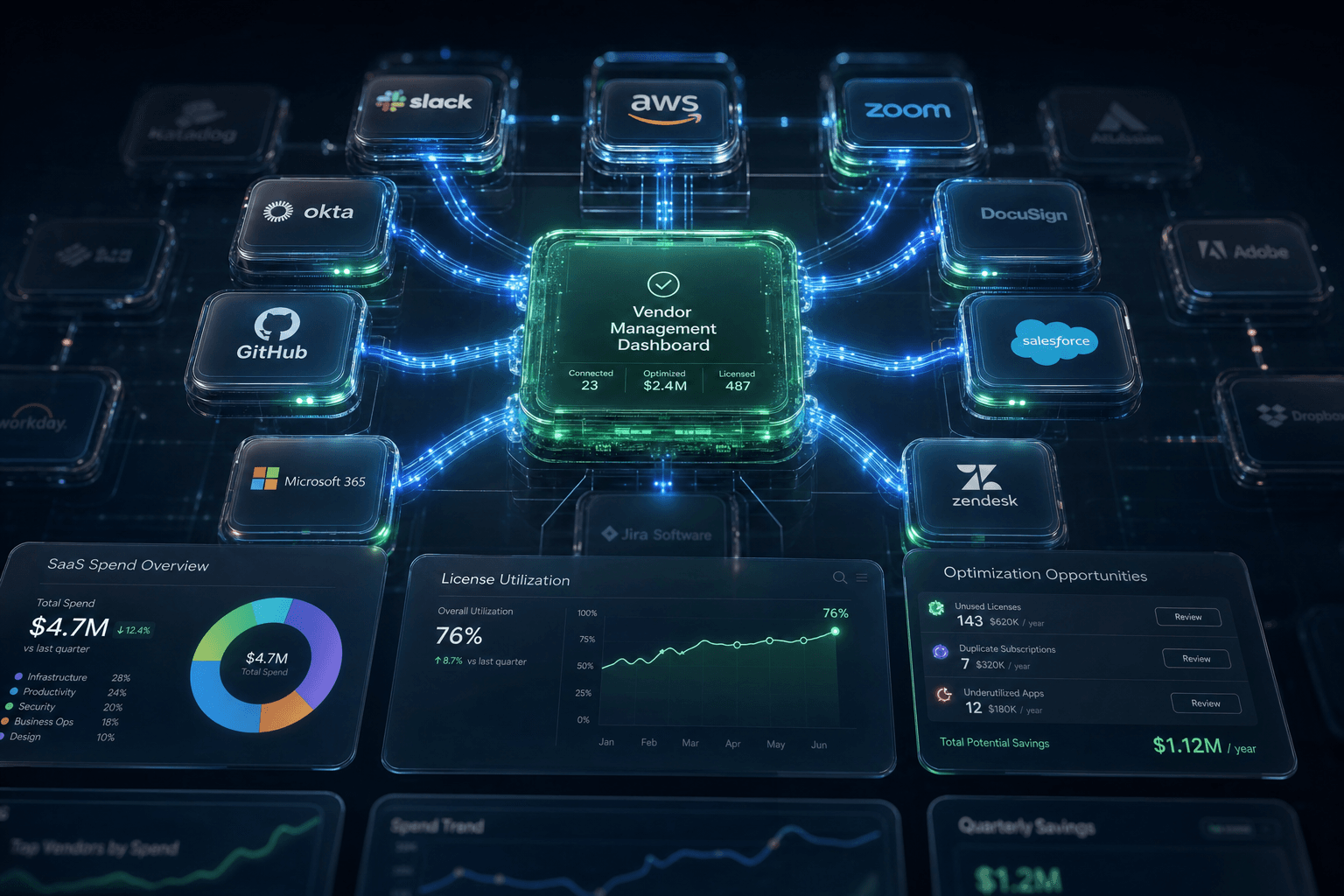
Modernizing SaaS subscription costs through integrated vendor management
Cut SaaS waste and reclaim budget by tracking usage, consolidating vendors, and negotiating better terms through integrated management.

The CTO's blueprint for scaling RevOps and operational excellence
How CTOs can build secure, scalable RevOps infrastructure that increases enterprise value and eliminates vendor lock-in.