
Accelerating enterprise integration with event-driven data flows
Move data between systems in seconds, not hours, by replacing brittle point-to-point integrations with event-driven architecture.
Key Takeaways
- Traditional batch processing and point-to-point integrations create data latency that undermines real-time operations and customer experience.
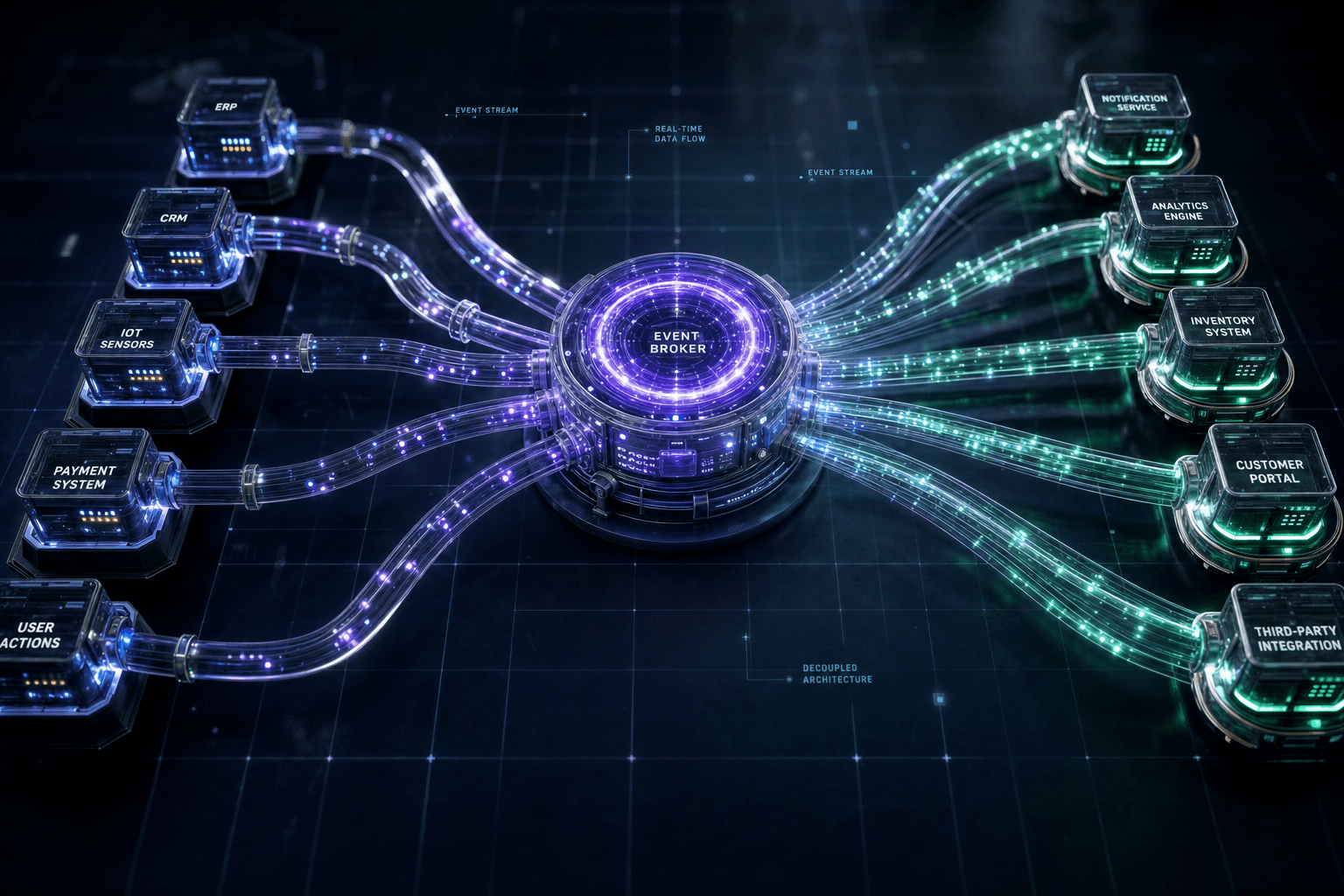
- Event-driven architecture decouples systems through a central broker, enabling immediate propagation of business state changes across the enterprise.
- Start by mapping high-impact business events and their source systems before selecting and deploying your event streaming platform.
- Real-time data flows deliver 20-40% faster operational responsiveness and enable instant fraud detection, personalisation, and inventory accuracy.
Most enterprises still run on batch processing and point-to-point integrations that weren't built for real-time operations. The result is stale data, delayed decisions, and integration systems that break under pressure. Event-driven architecture replaces this fragile model with a real-time data backbone that decouples systems and eliminates latency.
Enterprise integration remains one of the most stubborn operational bottlenecks in modern organizations. Your CRM updates don't reach your ERP for hours. Inventory changes sit in batch queues while customers place orders for out-of-stock items. Customer service reps work with stale data, making promises your operations team can't keep.
This isn't just an IT problem. It's a business velocity problem that directly impacts revenue, customer retention, and competitive positioning.
The root cause is architectural: point-to-point integrations and batch processing create inherent latency and fragility. Every new system integration requires custom connectors, manual mapping, and scheduled sync windows. The result is a brittle web of dependencies that breaks frequently and scales poorly.
Event-driven architecture eliminates this bottleneck by fundamentally changing how systems communicate.
Why traditional integration patterns fail at scale
Most enterprises built their integration layer on request-response patterns. System A calls System B directly, waits for a response, then proceeds. This creates tight coupling between systems.
When you need to add System C, you build another point-to-point connection. Then System D. Soon you have dozens of custom integrations, each with its own maintenance burden, error handling logic, and monitoring requirements.
Batch processing attempts to solve the performance problem by queuing changes and processing them in scheduled windows. But this trades immediacy for throughput. Your data is always hours or days behind reality.
The limitations become critical when you need:
- Real-time fraud detection that blocks suspicious transactions before they complete
- Instant inventory updates across all sales channels to prevent overselling
- Immediate customer profile updates that personalize interactions across touchpoints
- Live operational dashboards that reflect current business state, not yesterday's snapshot
You can't build these capabilities on batch jobs and scheduled syncs.
The architectural shift to event-driven data flows
Event-driven architecture flips the integration model. Instead of systems calling each other directly, they publish and subscribe to events through a central broker.
When something significant happens—an order is placed, a payment clears, a customer updates their profile—the source system publishes an event. The broker routes that event to every subscribed system immediately.
This decoupling changes the economics of integration:
- New systems subscribe to existing event streams without touching the publisher
- Systems can be upgraded, replaced, or taken offline without breaking dependencies
- Event replay enables recovery from failures without data loss
- Multiple consumers process the same events for different purposes without additional load on the source
The technical foundation is an event streaming platform that acts as your real-time data backbone. Popular choices include Apache Kafka, Azure Event Hubs, or Amazon Kinesis. These platforms handle high-throughput event ingestion, durable storage, and parallel consumption at scale.
Implementation blueprint for enterprise event-driven architecture
Map critical business events first
Start by identifying the state changes that matter most to your business operations. Don't try to event-stream everything on day one.
Focus on events that:
- Trigger workflows across multiple systems
- Currently cause customer-facing delays or errors
- Support high-value business processes like order fulfillment or customer onboarding
- Enable new capabilities like real-time recommendations or fraud detection
Common high-impact events include:
- Order lifecycle: order placed, payment authorized, payment captured, order shipped, order delivered, return initiated
- Customer data: customer created, profile updated, preferences changed, subscription modified
- Inventory: stock level changed, product added, product discontinued, restock alert
- Financial: invoice generated, payment received, refund processed, credit limit adjusted
Document the source system for each event and all downstream systems that need to react. This mapping reveals your critical data flows and helps prioritize migration.
Establish your event streaming platform
Select a broker that matches your scale, compliance requirements, and operational capabilities. Kafka offers the most flexibility and throughput but requires significant operational expertise. Managed services like Confluent Cloud or Azure Event Hubs reduce operational burden at slightly higher cost.
Key design decisions:
Event schema design: Use a structured format like Avro or Protocol Buffers for events. Define clear schemas that include event type, timestamp, source system, and payload. Version your schemas from the start to support backward compatibility as your data model changes.
Topic architecture: Organize events into topics by domain (orders, customers, inventory) rather than by consuming application. This enables new consumers to subscribe to existing topics without publisher changes.
Partitioning strategy: Partition events by a key that enables parallel processing while maintaining order within a logical group. For order events, partition by customer ID or order ID so all events for a single order go to the same partition.
Retention policies: Configure retention based on replay requirements and compliance needs. Financial events might require indefinite retention, while operational events can expire after days or weeks.
Phase migration to minimize risk
Don't attempt a big-bang migration. Start with a single high-value use case that demonstrates immediate business impact.
Phase 1: Publish existing events
Add event publishing to one critical source system without changing its existing integrations. This validates your platform setup, schema design, and operational monitoring.
Build a simple consumer that logs events or updates a dashboard. Verify event delivery, ordering, and latency under normal and peak load.
Phase 2: Migrate one point-to-point integration
Select an existing integration that's painful to maintain or frequently breaks. Replace the direct connection with event publishing and subscription.
Keep the old integration running in parallel initially. Compare results to verify correctness, then cut over completely.
Phase 3: Build new event-driven capabilities
Now you can build applications that were impossible with batch processing:
- Real-time fraud scoring that evaluates transactions as they occur
- Dynamic pricing that responds to inventory levels and competitive changes
- Personalization engines that update customer profiles instantly
- Operational dashboards that show current state, not stale snapshots
These capabilities deliver measurable business value that justifies continued platform investment.
Phase 4: Systematic migration of remaining integrations
With proven patterns and operational experience, migrate remaining point-to-point integrations systematically. Prioritize by business impact and technical risk.
Monitor latency and consistency religiously
Event-driven systems require different monitoring than traditional integrations. Track:
- End-to-end latency: Time from event occurrence in source system to processing completion in consumer
- Consumer lag: How far behind real-time each consumer is running
- Event delivery rate: Events published and consumed per second, broken down by topic and consumer
- Schema evolution: Track schema version usage to identify consumers that need upgrades
- Dead letter queue volume: Events that failed processing and require investigation
Set alerts on latency spikes and consumer lag. These indicate system problems or capacity constraints before they impact business operations.
Measurable business outcomes
Organizations that successfully implement event-driven architecture see quantifiable operational improvements:
20-40% reduction in integration latency: Data propagates across systems in seconds instead of hours or days. Customer service reps see current data. Inventory updates prevent overselling. Fraud detection blocks suspicious transactions in real-time.
30-50% decrease in integration maintenance costs: Decoupled systems reduce the ripple effect of changes. New integrations don't require touching existing code. Teams spend less time debugging broken connections and more time building business capabilities.
5-10x faster time to market for new integrations: Adding a new consumer to an existing event stream takes days instead of months. You don't need custom connectors or complex ETL pipelines.
Improved system resilience: Event replay enables recovery from failures without data loss. Systems can be upgraded or replaced without taking down dependent applications.
These improvements compound. Faster integration enables capabilities that drive revenue and reduce operational costs. Real-time data improves decision quality. System resilience reduces downtime and emergency fixes.
The strategic value extends beyond operational efficiency. Event-driven architecture enables new business models that require real-time data: dynamic pricing, instant personalization, predictive maintenance, and AI-driven automation.
Your legacy integration layer is a ceiling on business velocity. Event-driven architecture removes that ceiling and transforms your data infrastructure into a competitive advantage.
Related Reading:
Further Reading:
Want more on
Business Operations?
Add this topic to your Custom Digest. Drop your email to get our deepest insights on this exact topic.
Ready to fast-track your business?
We combine enterprise-level technical strategy with your existing business to solve complex blockers and accelerate your growth. Let's build something remarkable.
Partner With UsUp Next
Continue your journey into Business Operations.
Streamlining enterprise SaaS sprawl with rationalized technology portfolios
Cut SaaS costs by 25% and close security gaps by rationalising your enterprise technology portfolio.
Streamlining the lead-to-revenue cycle with RevOps automation frameworks
Build automation frameworks that eliminate manual handoffs and turn fragmented RevOps processes into a predictable revenue engine.
Modernizing SaaS subscription costs through integrated vendor management
Cut SaaS waste and reclaim budget by tracking usage, consolidating vendors, and negotiating better terms through integrated management.