
Architecting resilient data pipelines for sovereign AI: Eliminating vendor lock-in in enterprise RevOps
Build self-hosted AI data pipelines that eliminate vendor lock-in, ensure data sovereignty, and cut RevOps costs for enterprise leaders.

Key Takeaways
- Proprietary AI solutions introduce vendor lock-in, regulatory risks, and loss of control over your intellectual property.
- Sovereign data pipelines using open standards and self-hosted models keep data within your controlled infrastructure boundaries.
- Federated learning and container orchestration enable private AI training without exposing sensitive RevOps datasets to third parties.
- Architecture-first approaches eliminate recurring AI licensing costs and accelerate custom model development for predictable revenue growth.
Your AI vendor owns your data pipeline, your training models, and your exit strategy. For enterprise RevOps teams running sovereign AI, that's a compliance risk and a cost centre rolled into one. Here's how to build resilient data infrastructure that keeps your models, your data, and your intellectual property under your control.
Enterprise AI doesn't have to mean vendor handcuffs.
Most enterprise leaders are hitting the same wall: proprietary AI platforms promise sophisticated RevOps automation but deliver opaque data policies, black-box models, and pricing structures that escalate with every API call. Your data flows into systems you don't control. Your models train on infrastructure you can't audit. Your compliance team loses sleep over cross-border data transfers.
The cost isn't just financial. You're trading architectural flexibility for convenience, and the bill comes due when you need to customize, migrate, or simply understand what your AI is doing with customer data.
The answer isn't another vendor. It's a composable, self-hosted data infrastructure that puts you back in control.
Why vendor-locked AI creates systemic risk
Proprietary AI platforms create three failure modes that compound over time:
Data sovereignty violations. When your RevOps data lives in a vendor's cloud, you're subject to their data residency policies, their security incidents, and their compliance interpretations. If they decide to change data egress fees or sunset an API, your entire operation is exposed.
Intellectual property leakage. Fine-tuning models on vendor infrastructure means your competitive intelligence, customer insights, and process knowledge become training data you can't control. The IP embedded in your models isn't yours in any meaningful sense.
Escalating operational costs. Per-seat licensing, API call metering, and compute surcharges create unpredictable unit economics. As you scale RevOps automation, your AI costs scale faster than your revenue.
The technical debt is worse than the financial cost. Every integration with a proprietary system creates coupling that makes migration expensive and risky.
The architectural shift to sovereign AI infrastructure
Sovereign AI infrastructure means full control over data ingestion, transformation, model deployment, and inference. You own the compute. You control the data flow. You audit the models.
This isn't about running everything on-premise. It's about designing a composable system where each component is replaceable, auditable, and under your operational control.
The shift requires three architectural layers:
- A sovereign data ingestion layer that captures all RevOps events within your controlled infrastructure
- A federated model deployment layer that trains and runs AI without exposing raw data to third parties
- An agnostic orchestration layer that connects RevOps tools without vendor-specific SDKs
Each layer uses open standards and interchangeable components. No single vendor can hold your architecture hostage.
Building the sovereign data ingestion layer
Your data pipeline starts with an event-driven architecture that captures every RevOps signal: form submissions, email opens, CRM updates, product usage events, support tickets.
Implement a message broker like Apache Kafka as your central nervous system. Every upstream source publishes events to Kafka topics. Every downstream consumer reads from those topics. Your data never touches a vendor system until you explicitly route it there.
This design gives you:
- Replay capability. Reprocess historical events when you change transformation logic or add new AI models.
- Audit trails. Every data flow is logged, versioned, and traceable.
- Decoupling. Swap out CRM platforms, email tools, or analytics systems without rewriting pipelines.
Encryption happens at rest and in transit. Access controls operate at the topic level. Your security team can enforce data residency policies at the infrastructure layer instead of trusting vendor configurations.
The ingestion layer also handles schema evolution. As your RevOps data structure changes, schema registry ensures backward compatibility without breaking downstream consumers.
Deploying federated LLMs on sovereign infrastructure
Proprietary LLM APIs expose you to data leakage, usage restrictions, and unpredictable costs. Self-hosted open-source models eliminate those risks.
Start with a base model from the open-source ecosystem. Fine-tune it on your proprietary data using your own compute. Deploy it on Kubernetes clusters within your private cloud or on-premise infrastructure.
Federated learning frameworks let you train models across decentralized datasets without centralizing raw data. If you operate in multiple regulatory jurisdictions, you can train on European customer data in European infrastructure and American customer data in American infrastructure, then merge model weights without cross-border data transfers.
Container orchestration gives you scaling flexibility. Spin up inference pods during peak hours. Scale down during off-hours. Your cost structure becomes predictable: fixed compute costs instead of per-API-call metering.
Model versioning and A/B testing happen within your infrastructure. Track performance metrics, compare model versions, and roll back deployments without vendor approval or API rate limits.
The operational cost drops by 60-80% compared to proprietary API pricing at enterprise scale. The strategic value is higher: you control model behavior, training data, and inference logic.
Creating an agnostic RevOps control plane
Your AI models need to orchestrate actions across RevOps tools: update CRM records, trigger email sequences, route leads, score accounts, generate reports.
Build an API-first control plane that sits between your AI layer and your RevOps stack. This plane exposes standardized internal APIs for common RevOps operations. Your AI models call those internal APIs, not vendor-specific endpoints.
The control plane handles vendor integration through custom connectors. If you swap HubSpot for Salesforce, you rewrite one connector. Your AI models don't change.
Workflow automation platforms become execution engines, not strategic infrastructure. Use them to implement the logic defined by your control plane, not as the source of truth for your automation architecture.
This separation gives you negotiating leverage. Vendors can't lock you in when your core automation logic lives in your infrastructure, not theirs.
Your control plane also enables sophisticated workflow patterns:
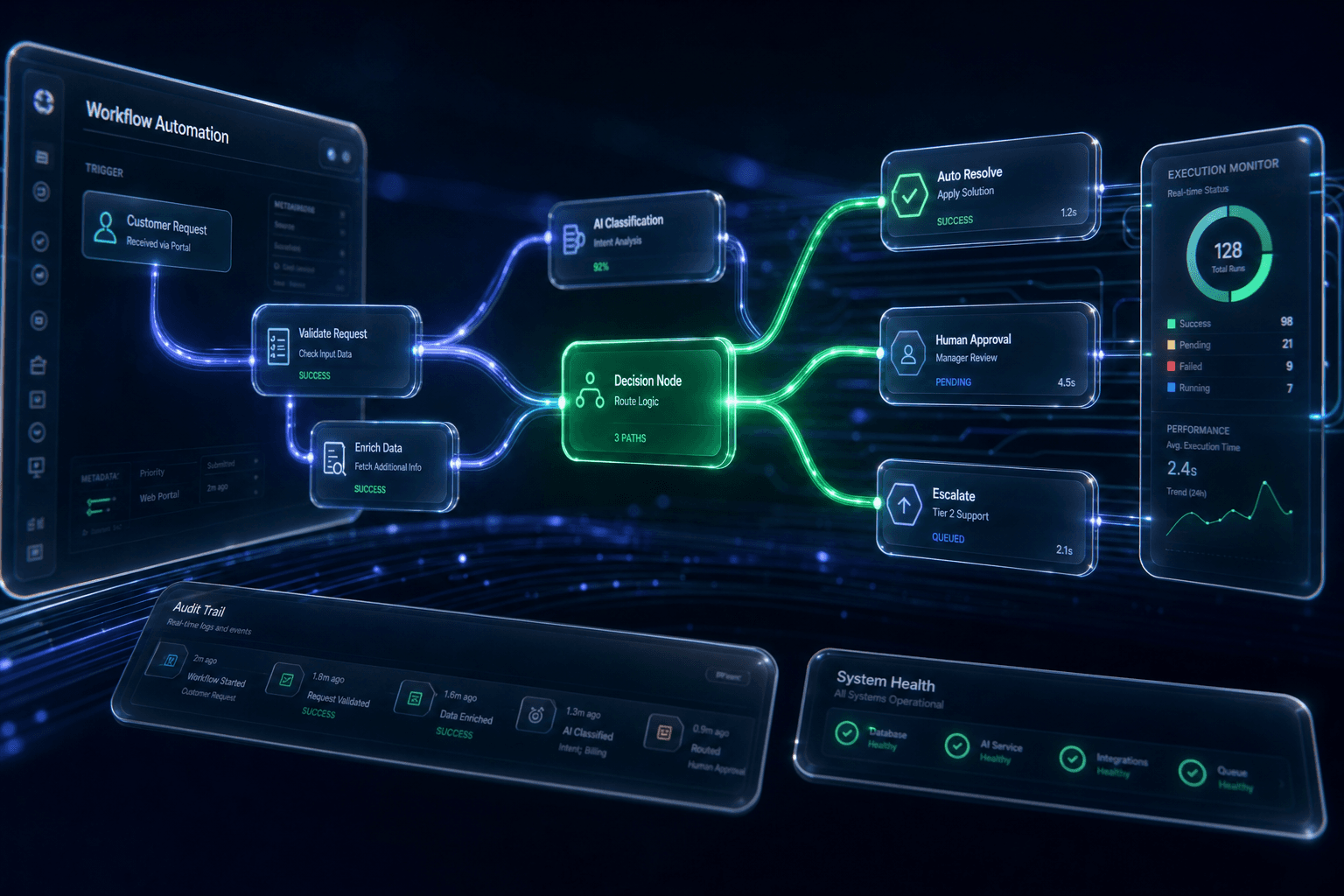
- Multi-step decision trees. AI models evaluate lead quality, then route to appropriate sequences based on account tier, industry vertical, and engagement history.
- Human-in-the-loop approvals. High-value workflows pause for manual review before executing, with full context from AI scoring.
- Fallback logic. If a vendor API fails, your control plane retries, queues for later execution, or routes to alternative tools.
Measuring the business impact
Sovereign AI infrastructure delivers ROI across three dimensions:
Cost avoidance. Eliminate per-seat AI licensing and per-API-call metering. At 10,000+ RevOps events per day, self-hosted inference costs $2,000-5,000 per month in compute versus $15,000-30,000 in proprietary API fees.
Compliance risk mitigation. Full data sovereignty eliminates cross-border transfer risks, simplifies audit processes, and reduces regulatory exposure. For enterprises in regulated industries, this is worth millions in avoided fines and legal overhead.
Development velocity. When your team controls the full stack, custom AI development cycles drop from quarters to weeks. You can experiment with new models, test workflow variations, and deploy improvements without vendor approval or procurement delays.
The strategic outcome is architectural optionality. You can adopt new AI capabilities, migrate between tools, and respond to competitive threats without renegotiating contracts or rebuilding pipelines.
Your AI infrastructure becomes a competitive advantage instead of a vendor dependency.
Implementation timeline and prerequisites
Building sovereign AI infrastructure isn't a weekend project. Plan for 12-16 weeks from architecture design to production deployment.
Weeks 1-3: Architecture design and technology selection. Map your current RevOps data flows. Identify sovereignty requirements. Select your message broker, container orchestration platform, and base LLM.
Weeks 4-8: Data ingestion layer implementation. Deploy your message broker. Build connectors to upstream data sources. Implement schema registry and access controls. Test replay and audit capabilities.
Weeks 9-12: Model deployment and fine-tuning. Set up your container orchestration cluster. Deploy base LLMs. Fine-tune on proprietary data. Build inference APIs.
Weeks 13-16: Control plane and integration. Build your API-first control plane. Create vendor connectors. Migrate existing workflows. Run parallel testing against legacy systems.
Prerequisites include:
- Engineering team with Kubernetes and event streaming experience
- Infrastructure for self-hosted compute (private cloud or on-premise)
- Executive buy-in for upfront engineering investment
- Clear data sovereignty and compliance requirements
The upfront investment is 2-4x higher than subscribing to a proprietary platform. The breakeven point hits within 18-24 months for mid-market enterprises, faster for companies with high data volumes or strict compliance requirements.
Where to start
If you're currently locked into proprietary AI platforms, start with a parallel implementation strategy:
- Audit your current data flows. Map where RevOps data lives, who controls it, and what sovereignty risks exist.
- Implement sovereign ingestion for one data source. Prove the architecture with a single CRM or marketing automation tool before expanding.
- Deploy a self-hosted LLM for one use case. Start with lead scoring or email classification before tackling complex multi-step workflows.
- Measure cost and performance. Compare self-hosted inference costs and latency against your current proprietary solution.
The goal isn't to replace everything immediately. It's to build optionality and prove the economic and operational case for sovereign infrastructure.
Once you control your data pipeline and model deployment, every strategic decision becomes easier. You negotiate from a position of strength. You respond to market changes at your pace, not your vendor's roadmap.
Sovereign AI infrastructure isn't about vendor avoidance. It's about architectural control that drives long-term enterprise value.
Want more on
Growth Systems?
Add this topic to your Custom Digest. Drop your email to get our deepest insights on this exact topic.
Ready to fast-track your business?
We combine enterprise-level technical strategy with your existing business to solve complex blockers and accelerate your growth. Let's build something remarkable.
Partner With UsUp Next
Continue your journey into Growth Systems.

Building sovereign data plane for enterprise AI
How to build enterprise-controlled AI infrastructure that cuts regulatory risk and protects your intellectual property from vendor exposure.

Structuring sovereign RevOps control plane
How treating RevOps infrastructure as version-controlled code cuts operational overhead by 40% and eliminates deployment bottlenecks.
Scaling revenue operations with low-code automation
Low-code CRM automation lets RevOps teams ship changes in hours, not weeks, without waiting for engineering capacity.