
Continuous AI cost governance as an operational safeguard
How to cut phantom AI costs through active resource governance and automated cost allocation across your entire AI estate.
Key Takeaways
- AI models accumulate phantom costs through idle compute, redundant API calls, and sprawling storage that erode ROI.
- Centralised cost observability with mandatory tagging reveals which models, teams, and projects drain budgets without delivering value.
- Automated resource provisioning and cost guards in MLOps pipelines eliminate idle cycles and optimise API consumption at source.
- Regular AI asset lifecycle reviews decommission underperforming models, cutting recurring infrastructure and licensing costs before they compound.
AI projects drain budgets through invisible costs that pile up after deployment. Unused compute, redundant API calls, and orphaned models quietly inflate your TCO and kill ROI. You need real-time cost controls built into your AI operations, not spreadsheets reviewed quarterly.
Most enterprise AI deployments succeed technically but fail financially. The models work. Inference runs. Revenue teams adopt the tools. Then finance flags a problem: AI costs are 40% higher than forecast, with no clear explanation.
The culprit is rarely the headline infrastructure spend. It's the phantom costs—idle compute clusters left running post-experiment, redundant API calls from poorly architected pipelines, and sprawling data stores that no one owns. These expenses accumulate invisibly, creating budget overruns that CFOs can't reconcile and procurement teams can't audit.
Without architectural cost controls, AI becomes a financial liability instead of a margin accelerator.
The real cost problem in production AI
AI cost management failures don't stem from lack of monitoring. Most enterprises run observability stacks. The problem is fragmentation.
Model training happens in one cloud environment. Inference runs in another. Third-party APIs sit outside the corporate procurement umbrella. Data pipelines operate with no ownership attribution. When finance asks "What did AI cost us this quarter?", engineering provides three different answers from three different dashboards.
This opacity creates three specific financial risks:
- Orphaned resources: Experimental models and their supporting infrastructure remain provisioned long after projects end. No team claims ownership. No one deprovisions them. Monthly charges accumulate.
- Inefficient API consumption: Inference pipelines make redundant calls due to missing caching layers or poor request batching. Each call costs fractions of a cent, but at scale, inefficiency translates to tens of thousands in avoidable spend.
- Storage sprawl: Training datasets, model artifacts, and logs persist indefinitely across multiple storage tiers. Hot storage costs 10x more than cold, yet most organisations never implement automated lifecycle policies.
The financial impact compounds. A mid-sized enterprise running 50 AI models can easily accumulate $30,000–$60,000 per month in phantom costs. Over a fiscal year, that's $360,000–$720,000 in margin erosion.
From reactive budgeting to architectural cost control
The solution isn't better spreadsheets. It's embedding cost governance directly into the AI engineering lifecycle.
This requires a shift from periodic budget reviews to continuous cost observability, automated resource management, and active asset lifecycle policies. The goal is to make every AI workload accountable to a business unit, usage pattern, and performance metric before it consumes infrastructure.
Three architectural changes create this shift:
Unified cost observability across all AI infrastructure
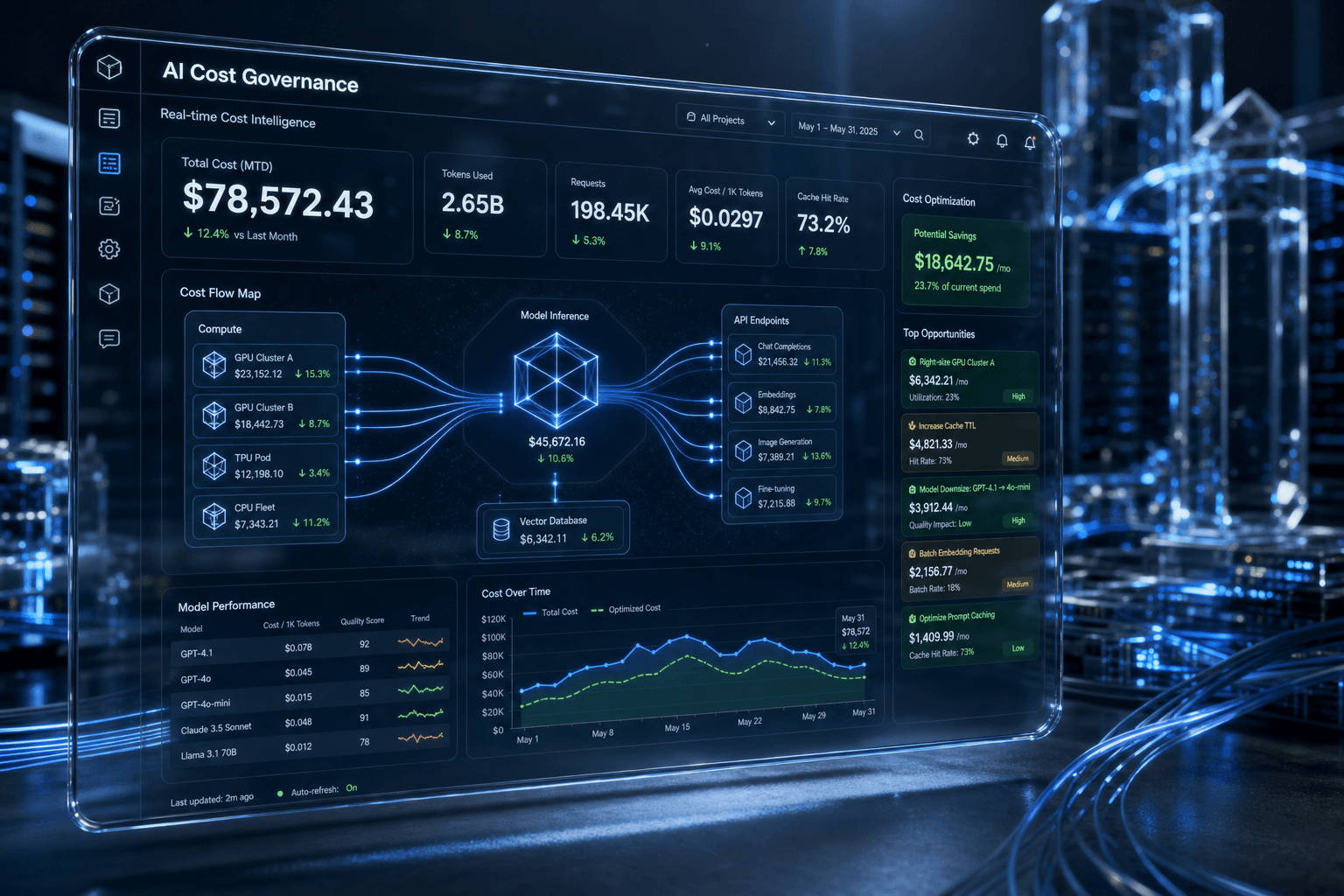
Centralise consumption data from every AI touchpoint: cloud compute, on-premise GPU clusters, third-party APIs, and managed AI services. Tag every resource with mandatory metadata—model ID, business unit, project, environment (dev/staging/prod).
This provides granular cost allocation. Finance can see that the customer churn model costs $4,200/month while the recommendation engine costs $11,800/month. More important, they can see which costs are production workloads generating revenue and which are abandoned experiments.
Implement this through:
- Cross-platform tagging standards: Enforce tagging policies at the infrastructure-as-code level. Resources without proper tags don't get provisioned.
- Unified dashboards: Consolidate cost data from AWS, Azure, GCP, and third-party APIs into a single view. Use tools that normalize billing data across providers.
- Cost allocation reporting: Automatically generate monthly cost breakdowns by team, model, and project. Make these reports accessible to both finance and engineering.
Cost-aware mlops pipelines with automated guards
Most MLOps platforms manage model versioning, deployment, and monitoring. Few manage cost as a first-class metric.
Build cost awareness into every pipeline stage:
- Training: Set maximum training budgets per experiment. Automatically terminate runs that exceed thresholds without achieving target performance. Use spot instances for non-critical workloads.
- Inference: Implement autoscaling with aggressive scale-down policies. A model serving 100 requests/minute at 2 PM doesn't need the same infrastructure at 2 AM.
- Data processing: Compress data aggressively. Move datasets to cold storage after 90 days of inactivity. Delete temporary processing artifacts within 24 hours.
The key is automation. Manual cost reviews happen too late. By the time someone notices a $15,000 overage, it's already accrued.
Architecture example: An e-commerce platform running product recommendation inference implemented request-level caching with a 5-minute TTL. For repeat product views, inference costs dropped 70% with zero impact on user experience. The caching layer cost $200/month. The savings exceeded $9,000/month.
Active AI asset lifecycle management
Most organisations track active projects. Few track active AI assets.
Establish a quarterly review process for every deployed model:
- Performance metrics: Is the model meeting accuracy, latency, and throughput targets?
- Usage data: How many requests does it serve? Is usage trending up or down?
- Business value: What revenue, cost savings, or operational efficiency does it generate?
Models that fail these criteria get decommissioned. Delete the model artifacts, deprovision the inference infrastructure, and archive the training data.
Define clear decommission criteria:
- Models with fewer than 1,000 requests/month
- Models with accuracy below business-defined thresholds
- Models replaced by newer versions (after 30-day grace period)
- Experimental models unused for 90+ days
This prevents asset accumulation. A typical enterprise retires 20–30% of AI models in the first review cycle, immediately cutting recurring infrastructure costs.
Quantifiable outcomes for finance leaders
This architectural approach produces measurable financial results:
- 20–40% reduction in AI infrastructure costs within the first year, primarily from eliminating orphaned resources and optimising underutilised workloads.
- Improved budget predictability: Monthly AI spend variance drops from ±25% to ±5%, making quarterly forecasts reliable.
- Faster procurement cycles: Clear usage attribution and cost allocation simplify vendor negotiations and licensing audits.
- Reduced operational overhead: Automated cost guards reduce the need for manual cost reviews, freeing finance and engineering teams for strategic work.
For a company spending $1.5M annually on AI infrastructure, this translates to $300,000–$600,000 in direct cost savings plus improved margin protection from eliminated budget overruns.
Building cost discipline into AI operations
AI cost management is not a finance problem. It's an architectural problem that requires engineering solutions.
The enterprises that treat cost as a technical requirement—not an afterthought—build AI platforms that scale profitably. They know exactly what each model costs, why it costs that amount, and whether the business value justifies the expense.
Start with visibility. Build in automation. Enforce lifecycle discipline. The margin you protect is your own.
Want more on
AI Engineering?
Add this topic to your Custom Digest. Drop your email to get our deepest insights on this exact topic.
Ready to fast-track your business?
We combine enterprise-level technical strategy with your existing business to solve complex blockers and accelerate your growth. Let's build something remarkable.
Partner With UsUp Next
Continue your journey into AI Engineering.

The engineer's framework for continuous AI model validation
How to build an automated validation system that detects model drift before it degrades your AI predictions.

The CTO's framework for adaptive AI customer journeys
How to build an AI orchestration layer that cuts campaign launch time by 60% and frees your team from developer bottlenecks.

How engineering tooling rationalisation cuts enterprise AI tco
How rationalising your AI engineering stack cuts operational costs by 15-25% and stops tooling sprawl from eroding margins.