
From patching windows to self-defending infrastructure
AI agents now write and deploy kernel-level security shields in minutes, closing the gap before patches arrive.
Key Takeaways
- AI-driven attackers exploit vulnerabilities within hours; traditional patch cycles take days or weeks, creating an impossible defence gap.
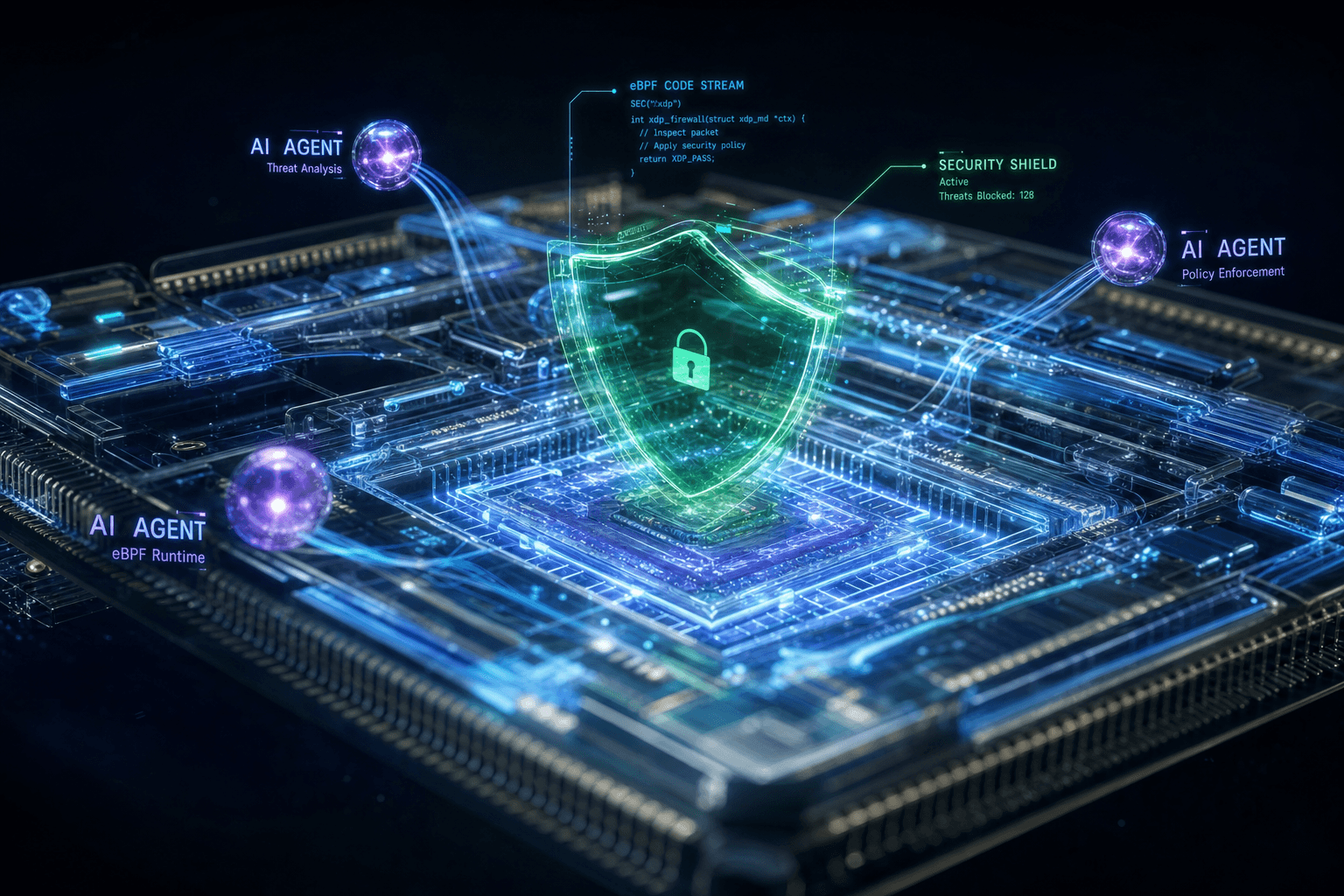
- Shirudo uses eBPF to let AI agents write, test, and deploy kernel-level shields in minutes while permanent patches roll out.
- Agentic security inverts the old model: protect unpatched systems at runtime instead of racing to harden everything before attacks land.
- Security infrastructure must become programmable and self-defending; static policies and manual workflows cannot match machine-speed threats.
The gap between vulnerability disclosure and exploitation has collapsed to hours. Traditional patch management—assess, build, test, deploy—operates on human timelines while AI-powered attackers move at machine speed. Cisco and OpenAI's Shirudo flips the model: AI agents write and deploy kernel-level protections while patches roll out, defending systems at the speed of the threat.
On November 23, 2026, Cisco and OpenAI announced Shirudo—an open-source project that lets AI agents write and deploy kernel-level protections while patches are still in testing. When recent critical vulnerabilities hit PHP and Java systems, attackers exploited them within hours of disclosure. Shirudo's AI agents detected both flaws and deployed working defenses before human security teams could schedule their first emergency meeting.
Your patch management process just became obsolete.
The defender's window has collapsed
The time between vulnerability disclosure and active exploitation used to be measured in days. Now it's hours.
Traditional patch management assumes human timelines: assess the risk, build the fix, test for regression, distribute to production, verify deployment. This process takes 48-96 hours minimum in most enterprises.
AI-powered attackers trained on vulnerability databases and exploit code operate at machine speed. They scan the internet, identify exposed systems, and deploy attacks before your security team finishes reading the CVE bulletin.
You face an impossible choice: patch thousands of systems within hours (operationally impossible), or accept that some systems will be compromised (unacceptable).
Shirudo closes this gap by inverting the security model. Instead of racing to patch everything before attackers strike, you deploy AI agents that protect systems while patches roll out.
How kernel-level agent defense works
Shirudo uses three technical layers to let AI agents defend infrastructure at machine speed:
eBPF as the injection layer
Extended Berkeley Packet Filter (eBPF) lets you run small, custom programs inside the Linux kernel without modifying or restarting the operating system. Think of it as programmable hooks that intercept operations at the lowest level—system calls, network packets, file access, process execution.
An eBPF program can examine every request hitting your database server and block malicious patterns before they reach the vulnerable code path. No application restart. No downtime. No prayer that your firewall rules cover every edge case.
AI agents as the shield builder
When a CVE drops, Shirudo's agent reads the vulnerability description, analyzes the exploit code, and traces the attack path through your system. It writes an eBPF program that blocks the attack vector, tests the program against both exploit traffic and legitimate requests, and deploys it to production—signed and verified.
The agent maintains state across the entire workflow. If the shield causes false positives, the agent refines the detection logic. If a new variant of the exploit appears, the agent updates the shield without human intervention.
Speed asymmetry as the strategic advantage
Attackers need one unpatched system. You need 100% coverage.
Traditional security tried to win by hardening everything faster than attackers could probe for weaknesses. Shirudo accepts that some systems will remain unpatched for hours or days (testing requirements, change control, vendor delays) and compensates by shielding them at runtime.
The agent doesn't replace patching. It buys you time to patch correctly instead of frantically.
Who needs agentic kernel defense
This model applies to organizations operating at scale:
You need this if:
- You manage thousands of servers across cloud and on-premise environments
- Your patch approval process takes longer than 24 hours for critical CVEs
- You run SaaS platforms where downtime costs exceed six figures per hour
- Your security operations center defends heterogeneous stacks (multiple languages, databases, container orchestrators)
- You've been compromised because a patch didn't deploy fast enough
You don't need this if:
- Your infrastructure is small enough to patch manually in under an hour
- You operate air-gapped or embedded systems where eBPF isn't available
- Your patch deployment pipeline already achieves 95%+ coverage within 30 minutes of CVE disclosure
The trade-off:
Running kernel-level shields introduces CPU overhead and latency (typically 1-3% depending on traffic patterns). This cost only makes sense if a successful exploit would cost more than the performance hit.
Build your first agentic defense system
Step 1: Measure your vulnerability timeline
Document your current process from disclosure to full deployment:
- CVE announced to internal vulnerability scan: _____ hours
- Scan complete to patch approval: _____ hours
- Approval to 100% production deployment: _____ hours
If the total exceeds 24 hours for critical vulnerabilities, attackers are faster than you.
Step 2: Identify your exposure surface
List systems that meet two or more criteria:
- Run shared software (Postgres, Nginx, Kubernetes, Python/Java/Node runtimes)
- Require extensive testing before patching (payment processors, authentication services, systems with strict SLAs)
- Handle sensitive data (customer records, API keys, financial transactions)
These systems need runtime protection while patches deploy.
Step 3: Deploy Shirudo locally
# Clone the repository
git clone https://github.com/shirudo-dev/shirudo
cd shirudo

# Review existing eBPF programs
ls src/shields/

# Run test suite against your kernel
make test

# Load an example shield (Java4shell protection)
sudo ./shirudo load --shield java4shell --config production.yaml
Pick one known vulnerability in your environment. Use Shirudo's examples (Java4shell or the PHP flaw) as templates to write an eBPF program that blocks that specific attack.
Test the shield against:
- Exploit traffic (verify it blocks the attack)
- Legitimate traffic (verify it doesn't break normal operations)
Step 4: Integrate with incident response
Rewrite your CVE response workflow:
Old process:
CVE drops → assess impact → schedule patch development → build patch → test → deploy → verify
New process:
CVE drops → (parallel track 1) assess impact + schedule patch development → build patch → test → deploy → verify
CVE drops → (parallel track 2) agent writes eBPF shield → test shield → cryptographically sign → deploy to production
The shield goes live in hours. The patch deploys in days. The shield auto-retires once 95%+ of your infrastructure runs the patched version.
Step 5: Automate shield generation
Feed your AI agent (Claude, GPT-4, or an internal model) this workflow:
Input:
- CVE bulletin text
- Exploit proof-of-concept code
- Vulnerable software version and attack surface documentation
Task:
"Parse this CVE and exploit. Trace the vulnerable code path. Write an eBPF program that intercepts the attack at the kernel level (syscall hook, network filter, or bytecode injection). Output C code for the eBPF program and a test harness that verifies it blocks the exploit without breaking legitimate requests."
Output:
- C source for eBPF program
- JSON configuration for Shirudo deployment
- Test cases for verification
Run the output through your existing security review process. When validated, the agent deploys the shield automatically.
The infrastructure is learning to defend itself
Static security policies can't keep pace with AI-driven threats.
Attackers train models on decades of vulnerability disclosures, exploit code, and system configurations. They find zero-days faster than vendors can patch them. They adapt techniques in real time based on your defenses.
If you treat security as a process—patch management, penetration tests, compliance checklists—you lose. Processes assume human timelines. Attackers moved to machine timelines two years ago.
Shirudo represents the structural shift: security infrastructure must become agentic. AI agents that reason about threats, write defensive code, test autonomously, and deploy at kernel speed.
This model extends beyond security. Observability, incident response, capacity planning, cost optimization—every infrastructure function will move to continuous-learning systems that adapt without human intervention.
The organizations that embrace agentic infrastructure first gain a 2-3 year advantage. The ones that wait will spend those years responding to breaches that could have been blocked automatically.
Your infrastructure can learn to defend itself. The question is whether you'll let it start before your next incident.
Get the checklist: Download our "5-step vulnerability pipeline assessment" to identify which systems need agentic protection first. [Link]
Need custom shields? WrightyMedia builds eBPF shield libraries tailored to your infrastructure (security assessment + shield code generation + testing harness). We can integrate Shirudo deployment into your existing incident response workflows. [Contact us]
Sources:
Expanding the Defender's Window with Self-defending Infrastructure — Cisco Blogs
Cisco and OpenAI Launch Shirudo, A New Project to Safeguard Agentic AI — Cisco Newsroom
Want more on
Enterprise Architecture?
Add this topic to your Custom Digest. Drop your email to get our deepest insights on this exact topic.
Ready to fast-track your business?
We combine enterprise-level technical strategy with your existing business to solve complex blockers and accelerate your growth. Let's build something remarkable.
Partner With UsUp Next
Continue your journey into Enterprise Architecture.
Reducing data infrastructure tco
Learn how to cut data infrastructure costs by 20-30% through lifecycle management, ROT elimination, and cost visibility frameworks.

Modernizing RevOps leader's blueprint for automating data integrity
Learn how RevOps leaders cut admin time by 30% and improve forecast accuracy through automated data integrity workflows.
Structuring $1.5 billion blind spot
Enterprise AI tools don't share data, creating blind spots that cost billions and block cross-functional insights.