
Reducing data infrastructure tco
Learn how to cut data infrastructure costs by 20-30% through lifecycle management, ROT elimination, and cost visibility frameworks.
Key Takeaways
- Hidden data infrastructure costs routinely consume 20-30% more budget than necessary through duplication and poor lifecycle management.
- Classifying data by business value and automating retention policies cuts storage waste and reduces regulatory exposure.
- Shared, governed data assets eliminate costly replicas and bespoke integrations that drain operational budgets.
- Centralised cost visibility with chargeback accountability prevents infrastructure bloat and frees capital for strategic investment.
Your data infrastructure is quietly bleeding money through duplicated storage, poorly governed lifecycles, and cloud bills no one truly understands. Finance leaders face mounting TCO without clear visibility into where costs accumulate or how to stop the drain. This framework cuts data infrastructure spend by 20-30% through systematic rationalisation and lifecycle automation.
Enterprise data infrastructure has become a silent profit killer. Your cloud bills climb every quarter. Storage costs compound. Processing expenses multiply across redundant systems. And nobody can tell you exactly what you're paying for or why.
This isn't a technology problem. It's a financial visibility problem that manifests as runaway infrastructure spend.
The hidden cost structure eating your margins
Most enterprise data infrastructure evolved through acquisition, departmental autonomy, and decade-old architectural decisions. The result is a cost structure that defies rational analysis:
- Redundant storage across silos: Marketing keeps customer data. Sales keeps customer data. Support keeps customer data. You're paying to store the same records three to seven times across different systems.
- Unmanaged data lifecycle: Data arrives but never leaves. Test datasets from 2015 sit in production storage tiers. Logs accumulate indefinitely. Nobody deletes anything because nobody knows what's safe to remove.
- Opacity in consumption patterns: Finance sees aggregate cloud bills but can't trace costs to specific business units, applications, or data sets. Chargeback models don't exist or lack granularity.
- Compliance as cost multiplier: Retaining unnecessary data doesn't just waste storage. It expands your regulatory surface area, increasing audit scope, e-discovery costs, and breach exposure.
The financial impact compounds annually. A 15% year-over-year increase in data infrastructure costs becomes structural before anyone notices.
The procurement shift that changes the equation
The fix requires treating data infrastructure as a managed financial asset rather than an IT utility bill.
This means moving from reactive purchasing ("we need more storage") to proactive architectural rationalisation ("what data delivers value and what data creates cost?").
Three architectural principles drive this shift:
Data lifecycle management as a first-class concern: Implement policies that automatically classify, archive, and delete data based on business value and regulatory requirements. This isn't a one-time cleanup project. It's an automated framework that prevents cost accumulation.
Canonical data planes that eliminate duplication: Decouple data from application silos. Build a single source of truth for each data domain. Applications reference this canonical data rather than maintaining their own copies. Storage costs drop immediately. Maintenance overhead drops with them.
Consumption visibility and chargeback: Make data infrastructure costs visible at the business unit level. When teams can see what they're spending on data storage and processing, behaviour changes. Unnecessary datasets get deprecated. High-cost, low-value workloads get optimised or eliminated.
This strategic shift transforms data infrastructure from an uncontrolled expense into a line item that finance can actually manage.
The three-step implementation blueprint
Comprehensive data audit and classification
Start with visibility. You can't optimise what you can't measure.
Conduct a full inventory of data assets across all systems:
- Identify ROT data: Redundant, obsolete, or trivial data that serves no business or compliance purpose. This typically represents 30-40% of enterprise data stores.
- Classify by business value: Which datasets drive revenue, reduce risk, or support active operations? Which are historical artifacts?
- Map access patterns: Which data gets accessed daily? Weekly? Never? Access frequency determines appropriate storage tiers.
- Document retention requirements: Legal and regulatory obligations define minimum retention periods. Everything beyond that is optional and costly.
This audit creates the foundation for rational decision-making. You now know what you have, what it costs, and what it's worth.
Automated lifecycle management policies
Manual data cleanup fails because it's not sustainable. Automation makes lifecycle management structural rather than episodic.
Implement policy-driven automation:
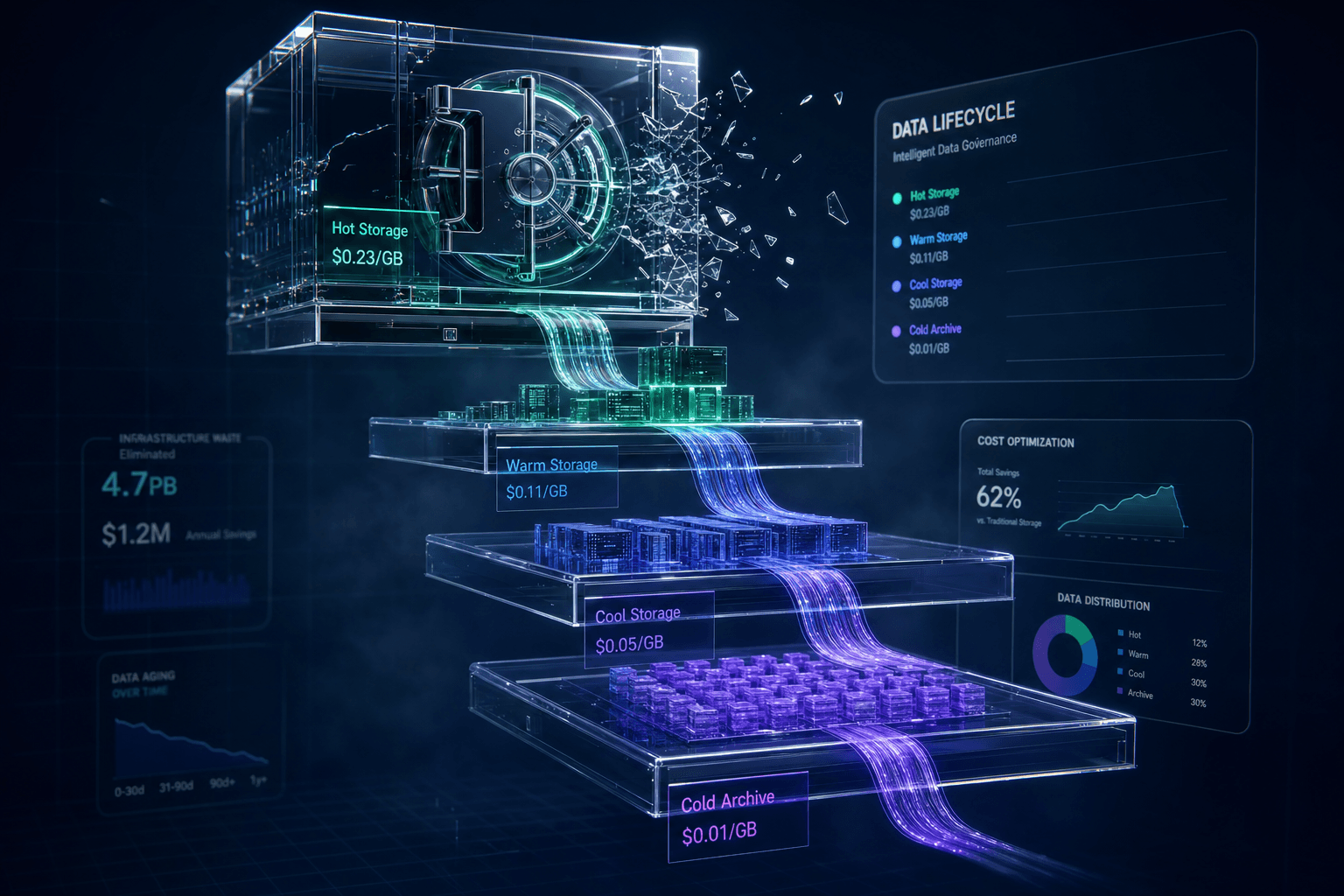
- Tiering rules: High-value, frequently accessed data stays in premium storage. Infrequently accessed data moves to cold storage automatically based on access patterns. Costs drop 70-80% for cold tier storage.
- Archival policies: Data that must be retained for compliance but isn't operationally relevant gets archived to long-term storage at 90% lower cost than active tiers.
- Deletion schedules: Data that has passed its retention requirement and serves no business purpose gets deleted automatically. This reduces storage costs and compliance exposure simultaneously.
These policies run continuously without human intervention. Data infrastructure costs stop accumulating by default.
Cost visibility and architectural governance
Make data infrastructure costs transparent and assign them to the business units that generate them.
Build a chargeback model that shows:
- Storage costs by department and application
- Processing costs by workload and business function
- Growth trends that predict future spend
Couple this visibility with quarterly architectural reviews:
- Identify new redundancies introduced by recent projects
- Find opportunities to consolidate storage or processing
- Validate that lifecycle policies are working as designed
- Track TCO reduction against baseline
This creates a feedback loop. Finance sees costs. Architecture finds optimisations. Policies implement changes. Costs decrease.
Expected financial outcomes
This approach delivers measurable cost reduction without introducing technical debt or operational risk:
20-30% TCO reduction in year one: Eliminating ROT data, implementing tiering, and consolidating redundant stores produces immediate savings. Most enterprises see this within 90 days of full implementation.
Budget reallocation to strategic initiatives: The capital freed up from infrastructure optimisation funds innovation projects that were previously unfunded. You're not just cutting costs. You're redirecting resources to growth.
Reduced compliance overhead: Smaller data footprint means smaller audit scope, lower e-discovery costs, and reduced breach exposure. Compliance becomes simpler and cheaper.
Operational efficiency gains: Streamlined data management reduces the time engineering teams spend on data-related issues. Fewer redundant systems means fewer integration points, fewer failures, and less maintenance burden.
The financial case is straightforward. Data infrastructure costs are largely fixed in most enterprises because nobody questions them. Making them variable and manageable produces immediate margin improvement.
You don't need new technology to implement this. You need a procurement mindset applied to data infrastructure and the architectural discipline to execute it systematically.
Want more on
Enterprise Architecture?
Add this topic to your Custom Digest. Drop your email to get our deepest insights on this exact topic.
Ready to fast-track your business?
We combine enterprise-level technical strategy with your existing business to solve complex blockers and accelerate your growth. Let's build something remarkable.
Partner With UsUp Next
Continue your journey into Enterprise Architecture.

The RevOps leader's blueprint for automating data integrity
Learn how RevOps leaders cut admin time by 30% and improve forecast accuracy through automated data integrity workflows.

Structuring $1.5 billion blind spot
Enterprise AI tools don't share data, creating blind spots that cost billions and block cross-functional insights.

From pilot purgatory to production
Most AI agent pilots fail in production because they're built as single systems, not orchestrated teams that can handle real multi-step workflows.