
How software licence governance cuts 15-25% from your annual software budget
Cut software costs by 15-25% and avoid audit penalties with a unified licence governance framework.
Key Takeaways
- Reactive licence management drains budgets through unused seats, compliance risks, and vendor audit penalties.
- A centralised data platform exposes real-time software usage against contractual entitlements across all enterprise systems.
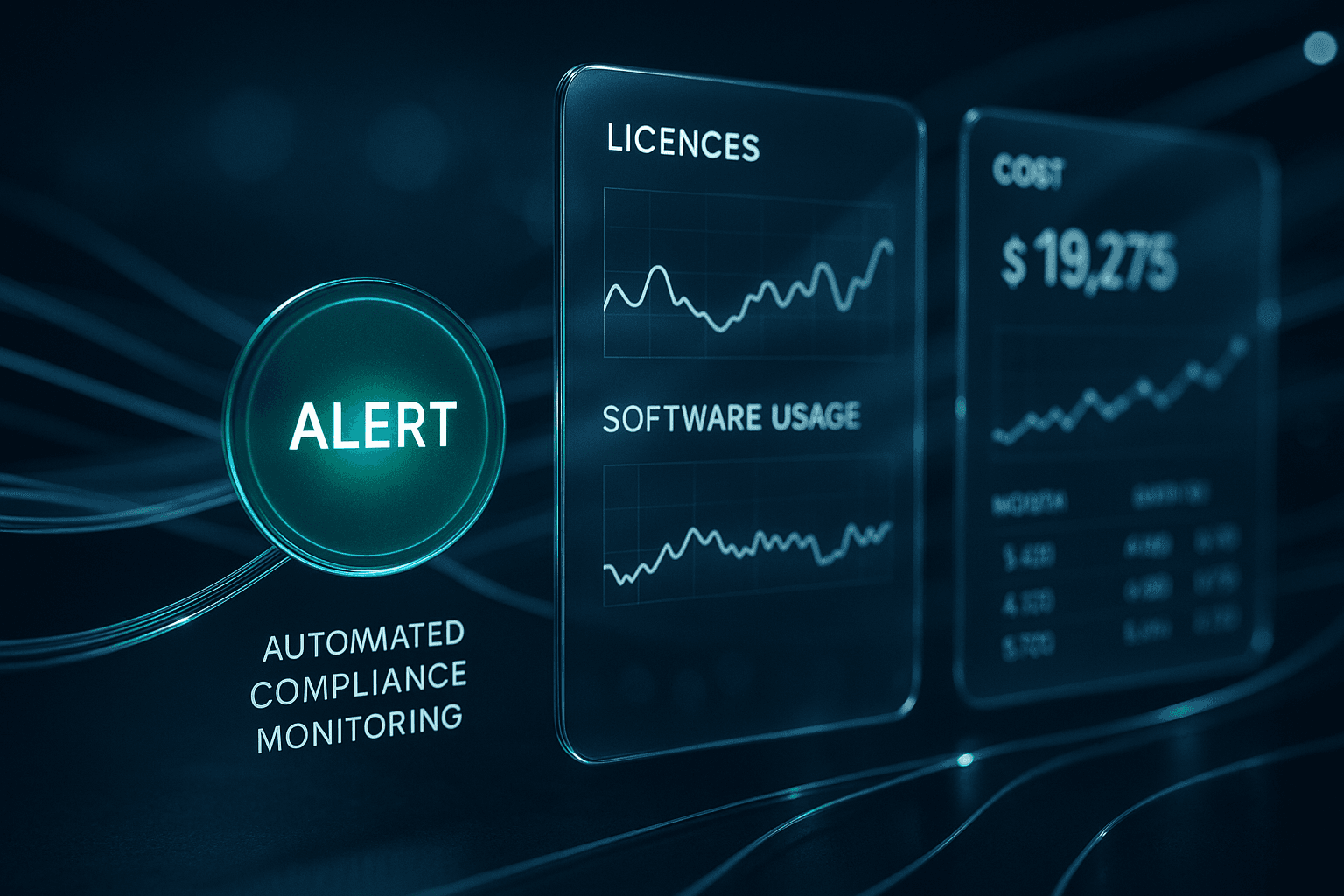
- Automated compliance workflows flag overages before penalties hit and trigger licence reallocation or decommissioning.
- Proactive governance cuts annual software spend by 15-25% while protecting margins from audit exposure.
Enterprise software spend is bleeding money through unused licences, unmonitored deployments, and audit penalties you didn't see coming. Finance and procurement teams lack real-time visibility into what's actually being used versus what's being paid for. A proactive governance framework cuts annual software costs by 15-25% and stops compliance violations before they hit your budget.
For enterprise finance and procurement leaders, software licensing represents one of the most opaque and consistently mismanaged cost centers in the technology stack. You're not just paying for the licenses you use—you're hemorrhaging budget on shadow IT deployments, unused seats, and compliance violations that only surface during vendor audits.
The numbers tell the story: most enterprises overspend by 15-30% annually on software licenses alone. This isn't a rounding error. For a mid-sized organization spending $10M on enterprise software, that's $1.5-3M in annual waste.
This waste stems from three architectural failures: decentralized procurement that bypasses governance, zero real-time visibility into actual usage, and manual reconciliation processes that can't keep pace with cloud-native deployment velocity.
The hidden costs destroying your software budget
Software license costs extend far beyond the purchase order. The real financial damage happens in three areas:
Unused license sprawl: Your CRM shows 2,000 licenses purchased. Usage telemetry reveals 1,400 active users. That's $600K in wasted spend at $1,000 per seat.
Audit penalties: Oracle, Microsoft, and SAP audits routinely uncover compliance gaps. Penalties average 1.5-3x the original license cost. A $200K underpayment becomes a $400-600K liability overnight.
Decentralized procurement: When individual business units purchase software outside central governance, you lose negotiating leverage, create integration nightmares, and duplicate functionality across departments.
The procurement team discovers these issues months after the damage is done. By then, contracts are signed, penalties are accruing, and budget variance explanations are due to the CFO.
Why reactive license management fails at scale
Most enterprises attempt license management through periodic manual audits. Teams export usage reports from individual systems, reconcile them against procurement records in spreadsheets, and identify optimization opportunities.
This approach breaks down for three reasons:
Time lag kills cost avoidance: Manual audits happen quarterly at best. By the time you identify 200 unused Salesforce licenses, you've already paid for another quarter of waste.
No single source of truth: Your ERP has procurement data. Your ITSM tool has deployment records. Your SaaS apps have usage telemetry. These systems don't talk to each other, creating reconciliation gaps where overspend hides.
Vendor complexity: Every software vendor structures entitlements differently. Named users vs. concurrent users. Core-based vs. socket-based. Perpetual vs. subscription. Manual tracking can't scale across 50+ enterprise applications.
You need an architectural solution, not another spreadsheet.
Building a license governance data backbone
Proactive license governance requires a purpose-built data infrastructure that connects three critical data domains: usage telemetry, contractual entitlements, and financial allocation.
Here's the technical blueprint:
Centralize usage telemetry collection
Build a unified data platform to ingest real-time usage data from every enterprise application:
- API-first collection: Connect to vendor APIs (Salesforce, Microsoft 365, Adobe Creative Cloud) to pull daily active user counts, feature usage, and authentication logs
- Agent-based monitoring: Deploy lightweight agents on on-premise infrastructure to capture usage from legacy systems without API access
- Log aggregation: Stream application logs to a centralized data warehouse, parsing authentication events and session data
The data platform must handle schema variations across vendors. Salesforce reports "active users" differently than SAP. Your ingestion layer needs transformation logic to normalize metrics into comparable units.
You're building a license data mesh—a domain-specific data product optimized for governance workflows.
Integrate contractual entitlements and cost data
Usage data means nothing without the contractual context. Connect your license data mesh to:
Procurement systems: Ingest purchase orders, contract terms, entitlement counts, and renewal dates. Extract the specific license metrics that define compliance (e.g., "500 named users" vs. "unlimited users, 100 concurrent sessions").
Finance systems: Map software costs to business units and cost centers. This enables TCO analysis at the department level and accountability for optimization.
Vendor portals: Some vendors (Microsoft, Adobe) provide compliance dashboards. Automate daily data pulls from these portals to catch vendor-detected overages before they escalate.
The integration architecture should support bidirectional data flow. When procurement negotiates a new contract, those entitlements automatically update in your governance platform. When finance reallocates a cost center, license allocations adjust accordingly.
Automate compliance monitoring and optimization
With unified data, build automated workflows that eliminate manual reconciliation:
Compliance alerting: Configure threshold rules (e.g., "Alert when usage exceeds 90% of entitled licenses"). Trigger notifications to procurement and finance before violations occur.
Optimization recommendations: Run daily analysis comparing purchased licenses to 90-day usage trends. Flag licenses unused for 60+ days as candidates for decommissioning.
Workflow orchestration: Use platforms like n8n to build automated workflows. When a user's license sits unused for 90 days, trigger an email to their manager requesting confirmation. If no response in 7 days, automatically flag for removal.
Cost attribution: Generate monthly reports showing software spend per business unit, broken down by application. Surface underutilized licenses by department to drive accountability.
The orchestration layer turns data into action. You're not generating reports for humans to interpret—you're triggering procurement actions automatically.
Implementation considerations for enterprise scale
Building a license governance backbone requires careful architectural decisions:
Data warehouse selection: You need a platform that handles high-volume telemetry ingestion, supports complex joins across procurement and usage data, and provides fast query performance for real-time dashboards. Snowflake, Databricks, or BigQuery fit these requirements.
Access control: License data contains sensitive business information. Implement role-based access control so finance sees cost data, procurement sees contractual terms, and business units only see their own usage.
Vendor API reliability: Not all software vendors provide robust APIs. Oracle and SAP APIs are notoriously difficult to work with. Build error handling and retry logic into your ingestion pipelines. Plan for manual data uploads as fallbacks.
Change management: Your new governance framework will identify expensive optimization opportunities—and political resistance. That unused $500K in engineering tools? The VP of Engineering approved that purchase. Prepare executive sponsors before surfacing high-value optimization targets.
Quantifiable outcomes from license governance
Organizations that implement centralized license governance achieve measurable financial outcomes:
15-25% reduction in software spend: Real-time usage visibility identifies unused licenses for immediate decommissioning. A $5M software budget returns $750K-1.25M in annual savings.
Zero audit penalties: Continuous compliance monitoring eliminates the surprise violations that generate vendor penalties. You catch and correct overages before vendors initiate formal audits.
Improved budget predictability: Automated tracking of usage trends enables accurate renewal forecasting. Finance can model next year's software budget with confidence, reducing variance between budget and actuals.
Faster procurement cycles: Centralized data eliminates the weeks of manual reconciliation required for renewal decisions. Procurement can approve renewals in days instead of weeks.
These aren't theoretical benefits. They're the documented outcomes from enterprises that treat license governance as a data architecture problem, not a spreadsheet problem.
The cost of inaction
Every quarter you delay implementing license governance, you're paying the price in three ways:
Direct waste: Unused licenses continue depleting budget. At 20% waste on a $5M software spend, that's $250K per quarter.
Audit risk exposure: The longer you operate without compliance monitoring, the larger your potential penalty grows. Vendors typically audit 3 years of history.
Negotiating weakness: When renewal time comes, you're negotiating blind. You don't know your actual usage, so vendors can inflate entitled counts and drive up contract values.
The finance and procurement leaders who eliminate software overspend don't do it with better vendor relationships or more aggressive negotiation. They do it by building the data infrastructure that makes invisible costs visible and ungovernable spending governable.
Your software budget is the largest discretionary technology expense you control. Stop managing it with quarterly spreadsheets and start governing it with real-time data architecture.
Want more on
Business Operations?
Add this topic to your Custom Digest. Drop your email to get our deepest insights on this exact topic.
Ready to fast-track your business?
We combine enterprise-level technical strategy with your existing business to solve complex blockers and accelerate your growth. Let's build something remarkable.
Partner With UsUp Next
Continue your journey into Business Operations.

How headless automation solves the RevOps engineering bottleneck
How to unify your RevOps stack with headless automation and eliminate the engineering queue that's slowing your revenue team down.

How composable platforms fix the revenue operations mess
Learn how connecting best-of-breed CRM and marketing tools via an API layer eliminates revenue leaks and accelerates deal cycles.

How unified operational data eliminates the growth ceiling in enterprise systems
Learn how breaking down data silos between HubSpot, Salesforce, and Zendesk unifies reporting and eliminates bottlenecks in enterprise operations.