
The 10x cost-per-answer benchmark nobody is measuring
When you measure cost per correct answer instead of cost per token, fine-tuned 7B models beat frontier APIs by 5-10x on narrow, high-frequency tasks.
Key Takeaways
- Cost per correct answer beats cost per token as the metric that matters for high-frequency AI tasks.
- Fine-tuned 7B models now deliver 5-10x better economics than frontier APIs on narrow, deterministic workflows.
- Break-even happens in weeks when you process 50,000+ daily decisions with measurable accuracy requirements.
- Hybrid routing architectures cut total inference spend 60-75% while maintaining quality floors through selective API escalation.
For two years, your AI bill climbed while accuracy stayed flat. You measured cost per token, ran prompt experiments, turned on caching, and still burnt six figures monthly on API calls that gave you the wrong answer 20% of the time. The problem wasn't your prompts—it was your accounting.
In 2025, a financial services firm processed 500,000 invoice classification decisions daily via the OpenAI API. At $0.12 per 1,000 tokens and 200 tokens per inference, they spent $120,000/day in API costs alone. Accuracy was 79%.
By October 2026, they fine-tuned Mistral 7B on 30,000 labeled invoices, deployed it on-prem, and cut costs to $8,000/day. Accuracy jumped to 92%.
The catch: the fine-tuning program cost $180,000 end-to-end (data curation, eval, ops infrastructure). Payback period: 22 days.
But here's what nobody measured: their $1,200/hour for human review of borderline cases also dropped 60% because the model was now specialized. The real ROI wasn't cost per token—it was cost per decision plus reduced downstream rework.
The market bifurcated in 2026
The LLM market split into two tiers. Tier 1: frontier models (Claude 3.5, GPT-4o, Gemini 2.0) that command premium pricing and are sold on usage-based models. Tier 2: open-weights models (Mistral, Qwen, LLaMA, Gemma) that are cheap or free, but require fine-tuning to compete on specific tasks.
Prompt engineering peaked in 2024-2025. Caching (reducing input costs 60-90%) became the new efficiency play.
But in late 2025-early 2026, engineering leaders discovered a third lever: cost-per-answer through small-model fine-tuning.
The breakthrough: quantization (QLoRA, 4-bit, 8-bit), parameter-efficient methods (LoRA, DoRA), and better eval frameworks made fine-tuning accessible to teams with $50-200k budgets.
Cost per correct answer emerged as the real metric. Teams that switched from "cost per token" accounting to "cost per business decision" accounting found fine-tuning ROI that API-only strategies could never match.
This is why enterprises are hiring ML infrastructure engineers for the first time—not to make models smarter, but to make them cheaper.
Why fine-tuning used to fail
The old fine-tuning problem (pre-2022 through 2024)
Goal: Use fine-tuning to teach a model new knowledge (medical diagnosis, legal analysis, customer support)
Result: Catastrophic failure. Fine-tuning broke existing knowledge, caused catastrophic forgetting, and degraded safety alignment.
Lesson: Fine-tuning is not how you inject knowledge into models.
Evidence: NEJM AI (2025) showed fine-tuned medical models achieved only 12% accuracy on synthetic tests despite memorizing training parameters.
The new fine-tuning problem (2026
Goal: Use fine-tuning to specialize a small model on a single, narrow, high-frequency task (invoice classification, ticket routing, catalog audits)
Requirements: Deterministic output (structured extraction, classification), high frequency (50k-100k+ calls/day), scorable (clear right/wrong, measurable reward)
Result: 5-10x cost savings vs. frontier APIs on the specific task, while improving accuracy.
Key insight: Fine-tuning doesn't make dumb models smart; it makes specialized models cheaper and more consistent than generalists.
The measurement inversion nobody talks about
Old metric (token-centric): Cost per 1M tokens = (API price per 1k tokens) × (avg tokens per inference)
New metric (decision-centric): Cost per correct decision = (total inference cost + fine-tuning amortization) / (total correct decisions made)
Example: Claude API at $3/1M input tokens, 200 tokens per call = $0.0006 per call. Looks cheap.
But if accuracy is 77% and you need 1.3 calls on average to get a correct answer (retries, escalations), true cost per correct answer is $0.00078.
A fine-tuned 7B model at $0.0005 per call with 92% accuracy (1.09 calls average to correct answer) = $0.00054 per correct answer. 36% cheaper on the metric that matters.
The hybrid routing architecture pattern
Don't replace frontier APIs; complement them.
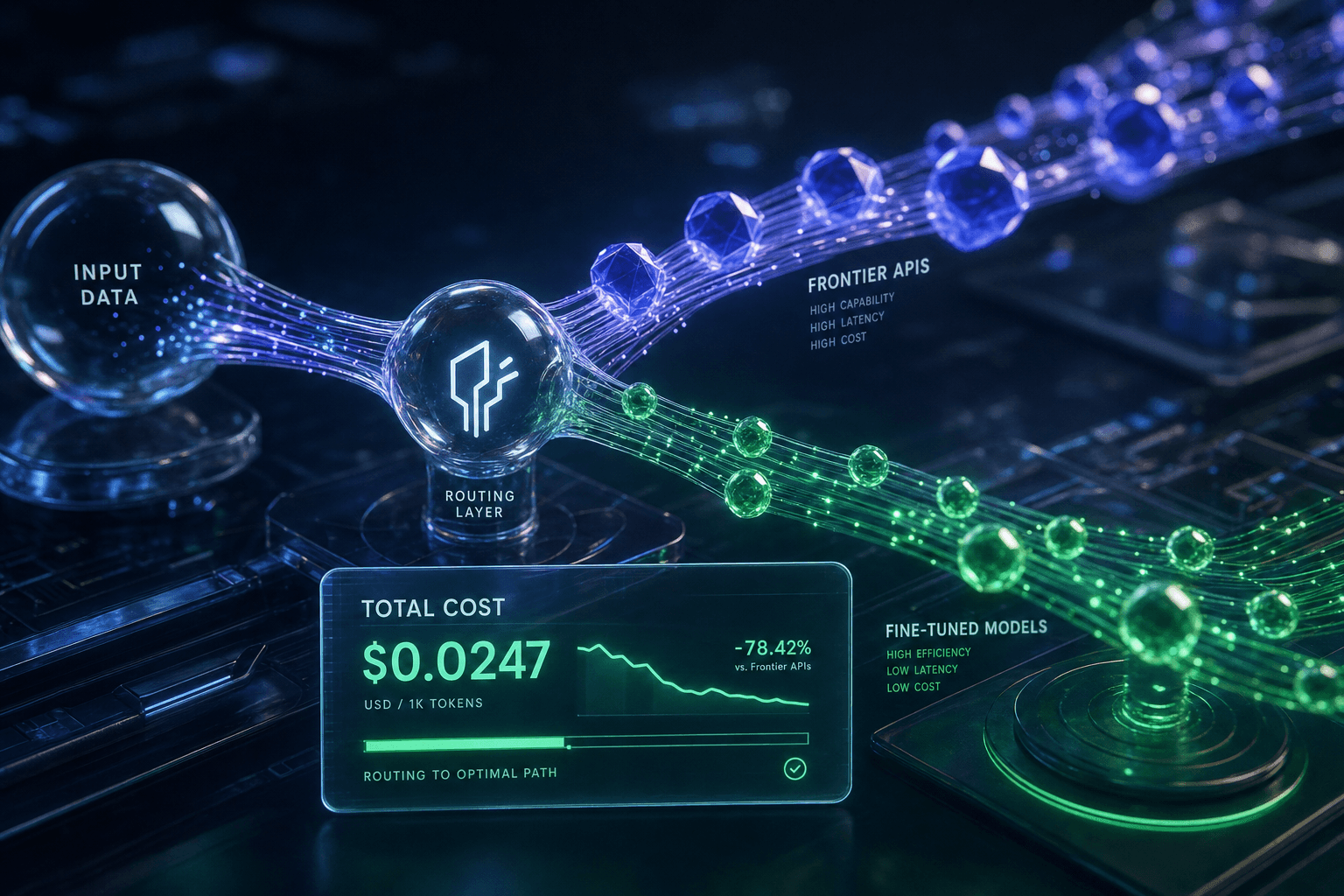
Fine-tuned 7B model handles 80-95% of standard, high-frequency requests. Route 5-20% of edge cases (ambiguous, novel, complex reasoning) to Claude/GPT-4.
Result: 60-75% cost reduction on the task vs. API-only, while maintaining accuracy floor.
Example: Support ticket routing—fine-tuned model routes 90% of tickets correctly, escalates 10% to senior team.
When fine-tuning makes business sense
Fine-tuning works only if all three of these are true:
- High-frequency calls: Minimum 50,000 requests per day (break-even point where per-token savings exceed fine-tuning overhead)
- Narrow domain & deterministic output: Single-objective classification, structured extraction, fixed format generation (not open-ended reasoning or creative writing)
- Scorable, verifiable results: Clear rule validation (regex match, database lookup), code compilation, or objective reward function enabling automated evaluation
If any one of these is missing:
- Low-frequency task? Use frontier API, no fine-tuning needed
- Broad reasoning? Frontier model still wins; fine-tuning can't inject new reasoning capability
- Ambiguous output? Hard to build automated evals; fine-tuning ROI unclear
This applies directly to
- E-commerce & marketplace ops: Catalog audits, product categorization, content moderation, fraud detection
- Financial services: Invoice classification, expense categorization, compliance screening, AML risk routing
- Customer support & CRM: Ticket routing, sentiment classification, chatbot response selection
- Supply chain & operations: Purchase order parsing, supplier risk classification, inventory forecasting
- Healthcare: Clinical note summarization (but NOT diagnosis—that's knowledge injection, which fails)
This does not apply to
- Creative content generation (open-ended reasoning, not deterministic)
- Multi-step research or planning (broad reasoning, not narrow classification)
- One-off or infrequent decisions (no cost savings on 100 calls/month)
- Tasks where performance threshold is already >95% (marginal improvements don't justify complexity)
How to build your fine-tuning infrastructure
Audit your current inference spend (cost per decision, not per token)
List all places you call GPT-4, Claude, or other frontier APIs.
For each: volume (calls/day), cost/call, accuracy, downstream rework cost.
Multiply: total daily cost = (calls/day) × (cost/call) × (1 + rework factor)
Example: 50k invoice classifications × $0.0006/call × 1.3 (rework) = $39k/day spend on ~79% effective accuracy
Identify candidates for fine-tuning (prioritize by cost-impact)
Sort use cases by daily spend.
Filter for: high frequency (>10k calls/day), deterministic output, domain-specific jargon/rules.
Rank by ROI: (annual API spend) - (fine-tuning cost) = annual savings.
Target: use cases with >$5M annual API spend (typically ROI <6 months)
Build your fine-tuning data pipeline
Collect 10k-30k labeled examples from production.
Tools: Label Studio (open-source), Scale AI (vendor), or internal annotation team.
Budget: $20-100k depending on domain (legal/finance more expensive).
Quality gate: Run inter-annotator agreement checks (target >90% consensus on 10% of data).
Red-team: Check for class imbalance (80/20 split is common failure pattern).
Choose your fine-tuning stack
Model: Mistral 7B or Qwen 3.5-9B (smaller = faster training, lower inference cost)
Method: LoRA (default) or DoRA if accuracy plateaus
Quantization: QLoRA for VRAM constraints; straight LoRA if compute is ample
Tooling: Unsloth (fastest), Axolotl (most flexible), TRL (Hugging Face standard)
Hardware: Rent H100 (spot $1.50/hr) from CoreWeave/Lambda/RunPod; expect 3-7 days of training for 30k examples
Estimated cost: $2-8k compute + $20-100k data = $22-108k total (vs. $120k API spend/day)
Build evaluation & deployment framework
Create a test set (5-10% of labeled data, held out).
Measure: accuracy, precision, recall, F1 (multi-class classification)
Compare: fine-tuned model vs. frontier API on the same test set
Deploy: ONNX (CPU, low latency), vLLM (GPU, high throughput), or quantized format
Monitor: accuracy drift over time; retrain monthly or when performance drops >2%
Implement hybrid routing architecture
Route routine requests to fine-tuned model.
For confidence score <0.75, escalate to frontier API or human review.
Log all escalations; use them as retraining data.
Measure cost-per-correct-answer for the hybrid system; compare to API-only baseline.
Cost per business outcome
Track: (fine-tuning amortized cost + inference cost) / (correct decisions + subsequent rework cost)
Not: cost per token, cost per call, or accuracy in isolation
Example dashboard: daily calls routed to fine-tuned model, % correct, escalation rate, cost/decision trend
Target: achieve 50-70% cost reduction vs. API-only within 6 months
The shift from capability to economics
In 2024-2025, the AI story was "bigger models, better reasoning." In 2026-2027, it's "smaller models, better economics."
The shift mirrors historical infrastructure patterns: cloud compute looked expensive until you factored in operational overhead; microservices looked complex until you measured time-to-market per team; monitoring looked optional until your production system broke.
Fine-tuning infrastructure is the same. The teams building cost-per-decision discipline, not just cost-per-token accounting, will outcompete those chasing headline model improvements.
The lesson transcends AI: efficiency scales from measuring the right metric.
Ready to build your fine-tuning business case? Download our LLM Fine-tuning ROI Calculator—input your daily API spend, accuracy, and estimated fine-tuning costs to see your break-even point in under 5 minutes. Or schedule a Fine-tuning Feasibility Audit where we analyze your top 3 use cases, build a proof-of-concept dataset, train a model, and benchmark it against your current API costs.
Want more on
Enterprise Architecture?
Add this topic to your Custom Digest. Drop your email to get our deepest insights on this exact topic.
Ready to fast-track your business?
We combine enterprise-level technical strategy with your existing business to solve complex blockers and accelerate your growth. Let's build something remarkable.
Partner With UsUp Next
Continue your journey into Enterprise Architecture.

Why shipping AI agents is just the beginning
Why deploying multiple AI agents without orchestration infrastructure creates coordination failures that cost more than they save.
How automated data workflows eliminate RevOps manual entry
Learn how event-driven workflow automation removes manual data entry, cuts reconciliation time, and gives RevOps teams a single source of truth.

Enterprise-owned LLMs as internal data products
How enterprise-owned LLMs cut cloud costs, protect proprietary data, and eliminate vendor lock-in through internal data products.