
Why shipping AI agents is just the beginning
Why deploying multiple AI agents without orchestration infrastructure creates coordination failures that cost more than they save.

Key Takeaways
- Orchestration infrastructure costs 10-20x more than individual agent capabilities at enterprise scale.
- Agent coordination failures create more manual work than automation removes without proper governance.
- Production-ready AI systems require durable workflows, audit trails, and role-based access controls.
- Organisations that retrofit orchestration after deployment spend years fixing compliance gaps.
By Q4 2025, 40% of enterprise software included task-specific AI agents. Yet only 23% of organisations scaled them beyond one business function. The blocker wasn't capability—it was coordination. Individual agents work brilliantly in isolation, but the moment two share workflows or data, silent failures cascade across systems.
By November 2025, 40% of enterprise software featured some form of task-specific AI agent. Yet only 23% of organizations were actually scaling agents beyond a single business function.
The reason isn't capability. It's coordination.
A global logistics firm deployed two AI agents in Q1 2026: one for inventory procurement, another for dynamic warehouse pricing. By late Q4, a data lag caused the procurement agent to misread inventory signals and over-order $2M in high-value components. The warehouse pricing agent, unaware of the inventory spike, ran clearance sales. Result: cascading losses, manual recovery, and both agents shut down.
The agents were fine. The orchestration was missing.
The market is bifurcating
Headline narratives celebrate individual agent breakthroughs—Claude API agents, GPT-4o orchestrators, custom reasoning models. Operations teams face a different problem: how to run 100+ agents across procurement, finance, HR, supply chain, and customer service without creating coordination chaos.
Gartner forecasts 150,000 agents per company by 2028 (up from 15 in 2025). Infrastructure firms like Temporal, ORAXSYS, n8n, and Mistral are raising capital specifically for "agentic orchestration platforms." 53% of enterprises cannot fully verify what their agents do across business systems.
The market gap is not model capability—it's orchestration.
Three architectural layers you need to understand
Individual agent capability
A single agent uses a base model plus tools (search API, database query, CRM action) to accomplish one narrow task. This is the "demo" phase. Agents work beautifully in isolation because there is no contention.
Your procurement agent can analyze vendor quotes and generate purchase orders flawlessly—when it's the only agent touching procurement data.
The orchestration problem
Multiple agents on shared data create silent failures:
- No shared memory: Agents duplicate work or step on each other's outputs
- Broken audit trails: Agent A calls agent B calls external tool; who owns the failure?
- N² coordination problems: One agent per workflow function creates exponential complexity
- Lost bounded autonomy: Agents exceed intended authority or operate without proper approval gates
- Access control theater: Agents see data they shouldn't, or can't access data they need
Scaling individual agents from 3 to 30 doesn't create 10x problems. It creates 100x problems.
The infrastructure layer
Real orchestration platforms layer four controls:
Durable workflows: Executions survive failures, retries, and restarts with full state preservation. Temporal-style execution means a three-day approval process doesn't lose context when a server restarts.
Control layer: Clear role definitions, least-privilege access, escalation paths to human loop when guardrails breach. Your procurement agent can approve orders under $50k without escalation; above $50k requires CFO approval.
Observability and audit: Tamper-evident logs of every decision, tool call, data access, and handoff. When something breaks at 2am, you can replay the exact sequence of agent decisions that led to failure.
Governance as code: Policies (segregation of duties, approval thresholds, data residency) enforced at runtime, not as safety guardrails. Your finance agent physically cannot access customer PII, even if prompt-injected to try.
Who this applies to
This is not theoretical. Four enterprise profiles need orchestration now:
SaaS platforms automating their own workflows at scale across sales, support, and ops. You're running 50+ agents across customer onboarding, churn prediction, support ticket routing, and revenue recognition.
Regulated enterprises where audit trails and role-based access are non-negotiable. Finance, healthcare, and insurance companies face compliance penalties for agent decisions they can't explain or attribute.
Multi-tenant systems running per-customer workflows with isolation requirements. Your B2B platform serves 500 customers; each customer's agents must never see another customer's data.
B2B2C platforms where one bad agent decision cascades across hundreds of downstream systems. Your pricing agent makes a mistake; 300 partner systems propagate incorrect data.
This does not apply to single-agent chatbots, toy prototypes, or organizations with fewer than 5 agents deployed. The inflection comes when you move from "one working agent" to "three agents sharing state." At that point, orchestration becomes the primary cost driver.
Map your agent topology first
Don't start with models. Start with the coordination graph.
List all agents you plan to run or are already running in pilot. For each agent, identify:
- Input source: What data does it read?
- Output action: What does it write or execute?
- Downstream dependency: Which other agents must coordinate with it?
- Bounded authority: What approval rules and data access limits apply?
Example matrix:
Agent Input Source Output Action Downstream Dependency Bounded Authority Procurement Vendor APIs, inventory DB Purchase orders Warehouse pricing, finance reconciliation <$50k auto-approve, >$50k CFO escalation Warehouse pricing Inventory levels, demand forecast Price updates Procurement, customer quotes Cannot discount >20% without GM approval Finance reconciliation Purchase orders, invoices Journal entries Reporting, audit trail Read-only access to HR payroll data
This exercise surfaces coordination failures before they happen. When you see that procurement and warehouse pricing both write to inventory state, you know you need transaction isolation.
Define roles and segregation of duties in code
Use industry-standard role models. Okta, Auth0, and Keycloak provide RBAC examples you can adapt.
For each agent, assign one primary role and list secondary roles it can assume. Define explicit rules: "Procurement agent can approve orders <$50k without escalation; >$50k requires CFO approval."
Encode these as policies in your orchestration layer:
- Temporal: Signal-based escalation with human-in-the-loop wait states
- n8n: Conditional branching with approval webhooks
- Custom Lua rules: Runtime policy evaluation with attribute-based access control
The procurement agent doesn't "know" it needs approval. The orchestration layer enforces it at runtime.
Choose your orchestration platform based on durability and auditability
Temporal powers Mistral and Anthropic's own workflows. Built for enterprise scale. Handles multi-second retries and long-running approvals. Strong at preserving state across failures.
ORAXSYS offers a visual workflow builder with built-in compliance logging. Good for regulated environments where audit trail generation is non-negotiable.
n8n is lightweight for SMB use cases with strong API integration. Less durable than Temporal but faster to prototype.
Mistral AI Workflows provides tight integration with Mistral APIs and strong reasoning agent coordination. Best when your agents primarily call Mistral models.
Evaluation criteria: How do you replay a failed execution? How do you audit a 10-step workflow? Can you pause for human input without losing context?
If you can't answer these questions, you don't have orchestration—you have a script.
Build your observability stack before shipping agents
Instrument every agent touchpoint: model call → tool execution → data write → escalation decision.
Store complete traces in a SIEM or centralized log store:
- Prompt sent to model
- Response received
- Tool input (API call parameters)
- Tool output (API response)
- Latency by operation
- Cost per decision
Example tech stacks:
- Datadog + OpenTelemetry
- Grafana Loki + Prometheus
- Splunk + custom forwarding
Measure:
- Agent success rate by agent and workflow
- Latency by agent and workflow
- Escalation frequency (how often do agents hit guardrails?)
- Cost per decision (model calls + tool invocations)
You cannot fix what you cannot see. When an agent fails at 2am, your observability stack should tell you exactly which tool call returned malformed data, which downstream agent choked on it, and which human needs to be paged.
Implement bounded autonomy gates
Don't let agents auto-execute high-value decisions. Gate them:
- Agent can execute <$10k spend
- $10k-$100k requires manager approval
$100k requires CFO + legal
Use structured decision trees: if revenue impact > threshold, escalate.
Log every gate: approved or rejected, by whom, rationale. Your finance agent proposes a $200k contract amendment. The orchestration layer pauses execution, sends a Slack message to the CFO with context, waits for approval, and resumes only when explicitly authorized.
This is not a safety guardrail. It's a hard stop.
Test failure scenarios before production
Red-team your orchestration:
- What happens if agent A crashes mid-workflow? Does agent B wait forever or timeout gracefully?
- What if agent A writes garbage data? Is there a rollback? A human reconciliation step?
- Can an agent exceed its authority by chaining multiple low-privilege actions?
- Can it access data it shouldn't by exploiting a tool API?
Failure testing is not optional. A procurement agent that crashes after submitting a purchase order but before recording it creates phantom inventory. A pricing agent that crashes after discounting but before notifying sales creates revenue leakage.
Your orchestration layer must handle partial failures, rollbacks, and idempotent retries.
The competitive moat shifts to infrastructure
Individual AI agent capability is table stakes. All models are converging to similar performance. The competitive moat shifts to orchestration, observability, and governance infrastructure.
Organizations that design their agent stack like a production financial trading system—complete audit trails, role-based access, disaster recovery, compliance-ready logging—will deploy 10x faster and operate at 1/10th the cost of those that retrofit governance later.
The lesson transcends AI: scale comes from removing human coordination overhead, not from removing humans.
You will spend 10-20x more on orchestration, observability, and governance infrastructure than on individual agent capabilities. Budget for it now, or pay for it later in compliance hell.
Enterprise AI infrastructure is not about building smarter agents. It's about orchestrating dumb ones reliably.
Want more on
Enterprise Architecture?
Add this topic to your Custom Digest. Drop your email to get our deepest insights on this exact topic.
Ready to fast-track your business?
We combine enterprise-level technical strategy with your existing business to solve complex blockers and accelerate your growth. Let's build something remarkable.
Partner With UsUp Next
Continue your journey into Enterprise Architecture.
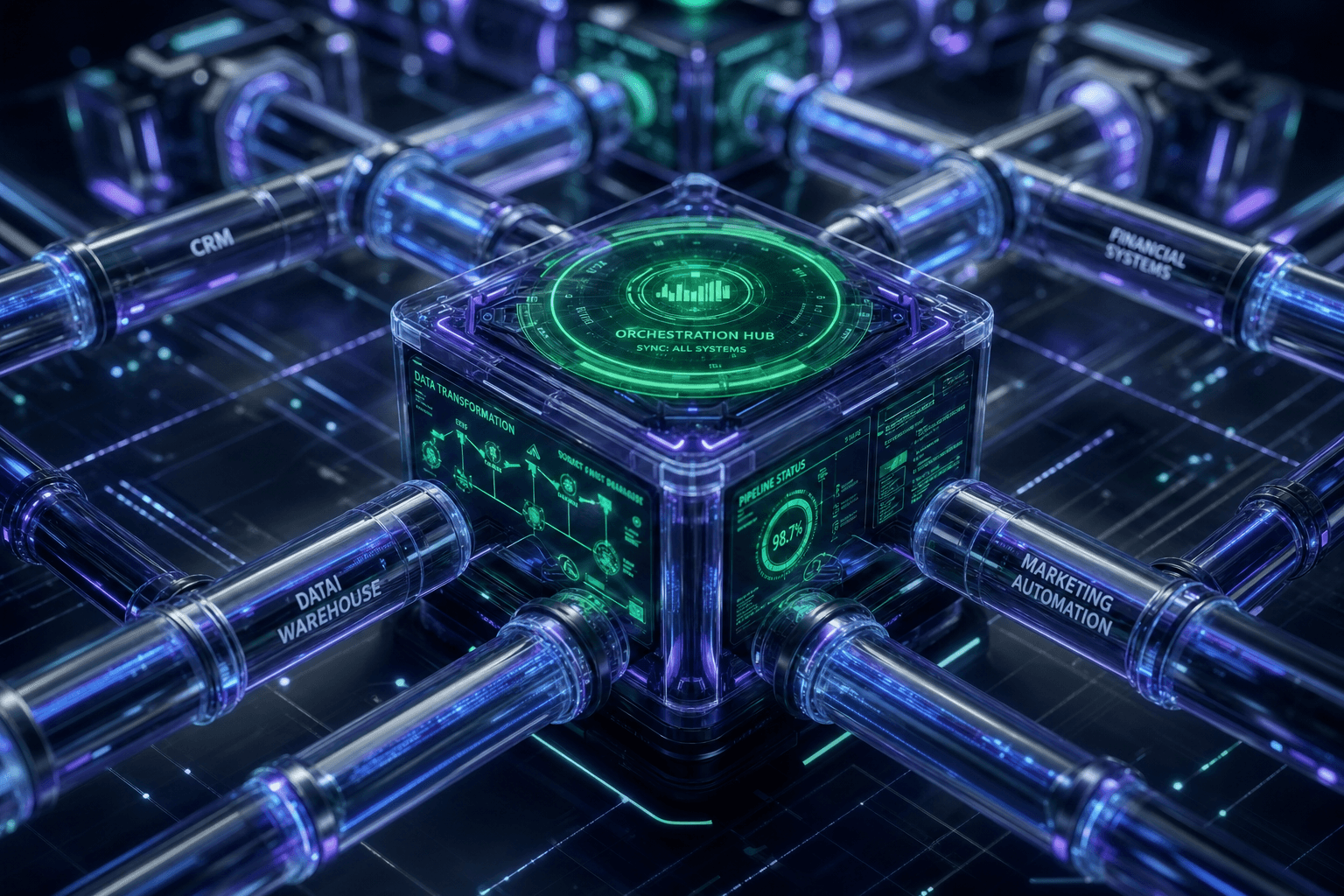
How automated data workflows eliminate RevOps manual entry
Learn how event-driven workflow automation removes manual data entry, cuts reconciliation time, and gives RevOps teams a single source of truth.

Enterprise-owned LLMs as internal data products
How enterprise-owned LLMs cut cloud costs, protect proprietary data, and eliminate vendor lock-in through internal data products.
Untitled
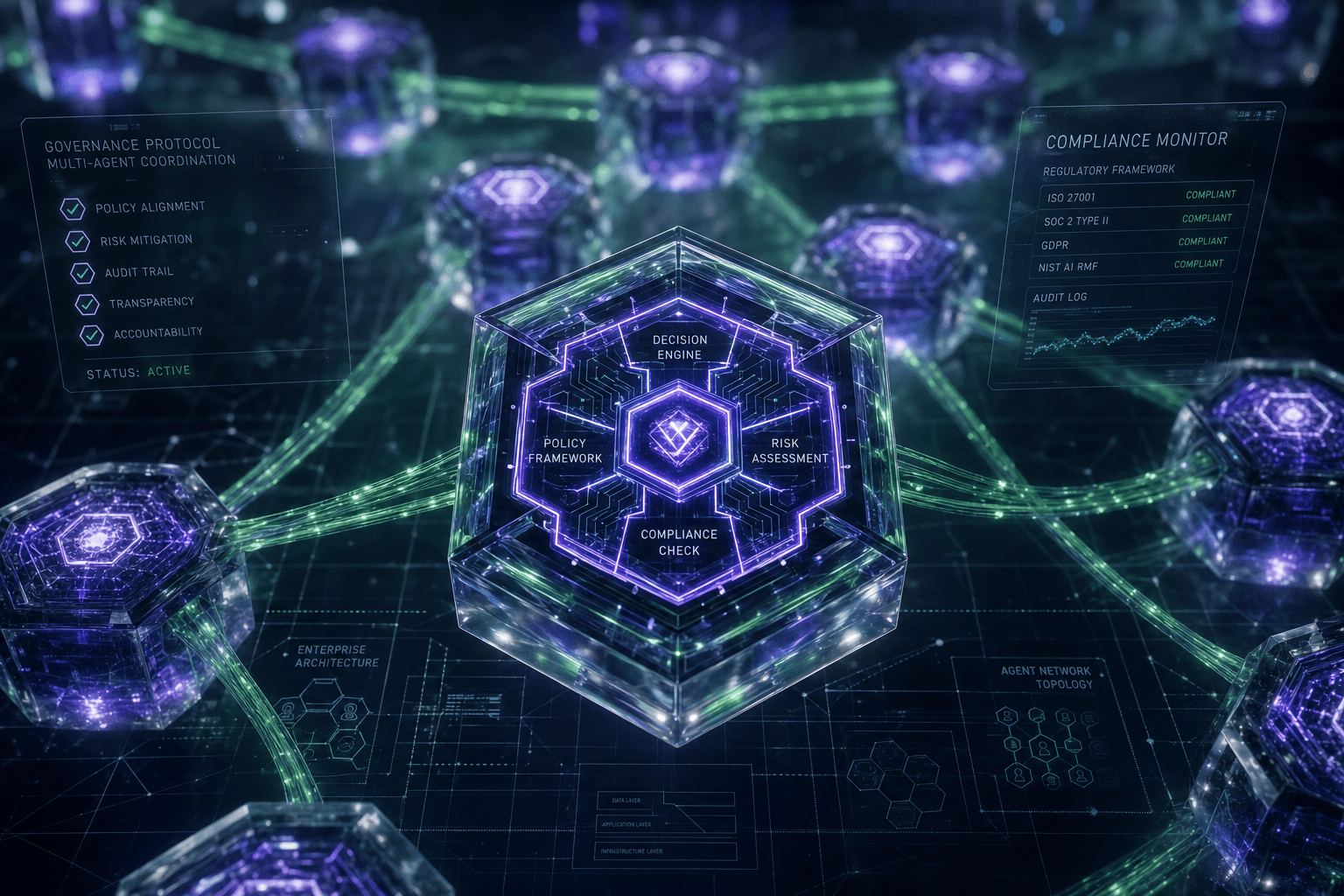
Why 98% of agentic AI pilots stay stuck: the governance architecture that separates production-ready systems from perpetual experiments.