
Application licence optimisation through unified data orchestration
How unified data orchestration cuts SaaS licence waste and turns your enterprise application stack into a profit centre.
Key Takeaways
- Enterprise application sprawl creates hidden costs through under-utilised licences and manual data reconciliation.
- Centralised data orchestration eliminates redundant workflows and provides real-time visibility into system usage.
- Automated inter-application data flows reduce manual labour costs and improve financial forecasting accuracy.
- Granular licence tracking and ROI dashboards prevent SaaS waste and protect profit margins.
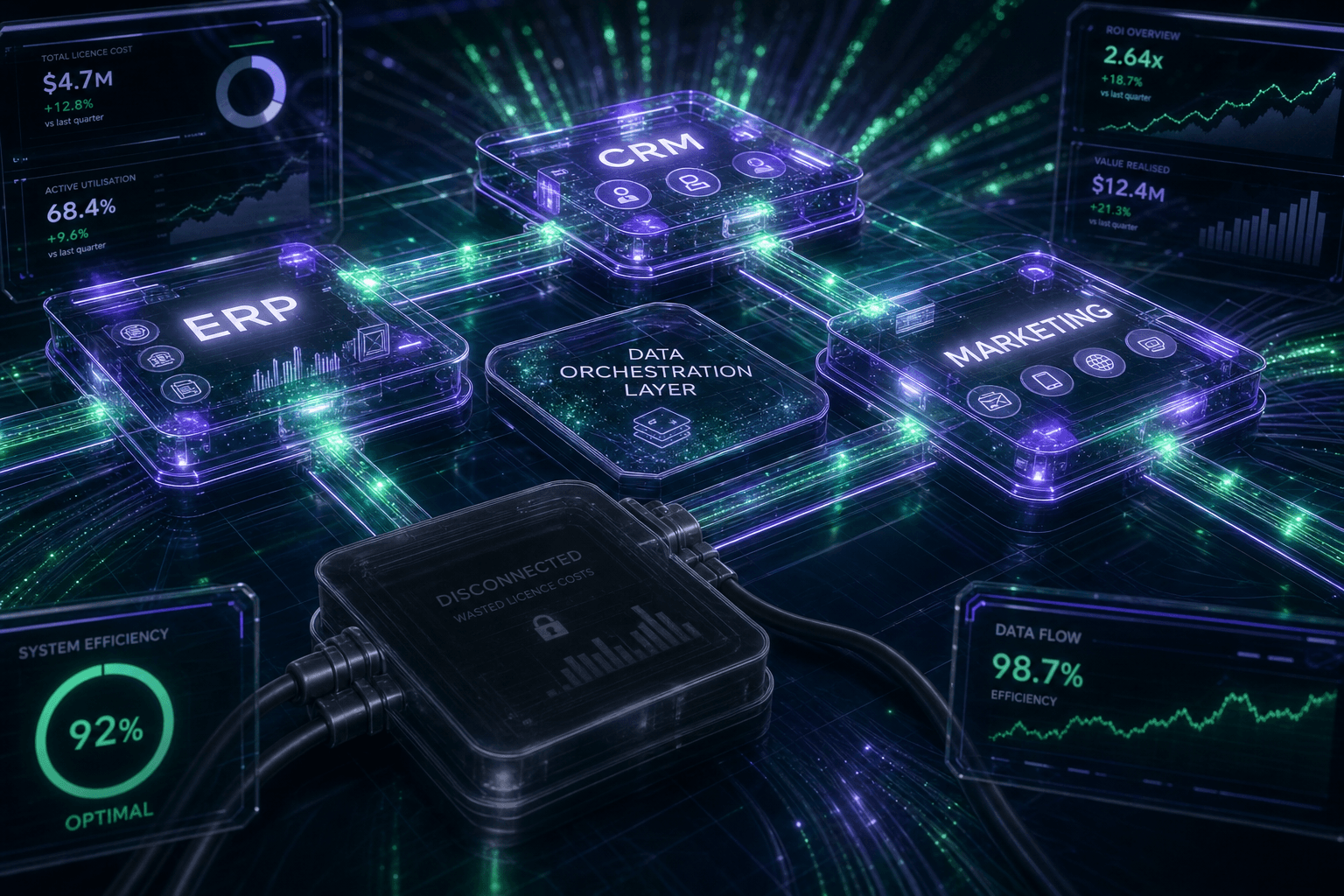
Most enterprise finance teams are paying for application licences they barely use. Manual data reconciliation across CRM, ERP, and marketing platforms creates hidden costs that erode margins and block accurate forecasting. Unified data orchestration cuts this waste by automating workflows and exposing true licence utilisation.
Your software stack is bleeding money. Not from vendor pricing increases or failed implementations, but from something far more insidious: the accumulated weight of under-utilised licences, disconnected data flows, and manual processes that scale linearly with headcount.
Finance teams know the symptoms. Marketing pays for 500 automation platform seats when 200 sit idle. Sales operations manually exports CRM data into spreadsheets because the ERP integration broke six months ago and IT deprioritised the fix. Procurement approved three different analytics tools because each department claimed the others didn't meet their needs.
The result? A phantom tax on every quarter's results. Operational expenditure that grows faster than revenue. Financial forecasting built on incomplete usage data. And a total cost of ownership calculation that makes every CFO wince.
This isn't a technology problem. It's an architecture problem masquerading as a budget problem.
The real cost of disconnected enterprise applications
Most organisations track software spend at the invoice level. They know what they pay Salesforce, SAP, and HubSpot each month. What they don't know is the operational cost of keeping those systems running in isolation.
Consider a mid-sized B2B company with standard enterprise tooling:
- CRM platform: $180,000 annually for 300 licences
- ERP system: $240,000 annually for 150 licences
- Marketing automation: $96,000 annually for 200 licences
The direct software cost hits $516,000. But the hidden costs dwarf that figure:
- Two full-time operations staff manually syncing lead data between marketing and CRM: $160,000 in loaded salary costs
- Finance team spending 40 hours per month reconciling customer data across systems: $32,000 in opportunity cost
- Sales reps wasting 6 hours per week on data entry instead of calls: $780,000 in lost productivity across a 50-person team
- Duplicate customer records creating shipping errors and service failures: unmeasured but material impact on customer lifetime value
The actual cost of that $516,000 software stack exceeds $1.4 million annually. And none of that accounts for the strategic cost: the deals lost because quote-to-cash takes three days instead of three hours, or the expansion opportunities missed because customer health data lives in three different systems with no unified view.
Why traditional integration approaches fail at scale
Most enterprises attempt to solve this through one of three approaches, all of which create more problems than they solve.
Point-to-point custom integrations connect Application A directly to Application B through custom code. This works for the first three integrations. By integration seven, you have 21 potential connection points to maintain. Each API change from a vendor breaks multiple workflows. Technical debt compounds faster than features ship.
Monolithic integration platforms promise a unified solution. In practice, they become expensive, complex, and rigid. You trade vendor lock-in with your applications for vendor lock-in with your integration platform. Customisation requires professional services. Changes take weeks to implement and test. The platform itself becomes another system to maintain, another licence to optimise, another line item to justify.
Manual workarounds emerge when integration projects stall. Someone exports a CSV daily and emails it to finance. Another person runs a weekly script that kind of works most of the time. These processes are fragile, undocumented, and completely dependent on specific people who become unfireable despite mediocre performance because they're the only ones who understand the data flow.
None of these approaches give finance teams what they actually need: real-time visibility into which applications drive value and which drain resources.
The data orchestration shift
The solution isn't better integration. It's data orchestration built on three architectural principles.
Principle 1 event-driven data flow
Stop thinking about data syncing. Start thinking about data events. When a prospect fills out a form, that's an event. When a deal closes, that's an event. When an invoice gets paid, that's an event.
An event-driven architecture means each application publishes events to a central data backbone when something meaningful happens. Other applications subscribe to relevant events and react automatically. No scheduled syncs. No batch processes. No middleware polling APIs every five minutes hoping something changed.
This approach reduces data latency from hours to seconds. It eliminates the manual reconciliation work that consumes operations teams. And it makes the data flow transparent: every event gets logged, tracked, and auditable.
Centralised data access layer
Your CRM, ERP, and marketing platforms should never talk directly to each other. Instead, they all connect to a central data access layer that owns the enterprise data model and enforces business rules.
This centralisation delivers three benefits. First, adding a new application requires one integration, not rebuilding connections to every existing system. Second, data quality rules get enforced in one place, eliminating the duplicate and conflicting records that plague distributed architectures. Third, removing an application becomes trivial, reducing switching costs and increasing vendor negotiation leverage.
Usage instrumentation as a first-class concern
Most enterprises can't answer basic questions about their application portfolio. How many marketing automation seats logged in last month? Which CRM modules actually get used? What percentage of ERP licences are active versus dormant?
A proper data orchestration layer instruments every interaction. You know exactly which users perform which actions in which systems. This transforms licence optimisation from an annual exercise in surveying department heads to a data-driven process running continuously.
When renewal time comes, you negotiate from a position of knowledge instead of vendor-provided usage reports.
The execution blueprint
Architectural principles don't reduce costs. Implementation does. Here's the tactical sequence that works.
Application audit and dependency mapping (weeks 1-3)
Build a comprehensive inventory of every enterprise application. Not just the big three, but every departmental SaaS tool, every legacy system, every shadow IT platform that somehow ended up with a corporate card attached.
For each application, document:
- Total licence count and monthly cost
- Actual active users over the last 90 days
- Data it produces, consumes, and stores
- Upstream and downstream dependencies
- Manual processes that touch its data
- Business criticality score
This audit typically reveals that 30-40% of paid licences haven't been used in the last quarter. That's your first round of immediate savings.
Orchestration layer architecture (weeks 4-6)
Design your central data backbone. The technology choice matters less than the architectural decisions. Whether you build on an iPaaS, an API gateway, a message queue, or a custom integration layer, these requirements stay constant:
- Event-driven rather than polling-based
- Versioned API contracts for each connected application
- Centralised logging and monitoring
- Automated error handling and retry logic
- Role-based access control for data flows
- Schema validation at ingestion
Start with three critical applications. Trying to integrate everything at once guarantees failure. Pick the CRM, the system that feeds it, and the system it feeds. Typically that's marketing automation → CRM → ERP.
Automated workflow implementation (weeks 7-12)
Identify the five manual processes consuming the most operational time. Automate them using your new orchestration layer.
Common high-value targets:
- Lead routing from marketing to sales
- Opportunity data flowing to finance for forecasting
- Customer onboarding data syncing across success, billing, and support systems
- Contract data moving from CRM to ERP at deal close
- Usage data flowing back from product to CRM for expansion plays
Each automated workflow eliminates hours of manual work per week and reduces data errors by an order of magnitude. More important, it makes those processes auditable and improvable.
ROI dashboard and continuous optimisation (week 13+)
Build a real-time dashboard tracking application utilisation, workflow performance, and cost per business outcome. This becomes your ongoing licence optimisation engine.
Track metrics that matter:
- Active users per application per week
- Data events processed per application
- Workflows triggered and completed
- Error rates and manual intervention frequency
- Cost per lead processed, per deal closed, per customer onboarded
Review quarterly. Cut licences that don't deliver value. Negotiate better rates armed with accurate usage data. Redirect savings toward higher-value tooling or headcount.
The measurable business outcomes
This architectural shift delivers quantifiable returns across four categories.
Direct cost reduction: Eliminating unused licences typically saves 25-35% of application spend in year one. For the example company spending $516,000 annually, that's $129,000-$180,000 in immediate savings.
Operational efficiency: Automating manual data workflows reduces operations headcount requirements. The two people syncing data manually can shift to higher-value work. Finance stops spending 40 hours monthly on reconciliation. Sales reps reclaim 6 hours weekly. Total operational savings: $800,000+ annually.
Revenue acceleration: Faster quote-to-cash cycles mean more deals close in-quarter instead of slipping. Better customer data means expansion plays get identified earlier. Quantifying this precisely requires baseline metrics, but a conservative estimate for a $50M ARR company: 2-3% revenue acceleration worth $1-1.5M annually.
Risk mitigation: Eliminating manual processes reduces errors. Centralising data access improves security posture. Auditable workflows satisfy compliance requirements. These benefits are harder to quantify but material when an audit happens or a data breach doesn't.
Total first-year financial impact: $2-2.5M on a $516,000 software investment. That's a 4-5x return before accounting for the strategic value of faster operations and better data.
The capital allocation conversation
CFOs and procurement leaders should reframe how they think about enterprise application spend. Software isn't a fixed cost. It's a portfolio of assets that require active management.
Every application should justify its existence quarterly based on usage data and business outcomes delivered. Renewals should be negotiated from a position of perfect information about actual utilisation. New tool requests should be evaluated against the total cost of integration and ongoing orchestration, not just the sticker price.
Most important: integration infrastructure is not a cost centre. It's a profit centre that compounds returns across every application in the portfolio. A $200,000 investment in proper data orchestration unlocks millions in operational efficiency and enables rapid experimentation with new tooling without accumulating integration debt.
The organisations that understand this build compounding advantages. They move faster than competitors because data flows automatically. They operate leaner because manual processes get eliminated systematically. They negotiate better because they know exactly what they use.
The organisations that don't understand this keep paying the phantom tax, quarter after quarter, wondering why their software spend grows faster than their business.
Which type of organisation are you building?
Want more on
Growth Systems?
Add this topic to your Custom Digest. Drop your email to get our deepest insights on this exact topic.
Ready to fast-track your business?
We combine enterprise-level technical strategy with your existing business to solve complex blockers and accelerate your growth. Let's build something remarkable.
Partner With UsUp Next
Continue your journey into Growth Systems.

Federated knowledge planes as modern enterprise search layers
CTOs can unify fragmented enterprise data through federated knowledge planes, cutting search time and reducing IT debt.

The growth leader's blueprint for composable content velocity
How marketing leaders build composable content systems that bypass engineering queues and accelerate campaign deployment without code.

Unifying RevOps insights with event-driven data planes
How to build an event-driven data plane that delivers real-time RevOps insights and cuts integration costs by 15%.