
Architecting the autonomous customer journey: Next.js and headless CRM for zero-latency RevOps personalisation
Learn how to connect your CRM directly to Next.js for automated, real-time customer personalisation without manual data synchronisation.
Key Takeaways
- Headless CRM and CMS architectures connected to Next.js deliver real-time personalisation without manual data synchronisation.
- Real-time customer data from your CRM powers dynamic pricing, tailored offers, and segmented content at the point of interaction.
- This architectural shift requires investment in API strategy and technical expertise, but eliminates operational friction long-term.
- RevOps teams can automate upsell, cross-sell, and retention efforts at scale by unifying systems of record with experience delivery.
RevOps leaders are wasting thousands of hours on manual data synchronisation while their competitors deliver real-time personalised customer experiences. By connecting your CRM directly to a Next.js frontend through a headless architecture, you can automate customer journeys and eliminate operational friction. This isn't about technology for technology's sake-it's about building a revenue engine that runs itself.
In 2026, analyst reports like the "Gartner Digital Experience Trends" show headless CMS and CRM integrations within Next.js deployments on platforms like Vercel are now standard.
RevOps leaders face a choice.
You can deliver hyper-personalised customer experiences at zero latency, directly informed by real-time CRM data. Or you can waste thousands of hours on manual data synchronisation and proprietary connector overhead that prevents dynamic personalisation.
Which path are you on right now?
Why Traditional Systems Can't Keep Up
Your customers expect tailored experiences at every touchpoint. That's just the reality now.
Traditional, monolithic CRM and CMS systems create layers of abstraction. They force data-stale synchronisation cycles that kill real-time personalisation.
Headless architectures change this equation. Pair them with Next.js performance and Vercel deployment efficiency, and you get an architecture where CRM customer data directly informs dynamic content delivery.
This isn't about website content anymore. You're talking personalised pricing, product recommendations, and segmented communications-all without manual intervention.
How the Architecture Actually Works
Here's what makes this pattern different:
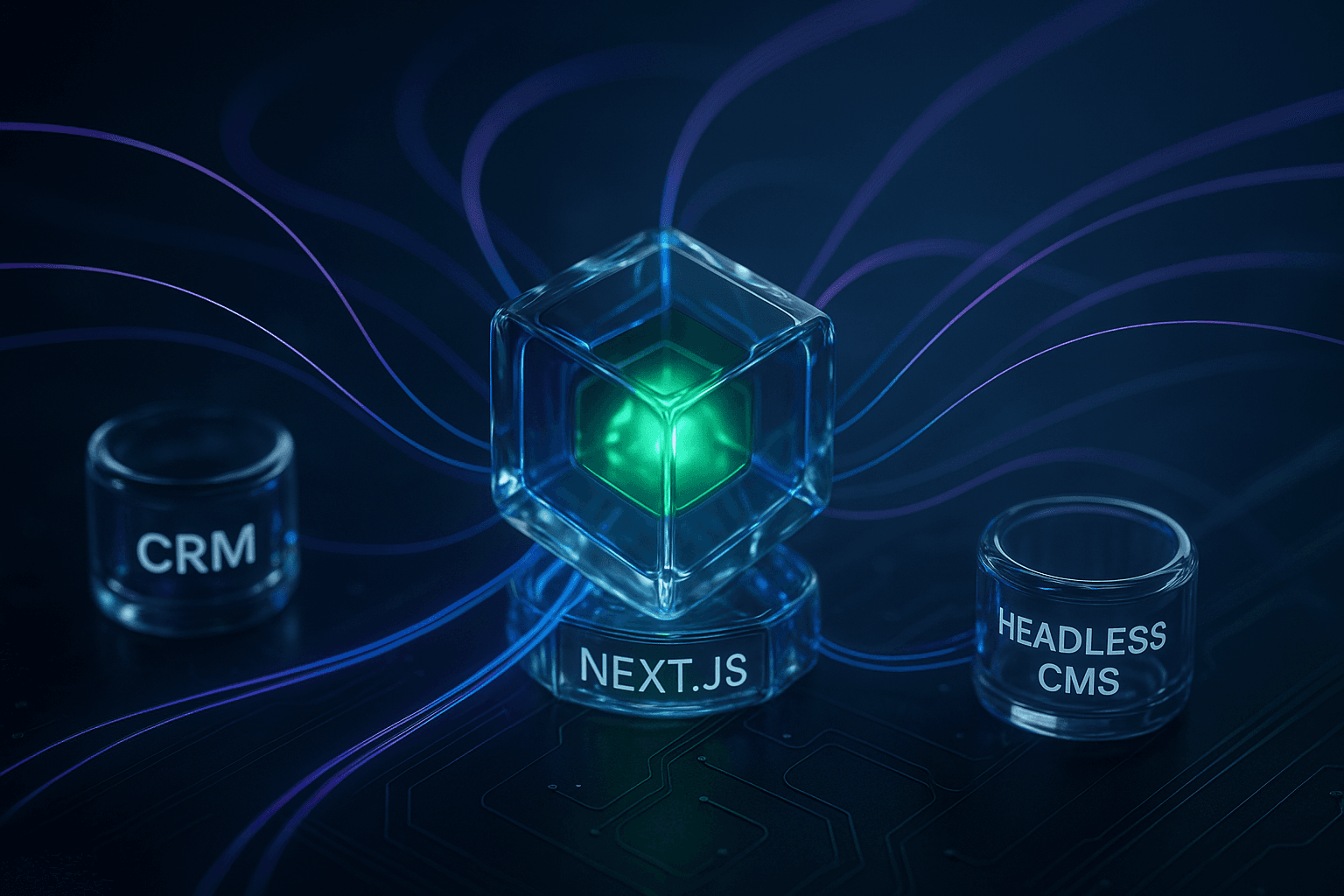
You decouple three critical layers:
- Customer data layer (CRM)
- Content management layer (headless CMS)
- Presentation layer (Next.js frontend)
A strong integration backbone-like n8n or custom API layers-maintains real-time synchronisation. Customer profiles, behavioral data, and product information flow from your CRM into the headless CMS and directly into your Next.js application at the Edge.
This powers server-side rendering (SSR) and static site generation (SSG) with dynamic data. Your users get highly personalised interfaces, content, and offers instantly. No client-side personalisation lag. No batch processing delays.
For RevOps, this means precise targeting of upsell, cross-sell, and retention efforts based on the most current customer state. Automated at scale.
What It Takes to Get There
Let's be clear about the investment required.
You're migrating from tightly coupled systems to a distributed, service-oriented architecture. Vercel simplifies deployment, but the integration logic between your CRM, headless CMS, and Next.js still needs careful design and implementation.
Your organisation needs:
- Clear understanding of data models
- Well-defined API strategy
- Teams with modern web development framework expertise
- API integration specialists (or training for existing staff)
This isn't plug-and-play. It's a foundational shift that delivers long-term efficiency.
Are your teams ready?
Three Real-World Applications
Dynamic Pricing & Offers
A B2B SaaS company pulls real-time usage data from their CRM to automatically generate personalised pricing structures. Feature upgrade offers appear directly on the customer's dashboard, rendered via Next.js. No manual updates needed.
Segmented Sales Playbooks
An enterprise sales team uses CRM data on prospect engagement and firmographics to automatically trigger specific content pathways. Their Next.js-powered sales enablement portal guides representatives to the most relevant resources and conversations in real-time.
Automated Customer Success Journeys
A financial services firm delivers highly tailored onboarding flows and educational content within their customer portal. The system reacts immediately to account changes or product usage patterns reported in the CRM. Support needs get addressed proactively. Feature adoption increases.
Building Your Autonomous Revenue Engine
This architectural shift moves you beyond reactive, human-intensive operations.
You're building an autonomous customer journey.
By connecting your systems of record (CRM) directly to your systems of experience (Next.js/Vercel frontend) through a headless content and integration layer, you architect a predictable, high-performance revenue engine.
Operational friction in delivering personalised experiences gets minimised. Your teams focus on strategic initiatives instead of data reconciliation and manual configuration.
That's marketing the right way.
Ready to Build Your Blueprint?
Need an architectural blueprint to unify your CRM, headless CMS, and Next.js frontend for autonomous personalisation?
Contact WrightyMedia for a technical consultation.
Want more on
RevOps & Strategy?
Add this topic to your Custom Digest. Drop your email to get our deepest insights on this exact topic.
Ready to fast-track your business?
We combine enterprise-level technical strategy with your existing business to solve complex blockers and accelerate your growth. Let's build something remarkable.
Partner With UsUp Next
Continue your journey into RevOps & Strategy.

Empowering marketing with headless CRM
Learn how headless CRM orchestration with Next.js transforms your marketing workflow. Build faster, personalise better, and market the right way.

Architecting sovereign CRM experiences with Next.js, headless
Build a sovereign CRM with Next.js, headless data mesh, and edge computing. Control your customer data, improve performance, and maintain compliance.

Architecting zero-cost CRM pipelines
Build a zero-cost CRM pipeline with Next.js and headless data layers. Cut licensing fees, control your data, and reduce CRM costs for your business.