
Empowering marketing with headless CRM
Learn how headless CRM orchestration with Next.js transforms your marketing workflow. Build faster, personalise better, and market the right way.

Key Takeaways
- Headless CRM architecture separates data from delivery for flexibility.
- n8n facilitates non-technical automation, reducing reliance on developers.
- Marketing teams can iterate and adapt campaigns without engineering delays.
Traditional marketing relies on rigid systems that slow down campaign execution, forcing teams to depend on engineering resources. By embracing headless CRM architecture and automation tools like n8n, marketers can regain control, streamline processes, and respond swiftly to market demands.
Your marketing team shouldn't wait for developers to ship every campaign asset. Your build queue shouldn't dictate when you can respond to market opportunities. Yet this is exactly what happens when marketing tools live in rigid, monolithic systems that require engineering intervention for every change.
The problem isn't your team. It's your architecture.
We've built dozens of enterprise systems where marketing operations run independently from engineering sprints. The pattern that works best? Headless CRM orchestration paired with Next.js front-ends and AI-powered workflow automation through n8n.
This isn't theory. This is the technical blueprint we use to remove operational friction for companies managing complex customer journeys across multiple touchpoints.
Why traditional CRM integrations create marketing bottlenecks
Most CRM implementations lock marketing data inside proprietary interfaces. When you want to build a custom landing page, trigger a personalized email sequence, or update customer segments based on behavior, you face three options:
- Wait for your development team to build it
- Use the CRM's limited native tools
- Export data manually and work in spreadsheets
None of these options scale. Your marketing velocity depends entirely on engineering bandwidth.
The root cause? Tight coupling between your data layer and your presentation layer. When your CRM dictates how you display information and what actions you can automate, you've given up control of your marketing operations.
The headless CRM approach: Separating data from delivery
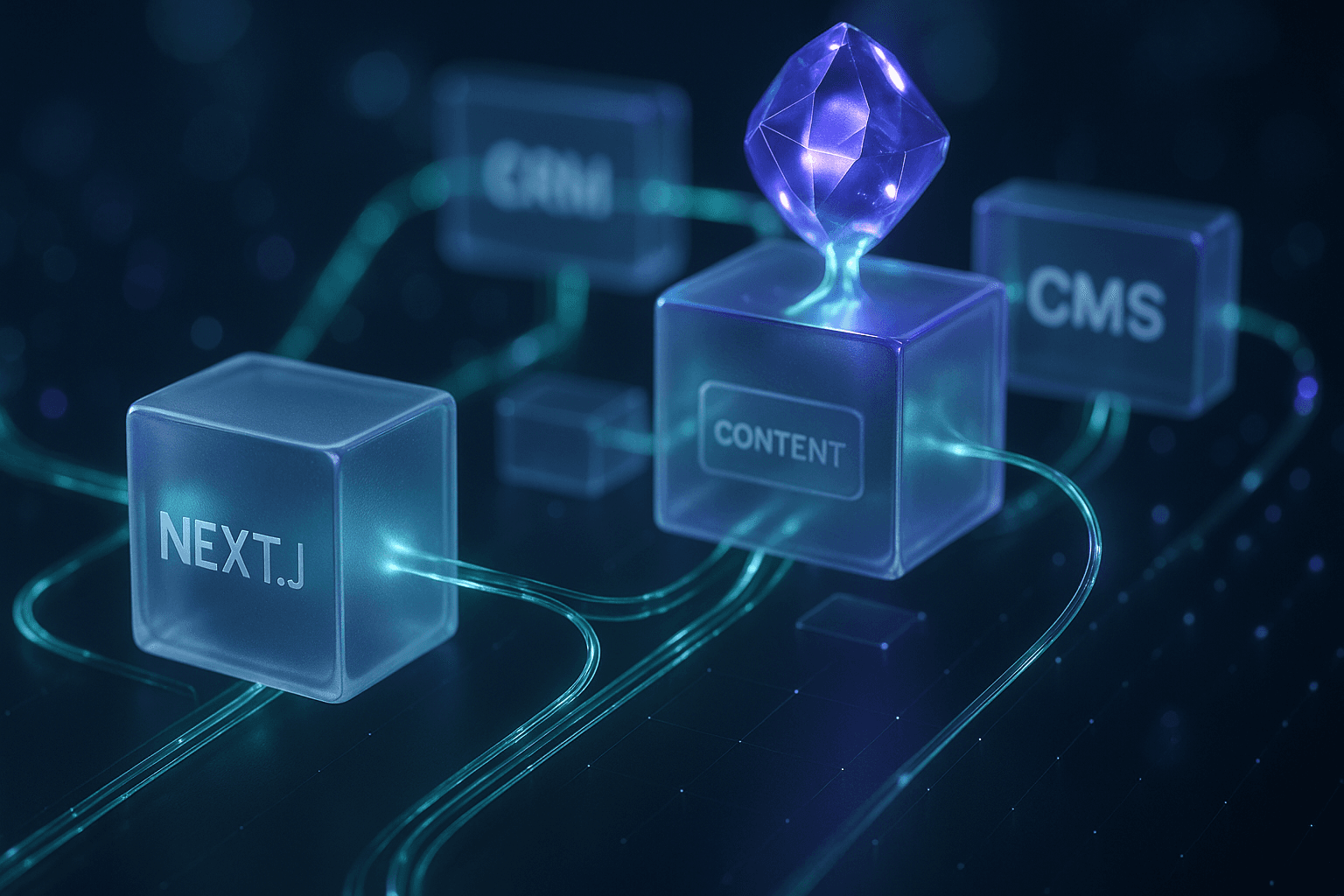
A headless CRM architecture treats your customer data as an API-first resource. Your CRM becomes a powerful database with a robust API. Everything else - your website, landing pages, email triggers, and automation logic - lives in separate, specialized systems.
Here's what this looks like in practice:
Data layer: Your CRM (HubSpot, Salesforce, or custom-built) stores all customer records, interaction history, and business logic.
Automation layer: n8n workflows connect your CRM to every other tool in your stack. These workflows handle data transformation, conditional logic, and multi-step processes without touching your production code.
Presentation layer: Next.js applications pull data from your CRM via API, render it server-side for performance, and give marketing teams full control over layout, messaging, and user experience.
Control layer: Your marketing team manages content, campaigns, and personalization rules through a headless CMS or custom admin interface built in Next.js.
This separation means marketing can iterate on campaigns, test messaging, and respond to opportunities without waiting for engineering resources.
How n8n enables non-technical marketing automation
n8n is an open-source workflow automation platform. Think of it as the connective tissue between your CRM and every other system you use.
What makes n8n different from tools like Zapier?
- Self-hosted deployment gives you complete control over data flow and security
- Custom JavaScript functions let you build complex logic without hardcoding it into your application
- Webhook triggers enable real-time responses to customer actions
- Error handling and retry logic make your automations reliable at scale
We use n8n to build workflows that would typically require custom development:
Lead scoring automation: When a prospect visits specific pages, downloads resources, or engages with email content, n8n calculates a composite score, updates the CRM record, and triggers different nurture sequences based on thresholds.
Dynamic segment management: n8n monitors CRM data changes and automatically adds or removes contacts from marketing segments based on behavior, purchase history, or engagement patterns.
Cross-platform data sync: When a customer updates their preferences on your website, n8n ensures that change propagates to your email platform, ad audiences, and support tools within seconds.
Conditional campaign triggers: n8n evaluates multiple data points from your CRM and external sources to determine which campaign variant a contact receives, when they receive it, and through which channel.
Your marketing team can build and modify these workflows through a visual interface. No pull requests. No deployment cycles. No engineering bottlenecks.
Why Next.js is the right framework for marketing-driven sites
Next.js solves the performance and flexibility problems that plague traditional CMS platforms and single-page applications.
Server-side rendering: Your pages render on the server before reaching the browser. This means faster load times, better SEO, and the ability to personalize content based on CRM data before the page loads.
Static site generation: For content that doesn't change frequently, Next.js can pre-build pages at deploy time. You get the performance of a static site with the flexibility of dynamic data.
API routes: Built-in serverless functions let you create custom endpoints for form submissions, webhook handlers, or data transformations without managing a separate backend.
Incremental static regeneration: Your marketing team can update content in a headless CMS, and Next.js will rebuild only the affected pages in the background. No full site rebuilds. No downtime.
React component architecture: Marketing pages are built from reusable components. Want to A/B test a new hero section? Swap the component. Need to add a custom calculator? Build it once, use it anywhere.
This architecture gives marketing teams the speed of a modern web app with the control of a traditional CMS.
Building a marketing operations pipeline: A technical walkthrough
Here's how we architect a complete marketing automation system using this stack:
Step 1: Design your CRM data model
Start by mapping every customer touchpoint and defining what data you need to capture. Your CRM should track:
- Contact properties (demographic, firmographic, behavioral)
- Interaction history (page views, content downloads, email engagement)
- Custom objects (deals, projects, support tickets)
- Calculated fields (lead scores, engagement metrics, lifetime value)
Build this model in your CRM first. Everything else connects to this foundation.
Step 2: Build n8n workflows for each marketing process
Create separate workflows for distinct marketing functions:
Lead intake: When a form submission hits your Next.js API route, n8n receives the webhook, validates the data, checks for duplicates in your CRM, enriches the contact with third-party data, and creates or updates the record.
Engagement tracking: Your Next.js site sends events to n8n when visitors take key actions. n8n logs these events in your CRM and evaluates whether they meet criteria for automated follow-up.
Campaign management: When your team marks a campaign as "active" in your CRM, n8n generates the appropriate audience segments, syncs them to your email platform and ad networks, and schedules follow-up workflows.
Data hygiene: Scheduled workflows run nightly to clean duplicate records, update stale data, and flag contacts that need manual review.
Each workflow should handle one job well. This makes debugging easier and prevents cascading failures.
Step 3: Build your Next.js front-end with dynamic data
Your Next.js application pulls data from your CRM at build time or request time, depending on how fresh it needs to be.
For landing pages that personalize based on UTM parameters or contact properties, use server-side rendering. For content that changes infrequently, use static generation with incremental regeneration.
Connect your Next.js app to a headless CMS (Contentful, Sanity, or a custom solution) so marketing can update copy, images, and layout without touching code.
Build reusable React components for common marketing elements: forms, hero sections, testimonials, pricing tables, and CTAs. Your marketing team can mix and match these components to create new pages without developer involvement.
Step 4: Implement testing and optimization infrastructure
Build A/B testing capability directly into your Next.js components. Store test variations in your CMS and use server-side logic to assign visitors to variants. Send test data to your analytics platform and your CRM so you can measure impact on revenue, not just clicks.
Create custom dashboards that pull data from your CRM, analytics platform, and ad networks. Your marketing team should see campaign performance, pipeline impact, and ROI in real time.
Common architectural mistakes to avoid
We've seen these patterns fail repeatedly in enterprise environments:
Over-relying on third-party iPaaS tools: Platforms like Zapier work for simple automations, but they lack the control and customization you need for complex marketing operations. You can't inspect their code, debug failures easily, or optimize for performance at scale.
Building monolithic marketing applications: When you try to solve every marketing need in one massive Next.js app, you create a new bottleneck. Break your front-end into multiple applications that each serve a specific purpose: public website, customer portal, campaign microsites.
Skipping proper error handling: Your workflows will fail. APIs will timeout. Data will be malformed. Build retry logic, error notifications, and fallback paths into every workflow. Your marketing operations shouldn't break because a third-party service had a bad day.
Ignoring data governance: When marketing can create and modify CRM records through automated workflows, you need clear rules about data ownership, validation, and audit trails. Document your data model. Implement validation at every entry point. Log every automated change.
Treating personalization as an afterthought: Server-side personalization based on CRM data is powerful, but it requires careful architecture. Plan your caching strategy, decide what data you'll fetch at build time vs. request time, and test performance under load.
Measuring the impact of marketing orchestration
This architecture shift should deliver measurable improvements in marketing performance and team velocity:
Campaign launch speed: Track how long it takes from campaign brief to live execution. Teams using this approach typically reduce launch time from weeks to days.
Developer dependency: Count how many marketing initiatives require engineering work. Your goal is to reduce this by 70-80% for standard campaigns.
Data latency: Measure the time between a customer action and your marketing response. Modern orchestration should get this down to seconds or minutes, not hours or days.
Cost per conversion: When marketing can test faster and personalize deeper, conversion rates improve. Track your cost per acquisition before and after implementation.
System reliability: Monitor workflow failure rates, API response times, and site performance. Your marketing infrastructure should be as reliable as your core product.
Who should consider this architecture
This approach makes sense for organizations with specific characteristics:
- You have a mature CRM with clean data and defined processes
- Your marketing team launches 10+ campaigns per quarter
- You need to personalize experiences based on CRM data
- Your current marketing stack requires constant developer intervention
- You have the technical resources to implement and maintain this infrastructure initially
This is not a solution for small businesses running simple lead generation campaigns. The upfront investment in architecture and automation pays off when marketing velocity and personalization become competitive advantages.
Getting started: A phased implementation approach
You don't need to rebuild your entire marketing infrastructure at once. Start with one high-value workflow:
Phase 1: Build a single n8n workflow that automates your most painful manual process. Prove the concept. Learn the platform.
Phase 2: Migrate one marketing site or campaign to Next.js. Connect it to your CRM via API. Let marketing update content through a headless CMS.
Phase 3: Expand your automation library. Build workflows for lead routing, campaign management, and data sync.
Phase 4: Develop your component library. Give marketing teams the building blocks to create new pages and campaigns independently.
Phase 5: Implement advanced personalization. Use CRM data to dynamically render content based on visitor attributes and behavior.
Each phase should deliver measurable value. If a phase doesn't improve marketing velocity or campaign performance, pause and reassess before moving forward.
Marketing operations as a competitive advantage
Your ability to execute marketing campaigns faster than competitors creates compound advantages. You can test more variations. You can personalize more touchpoints. You can respond to market changes in days instead of months.
The companies winning in competitive markets aren't necessarily the ones with bigger budgets. They're the ones with better operational infrastructure.
Headless CRM orchestration with Next.js and n8n gives your marketing team the independence they need to move fast while maintaining the data integrity and system reliability your business requires.
This is how you build marketing operations that scale with your business instead of becoming the constraint that limits growth.
If you want to build marketing systems that remove operational friction and give your team the speed they need to compete, we should talk. This is what we do.
Want more on
RevOps & Strategy?
Add this topic to your Custom Digest. Drop your email to get our deepest insights on this exact topic.
Ready to fast-track your business?
We combine enterprise-level technical strategy with your existing business to solve complex blockers and accelerate your growth. Let's build something remarkable.
Partner With UsUp Next
Continue your journey into RevOps & Strategy.

Architecting sovereign CRM experiences with Next.js, headless
Build a sovereign CRM with Next.js, headless data mesh, and edge computing. Control your customer data, improve performance, and maintain compliance.

Architecting zero-cost CRM pipelines
Build a zero-cost CRM pipeline with Next.js and headless data layers. Cut licensing fees, control your data, and reduce CRM costs for your business.
Reclaiming digital velocity: Architecting headless CRM for
Learn how headless CRM architecture with Next.js empowers marketing teams to deploy content faster, improve SEO, and drive growth without engineering delays.