
Reclaiming digital velocity: Architecting headless CRM for
Learn how headless CRM architecture with Next.js empowers marketing teams to deploy content faster, improve SEO, and drive growth without engineering delays.
Key Takeaways
- Decoupling systems eliminates operational friction.
- Empower marketing teams with independent control.
- Next.js enhances performance and SEO crucial for success.
Operational bottlenecks in your marketing stack can cripple growth. By shifting to a composable architecture, you can enable marketing autonomy, eliminate delays, and enhance your competitive edge without overloading engineering teams.
Your marketing team waits three weeks for engineering to publish a landing page. Your competitor launches theirs in three hours. Who wins that customer?
This operational friction isn't just inconvenient. It's bleeding revenue. Every delayed A/B test, every stalled content update, every postponed personalization experiment represents lost market share. The gap between your marketing strategy and execution capabilities is costing you predictable growth.
The solution isn't hiring more developers. It's rebuilding your architecture around marketing autonomy.
Why traditional CRM and CMS architectures bottleneck marketing velocity
Most enterprise marketing stacks operate as fragmented silos. Your CRM holds customer data. Your CMS manages content. Your frontend presents information. Each system speaks a different language, requiring custom middleware and constant engineering intervention.
The result? Marketing teams become perpetual ticket-filers. Want to test a new headline? Submit a ticket. Need to personalize content based on customer segment? Wait for the next sprint. Planning a seasonal campaign? Hope engineering has bandwidth.
This isn't a people problem. It's an architecture problem.
Monolithic CMS platforms couple content management with presentation logic. Change a button color? You're touching the same codebase that powers your checkout flow. This coupling forces every content update through engineering review, QA cycles, and deployment pipelines designed for application code, not marketing copy.
Your CRM contains rich behavioral and demographic data, but accessing it for real-time personalization requires backend development. The technical debt accumulates. The competitive gap widens.
The composable architecture model: Decoupling systems for independent velocity
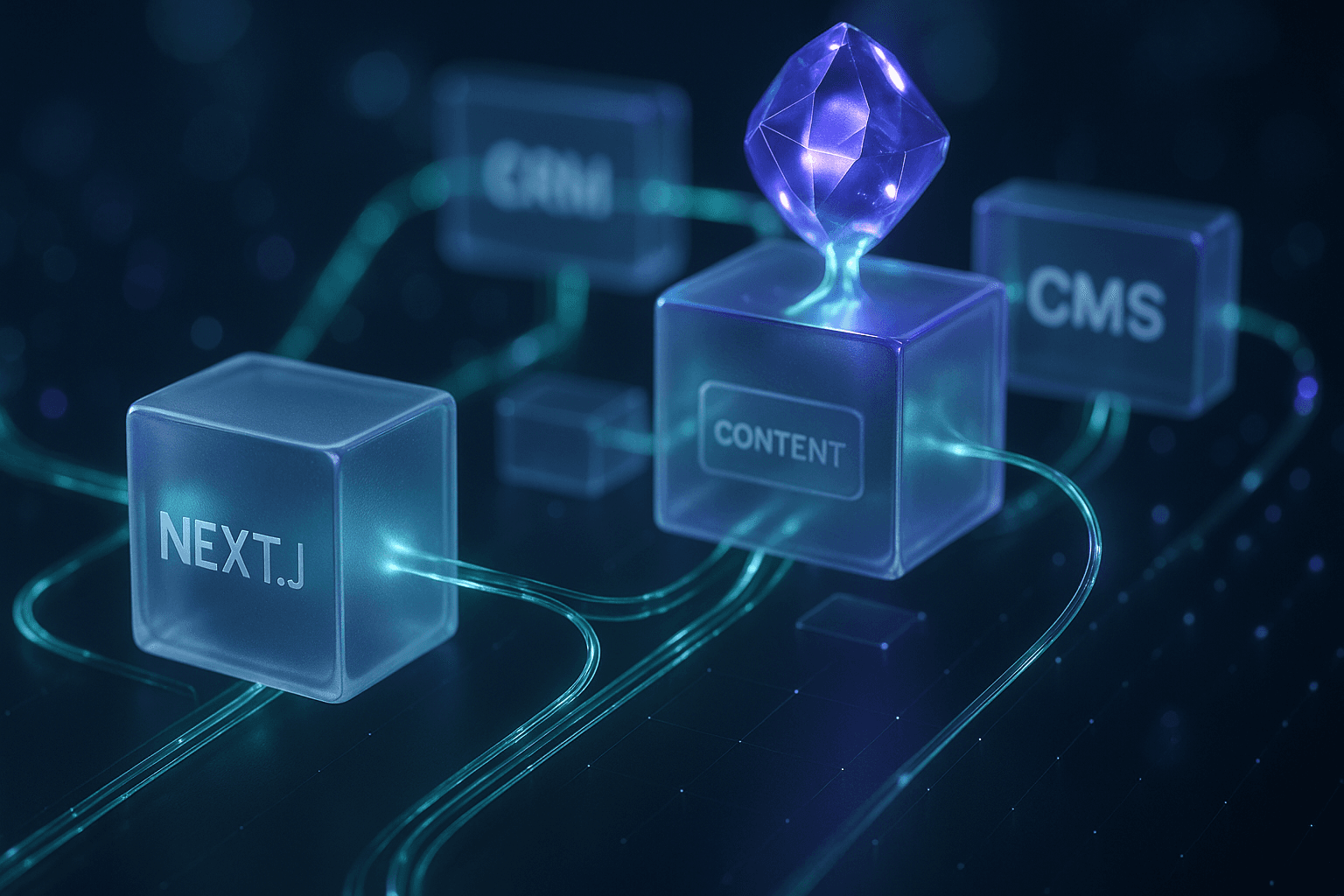
A headless architecture separates concerns by design. Your CRM manages customer data through APIs. Your headless CMS stores and delivers content through APIs. Your Next.js frontend consumes both through clean integration layers.
This decoupling creates operational independence. Marketing controls content. Engineering maintains infrastructure. Customer data flows bidirectionally without deployment friction.
Here's the technical foundation:
Frontend layer: Next.js for performance and flexibility
Next.js provides server-side rendering and static generation, delivering superior Largest Contentful Paint (LCP) scores. Fast LCP directly impacts SEO rankings and conversion rates. Google's Core Web Vitals aren't recommendations - they're ranking factors.
The framework's API routes enable lightweight backend logic without spinning up separate services. Need to validate a form submission against CRM data? Write an API route. Want to generate personalized content server-side based on user segment? Build it directly in your Next.js application.
Incremental Static Regeneration (ISR) lets you statically generate pages at build time, then update them on-demand. Your most trafficked pages load instantly. Your long-tail content regenerates when accessed. You get static site performance with dynamic site flexibility.
Content layer: Headless CMS for marketing autonomy
A best-of-breed headless CMS (Contentful, Sanity, Strapi) separates content creation from presentation. Marketing teams work in familiar interfaces - rich text editors, media libraries, content models - without touching code.
Content models define structure. You create reusable components: hero sections, testimonial blocks, feature grids. Marketing assembles pages from these components like building blocks. No HTML knowledge required. No deployment pipeline needed.
The CMS exposes content through GraphQL or REST APIs. Your Next.js frontend fetches content at build time or runtime. Change a headline in the CMS? The Next.js site reflects it within seconds through webhook-triggered rebuilds or ISR.
This architecture enables:
- Landing page creation without engineering tickets
- Real-time content updates without deployments
- A/B test variants managed directly by marketing
- Multi-regional content localization from a single interface
Data layer: CRM integration for personalization at scale
Your CRM (Salesforce, HubSpot, custom system) becomes a data source, not a bottleneck. APIs expose customer segments, behavioral triggers, and account properties.
Integration platforms like n8n or custom middleware connect your CRM to your content delivery pipeline. When a customer visits your site, your Next.js application queries their CRM profile through API routes. Based on their segment - enterprise vs. SMB, industry vertical, lifecycle stage - you serve tailored content.
This happens server-side. No client-side JavaScript fetching sensitive data. No flash of generic content before personalization loads. Just fast, personalized experiences from the first paint.
The technical workflow:
- User requests a page
- Next.js API route identifies the user (session, cookie, UTM parameter)
- API route queries CRM for user segment data
- API route queries headless CMS for content variants matching that segment
- Server renders personalized HTML
- Client receives fully formed, personalized page in milliseconds
Architectural patterns for common marketing use cases
Rapid landing page deployment for seasonal campaigns
Your Q4 campaign launches in 48 hours. Your current process: design mockups, create ticket, wait for engineering sprint, build page, QA, deploy. Timeline: 2-3 weeks.
With headless architecture:
- Marketing creates landing page in CMS using pre-built components
- Sets publish date and UTM tracking parameters
- Webhook triggers Next.js rebuild
- Page goes live in minutes
No engineering involvement. No deployment pipeline. No missed launch dates.
The SEO benefit compounds. Each landing page targets specific long-tail keywords. Faster deployment means more topical coverage, more indexed pages, more organic entry points.
Real-time personalization without code deployments
A financial services client wanted to show different mortgage rates based on user location and credit score estimates (derived from CRM data). Their legacy system required backend code changes for each new personalization rule.
Headless architecture solution:
- CRM stores customer segment (location, estimated credit tier)
- Headless CMS stores content variants (premium rates, standard rates, subprime guidance)
- n8n automation watches CRM updates and syncs segment changes
- Next.js API route matches user to segment and fetches appropriate content
- Marketing controls which content serves to which segment via CMS interface
Result: Marketing iterates on personalization strategies daily. Conversion rates improved 34% over six months through continuous testing and optimization.
Global content localization with centralized governance
Managing content across regions in a monolithic CMS means duplicating entire page structures or building complex conditional logic. Updates require touching multiple codebases. Consistency suffers.
Headless CMS platforms support localization natively. You define content once. Create translations as variants. Reference shared assets (images, videos). Marketing in each region controls their copy while technical structure remains centralized.
Next.js dynamic routing handles locale-specific URLs automatically. Your frontend detects user locale (header, cookie, geolocation) and fetches the appropriate content variant.
One architecture. One codebase. Dozens of markets. Consistent performance and SEO across all regions.
A/B testing velocity for continuous optimization
Your legacy system requires engineering to set up A/B tests. You run one test per quarter if you're lucky. You're optimizing blind.
With headless architecture:
- Create content variants in CMS (Variant A: aggressive headline, Variant B: educational headline)
- Configure test parameters (traffic split, success metrics) in your experimentation tool
- Next.js serves appropriate variant based on test assignment
- Results flow into analytics platform
- Marketing adjusts strategy based on data, creates new tests
You move from quarterly optimization to weekly iteration. Compound improvements stack. Your conversion rates climb while competitors remain static.
Implementation considerations: Planning for architectural transition
This isn't a weekend project. Successful implementation requires strategic planning across several dimensions.
Tool selection and integration strategy
Choose your headless CMS based on your content complexity and team workflows. Contentful excels at structured content and complex relationships. Sanity offers powerful customization and real-time collaboration. Strapi provides open-source flexibility for custom requirements.
Your CRM integration approach depends on API maturity and data volume. High-volume personalization benefits from Redis caching layers. Complex customer journeys need robust webhook infrastructure. Plan your data flow before building.
Next.js deployment options range from Vercel (simplest, tightly integrated) to self-hosted Kubernetes clusters (maximum control, higher operational overhead). Choose based on your existing infrastructure capabilities and compliance requirements.
Content migration and governance
Migrating content from legacy systems requires content modeling before migration. Define your component library. Map old content structures to new models. Write migration scripts. Validate data integrity.
Establish governance early. Who approves content models? How do regional teams request new components? What's the workflow for publishing changes? Clear processes prevent architectural drift.
Team training and capability development
Your marketing team needs training on headless CMS workflows. These tools are powerful but different from traditional page builders. Invest in enablement. Create documentation. Build internal component libraries with clear usage guidelines.
Your engineering team shifts from content deployment to platform maintenance. They build components, optimize performance, monitor infrastructure. This is higher-leverage work than updating button copy.
Phased rollout for risk mitigation
Don't rebuild everything simultaneously. Start with high-impact, lower-risk pages. Landing pages are ideal first candidates. They're contained, high-volume, and marketing-controlled by nature.
Prove the model. Measure velocity improvements. Document marketing autonomy gains. Then expand to product pages, blog infrastructure, and eventually core site pages.
Run parallel systems during transition. Your old CMS continues serving existing pages while new pages deploy on headless architecture. Gradual migration reduces risk and maintains business continuity.
The operational transformation: From bottleneck to growth engine
The technical architecture enables a fundamental shift in how marketing operates. Instead of planning campaigns around engineering capacity, you plan based on market opportunity.
Your website transforms from a static brochure requiring constant IT support into a dynamic, always-optimizing growth platform controlled by the teams closest to customer needs.
Marketing velocity compounds. Each A/B test informs the next. Each personalization experiment builds on previous learnings. Your site becomes smarter, faster, more effective without expanding headcount.
The SEO advantages multiply. More pages indexed. Faster load times. Better user signals. More topical authority. Your organic traffic grows while paid acquisition costs stabilize.
Your competitors still wait for engineering sprints. You ship daily.
Moving from planning to execution
This architectural model isn't theoretical. It's how modern enterprises are building competitive advantage through marketing agility.
The question isn't whether to adopt composable architecture. It's how quickly you can execute the transition before your market position erodes.
Your first step is assessing your current state. Map your content workflows. Identify bottlenecks. Quantify the cost of slow deployment. Calculate the opportunity cost of delayed experiments.
Then architect your target state. Select your headless CMS. Design your integration patterns. Plan your Next.js infrastructure. Define your migration roadmap.
The technical complexity is manageable with the right expertise. The business impact is measurable. The competitive advantage is real.
If you're ready to rebuild your marketing infrastructure for velocity and autonomy, contact WrightyMedia for a technical consultation. We'll assess your current architecture, design your composable stack, and build the implementation roadmap that turns marketing from a cost center into a revenue engine.
Want more on
RevOps & Strategy?
Add this topic to your Custom Digest. Drop your email to get our deepest insights on this exact topic.
Ready to fast-track your business?
We combine enterprise-level technical strategy with your existing business to solve complex blockers and accelerate your growth. Let's build something remarkable.
Partner With UsUp Next
Continue your journey into RevOps & Strategy.

Empowering marketing with headless CRM
Learn how headless CRM orchestration with Next.js transforms your marketing workflow. Build faster, personalise better, and market the right way.

Architecting sovereign CRM experiences with Next.js, headless
Build a sovereign CRM with Next.js, headless data mesh, and edge computing. Control your customer data, improve performance, and maintain compliance.

Architecting zero-cost CRM pipelines
Build a zero-cost CRM pipeline with Next.js and headless data layers. Cut licensing fees, control your data, and reduce CRM costs for your business.