
How marketers actually get cited by AI search
How to get your brand cited in ChatGPT and Perplexity answers using extractable content, structured data, and citation tracking.
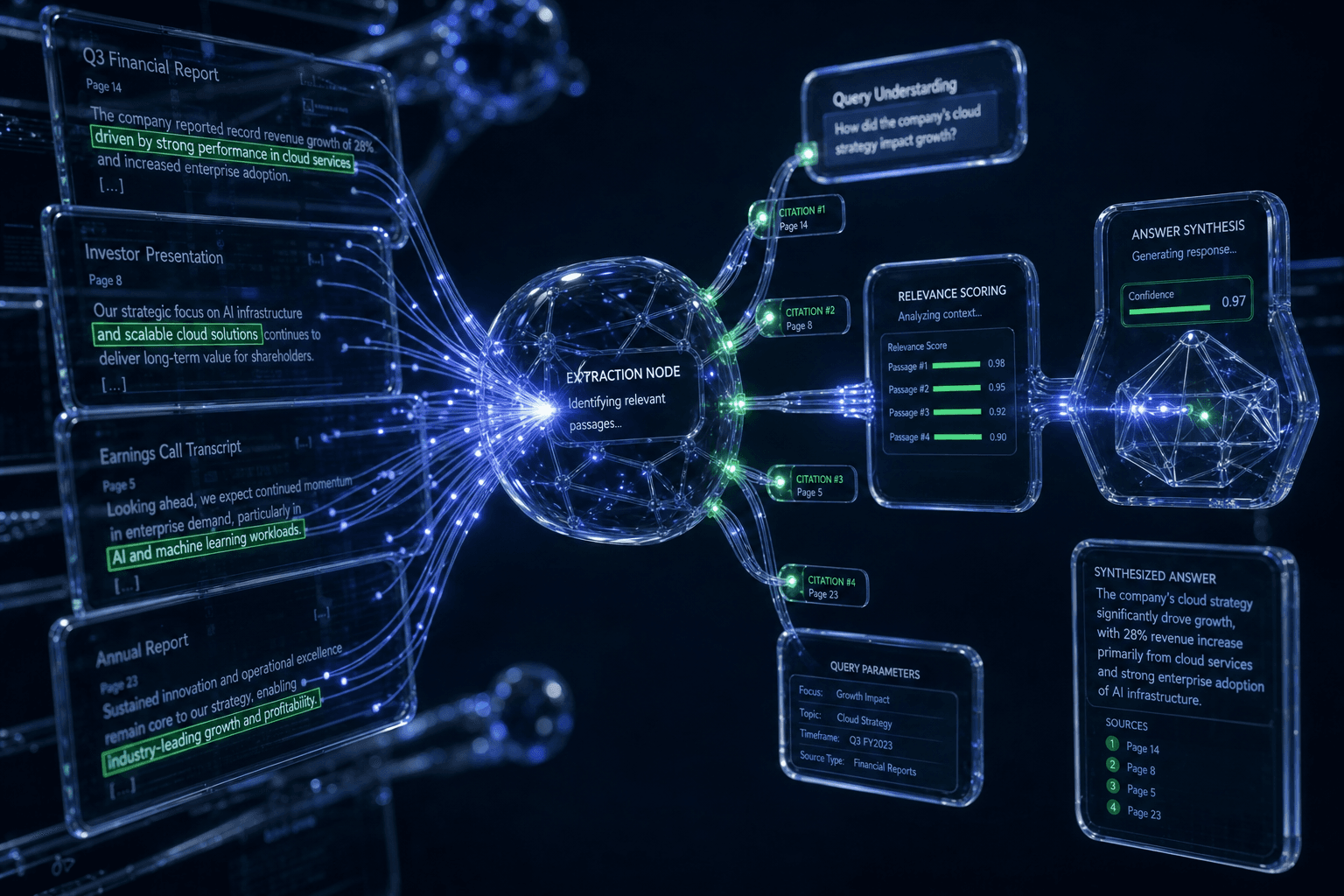
Key Takeaways
- AI answer engines extract and quote the clearest answer, not the page with the most backlinks.
- Structured data tells crawlers exactly what your content is and who wrote it.
- IndexNow pushes updates to AI crawlers faster than waiting for the next scheduled visit.
- Bing's free AI Performance report shows which queries cite you and which don't.
AI search engines don't rank pages for humans to click. They extract answers from a handful of sources and cite the clearest, most structured content. That shifts the entire optimisation game from keywords and backlinks to extractability and structural markup.
AI answer engines don't rank pages anymore. They quote them.
ChatGPT, Perplexity, and Copilot extract the best answer from a handful of candidate pages and serve it directly. There's no click-through. No page two. No list of blue links.
That breaks the foundational assumption of traditional SEO: keyword density, backlink authority, and dwell time all optimized for a human clicking through search results. Answer Engine Optimization (AEO) demands something different: extractability and structural clarity.
We discovered this the hard way. After analyzing our own site through Bing Webmaster Tools' AI Performance report, we found a 10K-50K citation opportunity cluster sitting inside our existing topic authority. The gap wasn't traffic or rankings. It was that AI engines couldn't cleanly extract our answers.
This week, we ran the exact process outlined below on our own properties. Fixed broken meta descriptions. Added missing Article structured data. Set up IndexNow for real-time crawl notification. The difference wasn't subtle.
Here's the roadmap we used, written as a repeatable loop your team can run.
Audit for extractability, not readability
Most content is written for humans to read top-to-bottom. AI engines don't read that way. They scan for discrete, self-contained answers they can lift and quote.
Open your highest-traffic pages. Look at the first three paragraphs. Can an AI extract a clear, complete answer without reading the full article? If the real point is buried under context-setting, scene-painting, or vague value propositions, it won't get cited.
Run this test:
- Does the introduction state the answer in one declarative sentence?
- Are key claims supported by specific numbers, timeframes, or named entities?
- Can a single paragraph stand alone as a quoted source?
If not, restructure. Move the answer higher. Break complex ideas into short, punchy sentences. One claim per sentence. No hedging language.
We found eight blog posts on our own site where the actual answer didn't appear until paragraph five. AI engines weren't citing us because they couldn't find what we were saying.
Add structured data (the highest-leverage fix)
Structured data is the clearest signal a crawler gets about what your page actually is, who wrote it, and when it was published.
Most marketing sites are missing it completely.
This week, we audited our own blog and found zero Article schema markup. No FAQ schema. No HowTo schema. We were asking AI engines to guess what our content represented.
Add schema.org markup for:
- Article (headline, author, datePublished, dateModified, publisher)
- FAQ (question/answer pairs that can be extracted as discrete snippets)
- HowTo (step-by-step guides with named steps and tools)
Google's Structured Data Markup Helper and schema.org documentation make this straightforward. If you're on WordPress, Yoast or RankMath can generate it automatically.
The impact is immediate. AI engines can now parse your content type, authorship, and recency without inferring it from page layout or prose style.
Fix sitemap and crawl hygiene, then use indexnow
AI crawlers re-index more aggressively than traditional search. That means a stale index costs you visibility faster than it used to.
Most brands aren't notifying crawlers when content changes.
IndexNow is a free protocol supported by Bing, Yandex, and a growing list of search engines. When you publish or update a page, you ping the IndexNow endpoint. The crawler re-indexes within minutes, not days.
We set this up on our own sites this week:
- Generate an IndexNow API key (a simple text string)
- Host the key file at your domain root
- Configure your CMS or deployment pipeline to POST the updated URL to the IndexNow endpoint on every publish
If you're on WordPress, the IndexNow plugin handles this automatically. If you're on a headless CMS or static generator, add the POST request to your build script.
Then fix your XML sitemap. Remove 404s. Remove redirects. Remove pages with noindex tags. AI crawlers treat your sitemap as the canonical list of what matters on your site.
Write answers the way you want them quoted
AI engines prefer short declarative sentences with specific, named entities.
Compare these two sentences:
- "Our approach helps brands improve their visibility in AI-driven search environments through a combination of technical and content strategies."
- "Brands get cited in AI search by adding structured data, fixing crawl hygiene, and writing extractable answers."
The second sentence is quotable. It names three concrete actions. It uses active verbs. It doesn't hedge.
Rewrite your content with this lens:
- Use numbers, percentages, and timeframes wherever possible
- Name specific tools, frameworks, or standards
- Keep sentences under 25 words
- Front-load the claim, then support it
We rewrote the introductions of twelve articles this week using this structure. The goal wasn't readability. It was extractability.
Measure citations, not rankings
Most marketers are still tracking keyword rankings and organic traffic. Those metrics don't capture whether you're being cited inside AI answers.
Bing Webmaster Tools offers a free AI Performance report that shows:
- Total citation volume (how many times your site was quoted in AI answers)
- Top cited pages (which URLs are being extracted most often)
- Gap queries (questions where you rank but aren't cited, or questions where competitors are cited instead)
This is the single most useful AEO diagnostic tool available today. Google Search Console doesn't offer an equivalent yet.
We used this report to identify our 10K-50K citation opportunity cluster. It showed us exactly which queries we were losing to competitors, and which pages needed structural fixes.
Set up Bing Webmaster Tools if you haven't. Import your Google Search Console property to speed up verification. Check the AI Performance tab weekly.
Treat this as a loop, not a project
AI answer engines are still changing how they select sources. The citation criteria that work today may shift in six months.
That means AEO isn't a one-time optimization project. It's a continuous loop:
- Audit existing content for extractability
- Fix structured data and crawl hygiene
- Notify crawlers with IndexNow
- Rewrite answers for quotability
- Measure citation volume and gaps
- Repeat
We're running this loop monthly on our own properties. The first pass took two days. Subsequent audits take under an hour.
The brands that treat AEO as an ongoing discipline will own the citation layer. The ones that treat it as a checklist will watch competitors get quoted instead.
Where does your brand stand in AI search right now?
Most marketing leaders don't know if their content is being cited in AI answers. They're optimizing for a search paradigm that's already shifting.
We'll audit your brand's current AEO performance using the exact process outlined above: extractability review, structured data gaps, citation volume analysis, and competitive gap mapping.
No hype. No generic recommendations. Just a clear-eyed breakdown of where you stand and what needs fixing.
Get in touch if you want the audit.
Want more on
Marketing?
Add this topic to your Custom Digest. Drop your email to get our deepest insights on this exact topic.
Ready to fast-track your business?
We combine enterprise-level technical strategy with your existing business to solve complex blockers and accelerate your growth. Let's build something remarkable.
Partner With UsUp Next
Continue your journey into Marketing.
Validating AI reasoning for business logic
Build transparent AI systems that trace every decision back to your business rules, closing the auditability gap that blocks enterprise adoption.
Composable content data planes as marketing velocity
Learn how composable content data planes let marketing teams deploy campaigns and optimise SEO without waiting for developers.
Stop pipeline leaks with automated data flows
Learn how automated data flows stop pipeline leaks, cut manual work, and give RevOps teams clean, reliable data for faster sales cycles.