
Validating AI reasoning for business logic
Build transparent AI systems that trace every decision back to your business rules, closing the auditability gap that blocks enterprise adoption.
Key Takeaways
- Without transparent validation, AI remains a black box that blocks enterprise adoption and magnifies compliance risk.
- Hybrid systems that combine symbolic logic with statistical models make AI decisions traceable and auditable at runtime.
- Codifying business rules into machine-readable formats creates an enforcement layer that flags deviations before they reach production.
- Verifiable reasoning transforms AI from a liability into an auditable asset that reduces oversight costs and accelerates regulatory approval.
AI decisions in enterprise operations carry real risk when you can't trace how they were made. Most systems still function as black boxes, leaving CTOs unable to verify that outputs align with business rules or compliance requirements. The gap between AI capability and organisational trust comes down to one missing piece: verifiable reasoning you can audit.
Why AI audit trails matter more than model accuracy
You're evaluating AI to automate complex business workflows—credit approvals, supplier risk scoring, claims adjudication. The models perform well in testing. But when you ask your engineering team how the system arrived at a specific decision, you get a shrug.
That's the problem. High model accuracy means nothing if you can't prove why a decision was made when regulators, auditors, or legal teams come asking. The black box problem isn't just a philosophical concern. It's a liability that blocks enterprise AI adoption.
Without transparent validation mechanisms tied directly to your business logic, you're deploying systems you can't defend. That risk compounds when AI touches sensitive data, regulated processes, or high-stakes financial decisions. CTOs who can't answer "why did the AI do that?" will watch their AI initiatives stall in committee.
The gap isn't just technical—it's architectural. Most AI pipelines focus on inference speed and model performance. Auditability and business rule validation are afterthoughts, bolted on through manual review or superficial logging. This approach doesn't scale and doesn't satisfy compliance requirements.
The shift from monitoring outputs to validating reasoning
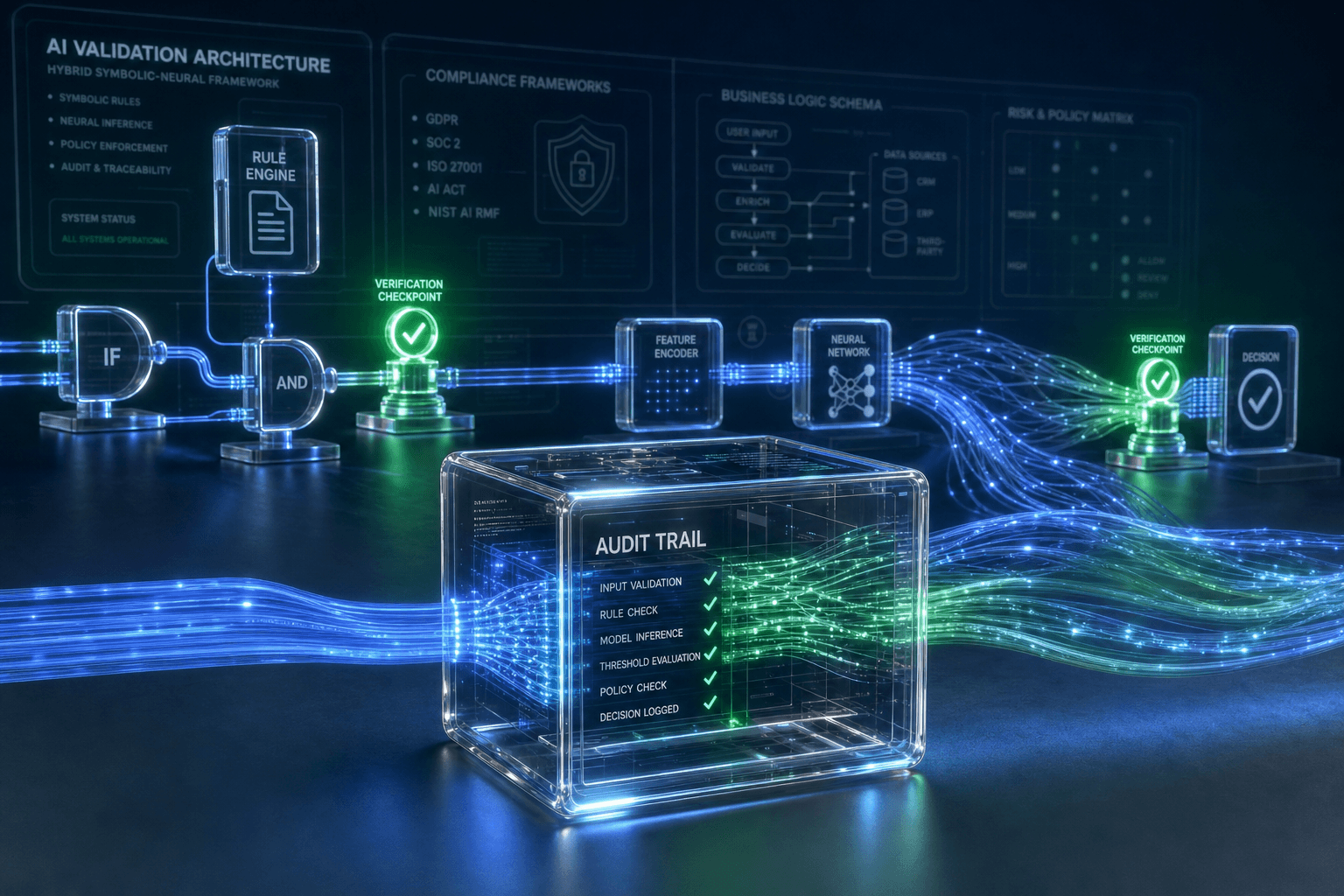
The solution requires rethinking how AI integrates with your business logic layer. Instead of treating the model as a standalone black box, you need hybrid systems where AI outputs are automatically cross-checked against codified business rules at runtime.
This means moving from pure statistical models to architectures that combine:
- Symbolic AI components that encode explicit business logic, regulatory constraints, and domain knowledge in machine-readable formats
- Formal verification layers that validate model outputs against these rules before they trigger downstream actions
- Provenance logging that captures the complete chain of reasoning—which data points influenced the decision, which rules were applied, and where human judgment overrode the model
This isn't about making models more interpretable through post-hoc explanation tools. It's about building validation directly into the inference pipeline. If your AI recommends rejecting a loan application, the system should automatically log which credit policy rules were triggered, which data points fell outside acceptable thresholds, and which regulatory requirements were satisfied.
The architectural benefit: you control the validation layer. That reduces vendor lock-in and gives you the ability to swap models without rebuilding your entire governance framework. The business logic and audit requirements remain stable even as the underlying AI evolves.
Building verifiable AI pipelines in three stages
Codify your business logic
Start by extracting every critical business rule, compliance requirement, and operational policy from spreadsheets, tribal knowledge, and policy documents. Convert these into a structured, machine-readable format.
The best approaches:
- Knowledge graphs that model relationships between entities, rules, and regulatory requirements
- Declarative policy engines (like Open Policy Agent or similar frameworks) that separate business logic from application code
- Domain-specific languages that let subject matter experts define rules without writing code
This step is tedious. It requires collaboration between legal, compliance, operations, and engineering. But without this foundation, you're building AI on quicksand. The investment in codifying business logic pays off across the entire enterprise, not just for AI validation.
Architect explainability into the pipeline
Design your AI inference pipeline with logging and traceability as first-class concerns, not afterthoughts.
Key components:
- Decision provenance tracking: For every inference, log the input data, the model version, the specific features that influenced the prediction, and the confidence score
- Rule engine integration: Route model outputs through a validation layer that applies your codified business logic before any action is taken
- Exception handling: When AI outputs conflict with business rules, flag the discrepancy, escalate to human review, and log the resolution
This architecture creates an audit trail that satisfies regulatory requirements without slowing down your operations. If an auditor asks why a specific decision was made six months ago, you can reconstruct the entire reasoning chain from logs.
The technical investment here is moderate. Most enterprises already run rule engines for other purposes. The challenge is integration—ensuring the AI pipeline talks to the validation layer in real time without introducing unacceptable latency.
Implement continuous validation
Once your business logic is codified and your pipeline is instrumented, deploy a continuous validation framework that monitors AI behavior against expected patterns.
This includes:
- Automated regression testing that runs codified business rules against historical decisions to detect drift
- Anomaly detection on the validation layer itself, flagging cases where AI outputs increasingly deviate from established logic
- Governance dashboards that give risk and compliance teams visibility into AI decision patterns, rule violations, and human override rates
Continuous validation transforms AI from a "deploy and hope" system into a managed, auditable asset. When model behavior changes—due to concept drift, data quality issues, or updates—you detect it before it creates liability.
Risk reduction and faster AI adoption
This approach delivers measurable business outcomes:
Regulatory defensibility: When you can produce a complete audit trail showing that every AI decision complied with relevant regulations and internal policies, you reduce legal exposure and pass audits faster.
Lower oversight costs: Automated validation reduces the need for manual review of AI outputs. Subject matter experts shift from checking every decision to reviewing exceptions and refining rules.
Accelerated deployment: Stakeholders trust AI systems they can audit. By addressing the black box problem at the architecture level, you remove the biggest blocker to executive buy-in and speed up rollout timelines.
Better valuation: Enterprises with auditable AI systems are less risky investments. That matters for acquisition, funding, and strategic partnerships. Transparent, governed AI is a competitive differentiator when customers and partners evaluate vendors.
The technical complexity is real. Integrating symbolic reasoning with statistical models, maintaining rule consistency across updates, and instrumenting pipelines for auditability all require engineering investment. But the alternative—deploying AI you can't defend—creates existential risk in regulated industries.
If you're building AI for enterprise operations, start with the validation layer. Codify your business logic, instrument your pipelines, and treat auditability as a core requirement, not a nice-to-have feature. That's how you move from experimental AI projects to production systems that drive real operational leverage.
Want more on
AI Engineering?
Add this topic to your Custom Digest. Drop your email to get our deepest insights on this exact topic.
Ready to fast-track your business?
We combine enterprise-level technical strategy with your existing business to solve complex blockers and accelerate your growth. Let's build something remarkable.
Partner With UsUp Next
Continue your journey into AI Engineering.
Cutting developer lock-in for AI-driven marketing
How marketing teams cut AI deployment cycles by 60% and break free from engineering dependencies.

Why generic AI systems fail revenue operations data
Why off-the-shelf AI systems fail at RevOps data quality and what custom-trained models deliver instead.

Where LLM hallucinations indicate architectural debt
LLM hallucinations reveal system-level architectural flaws that block enterprise AI adoption and waste engineering resources.