
Moving enterprise agentic AI from pilot to production
Why 98% of agentic AI pilots stay stuck: the governance architecture that separates production-ready systems from perpetual experiments.
Key Takeaways
- Forty per cent of enterprise applications are integrating AI agents in 2026, but only 2% have reached full-scale production.
- The blocker is not model capability but governance and coordination architecture built into the agent runtime from the start.
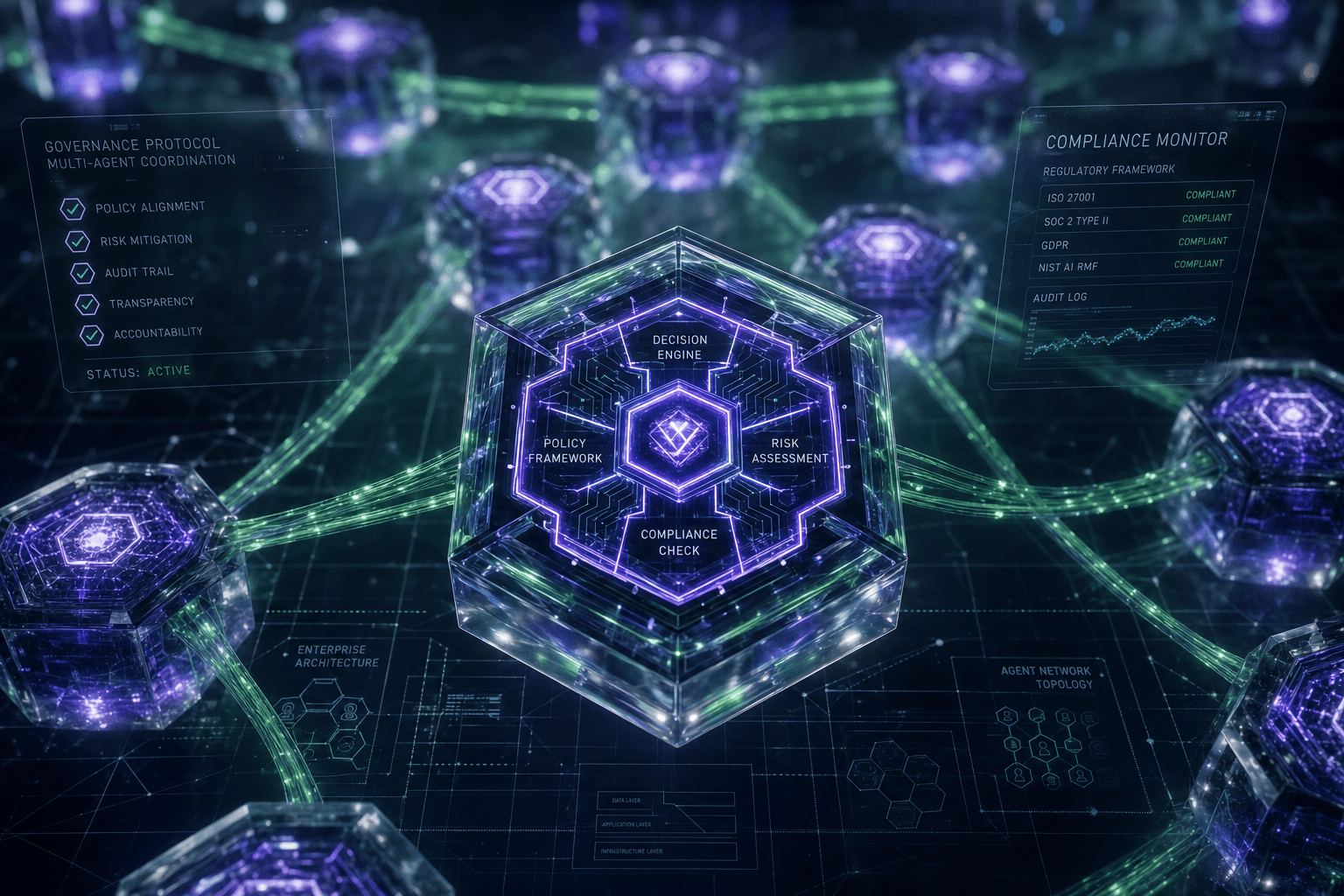
- Production-grade agentic systems require bounded decision authorities, multi-agent orchestration, real-time enterprise data grounding, and immutable audit trails.
- Teams that embed governance as infrastructure, not compliance overhead, scale agents ten times faster than those retrofitting governance after deployment.
Most enterprise agentic AI pilots never reach production. The blocker isn't the models or the infrastructure—it's governance. The 2% of enterprises scaling agents right now built decision boundaries, multi-agent coordination, and compliance checking into the architecture before deploying a single agent.
Google Cloud's State of Infrastructure report surveyed 1,402 IT leaders in October 2026 and found 83% say their infrastructure requires upgrades to support production-grade agentic AI. But the real story is hidden in the unspoken question: "What does production-grade actually mean?"
For the 98% of enterprises still in pilot, it means agents running in sandbox environments, touching non-critical workflows, logged for auditability but not governed for autonomy. For the 2% at scale—JPMorgan's COiL (Contract Intelligence and Learning), Accenture's service delivery automation, Goldman's research synthesis—it means something different: agents operating within explicitly bounded decision authorities, coordinating across specialized agent teams, grounded in real-time enterprise data, and every single action traced for compliance.
The teams scaling agentic AI faster are not those with bigger models. They're those who decided governance is not a compliance checkbox at the end—it's the architectural foundation from day one.
The bottleneck blocking production deployment
Agentic AI adoption hit the messy middle in Q4 2026. The easy wins (email drafting, document summarization) are done. Now enterprises want agents to touch real systems: adjust inventory, approve exceptions, route customer issues, recommend pricing, execute trades. That requires trust, and trust requires transparency.
The problem: traditional IT infrastructure assumes humans-in-the-loop for every sensitive decision. Agentic systems promise to eliminate that loop—agents make decisions and execute them directly. Enterprise IT can't retrofit governance onto agents after they ship. Every decision boundary, approval workflow, escalation path, and audit trail must be architected into the runtime from day one.
This is why 98% of agentic AI pilots are still in pilot. Teams ran agents on non-critical workloads, saw cost savings, and then hit the wall: "How do we let agents touch production systems? What happens if an agent makes a bad decision? Who is liable?" Governance architecture answers those questions before agents start running, not after.
Infrastructure pressure is rising. Agentic AI doesn't just mean one agent—it means multi-agent swarms. Specialized agents (fulfillment agent, compliance agent, pricing agent, escalation agent) coordinate autonomously. A single workflow can trigger hundreds or thousands of agent-to-agent calls, each issuing queries. Infrastructure built for human-rate traffic (queries per second) collapses under agent-rate traffic (queries per decision). The teams scaling agents also scaled their orchestration layer, observability layer, and governance enforcement layer in parallel.
Four concepts that separate pilot from production
Design decision authorities before agents run
You need a graduated authority model:
Tier 1 (Routine, low-risk): Agents execute immediately, log after
- Example: Categorize incoming customer email into existing buckets
Tier 2 (Medium-risk): Agents decide, trigger notification, human can override within SLA
- Example: Adjust inventory reorder points within ±5% of current
Tier 3 (High-stakes): Agent prepares decision, human approves before execution
- Example: Approve customer refund over $5K
Design decision boundaries before agents start. Adding boundaries post-hoc creates inconsistent agent behavior and audit nightmares.
Ground agents in real enterprise data
Agents reason better with data. Agents reason dangerously without it.
Grounding means connecting agents to: CRM, ERP, policy repositories, knowledge bases, real-time operational data. Without grounding, an agent runs in a vacuum and generates confident-sounding but incorrect decisions that compound at scale.
The architecture: Agent queries enterprise data layer → enriches context → makes decision. Hallucinations drop by 95%+ when agents have verified data instead of training data alone.
Agents need to work together
A single monolithic agent trying to handle all workflows is inefficient. Better model: Specialized agents (customer service agent, fulfillment agent, compliance agent) + coordinator agent managing handoffs.
The advantage: Modular architecture scales. Need a new capability? Deploy a new specialized agent instead of retraining a monolith.
The challenge: Agents need shared memory, coordination signals, and the ability to route work between each other. This is orchestration architecture.
Every decision must be traceable
Compliance teams require: Why was this decision made? What data was used? Which rules were applied?
Governance agents are specialized agents whose job is to continuously monitor other AI systems for policy violations, bias, anomalous behavior, and rule drift.
Audit trail requirement: Every decision must be loggable with reasoning chain intact. "Agent X decided Y because [data inputs] + [rules applied] at [timestamp]"
The risk: Without explainability, one bad agent decision with no audit trail is a compliance violation and a lawsuit.
Who needs governance-first architecture now
This applies to:
- Enterprise teams (50+ people in IT/operations) with 5+ workflow automation initiatives
- Companies with agent pilots that succeeded but governance questions blocked production rollout
- Organizations needing to comply with SOX, GDPR, HIPAA, or other regulatory frameworks (agents can't hide behind "black box" excuses)
- Teams managing customer-facing AI decisions (anything that affects revenue, SLA, or customer trust)
This does NOT apply to:
- Internal-only agents handling low-risk tasks (markdown to HTML converter, log summarizer, internal documentation bot)
- Startups or fast-moving teams where governance overhead would kill iteration speed
- Single-person teams or research labs where "one person decides what the agent does" is sufficient
Your transition window: Organizations have 12-18 months before agentic AI governance becomes table stakes. Enterprises deploying agents without governance architecture will be blocked by compliance, liable for bad agent decisions, and unable to scale multi-agent swarms. Teams that build governance-first now will have an 18-month head start.
Your production deployment blueprint
Define agent decision authorities (week 1-2)
Step 1: Map current workflows that might benefit from agents:
Workflow: Customer Refund Request
├─ Current process: Human reviews, decides approve/deny, executes
├─ Time: 2 hours per request
└─ Volume: 100/week
Step 2: Design graduated authority for each workflow:
Decision Authority Matrix
┌──────────────────┬──────────────────┬────────────────────┐
│ Decision Type    │ Tier             │ Authority          │
├──────────────────┼──────────────────┼────────────────────┤
│ Refund <$100     │ Routine          │ Agent executes     │
│ Refund $100-1K   │ Medium           │ Notify, 4hr window │
│ Refund >$1K      │ High-stakes      │ Agent proposes,    │
│                  │                  │ human approves     │
└──────────────────┴──────────────────┴────────────────────┘
Step 3: Enforce in code—agent runtime checks decision tier before executing:
@decisionauthority(tier="routine", maxvalue=100)
def approverefund(customerid, refund_amount):
    # This function only executes if refund_amount <= $100
    # Agent logs decision; no human required
    # Audit trail: [timestamp, agent_id, decision, reason]

@decisionauthority(tier="highstakes", requires_approval=True)
def approverefundlarge(customerid, refundamount):
    # This function requires human approval before execution
    # Agent prepares decision; human approves in UI
Build agent context layer — grounding in enterprise data (week 3-4)
Step 1: Audit data sources agent needs to make good decisions:
Agent: Refund Approval Decision
Needs: Customer history, refund policy, account status, fraud flags
Sources:
├─ CRM: Customer account, purchase history, churn risk
├─ ERP: Inventory, refund policy by product, SLA by customer tier
├─ Fraud system: Chargeback history, account age, payment method
└─ Real-time: Current balance, outstanding disputes
Step 2: Build agent context retrieval layer (call this pre-decision):
# Before agent makes refund decision, retrieve context
context = retrieve_context(
    customerid=customerid,
    sources=["crm", "erp", "fraud_system"]
)

# Agent now reasons with verified data, not training data
decision = agent.decide_refund(
    customerid=customerid,
    refund_amount=amount,
    context=context
)
Step 3: Measure hallucination rate before/after grounding:
- Before: Agent reasoning in a vacuum
- After: Agent reasoning with enterprise data
- Target: 95%+ reduction in conflicting or nonsensical decisions
Design multi-agent orchestration and coordination (week 5-6)
Step 1: Identify specialized agent teams:
Workflow: Complex customer issue resolution
├─ Customer Service Agent: Categorize issue, pull customer context
├─ Fulfillment Agent: Check inventory, assess delivery options
├─ Compliance Agent: Check regulations for solution type
├─ Pricing Agent: Calculate discount/credit if needed
└─ Escalation Agent: Route to human if no path found
Step 2: Design coordinator agent to orchestrate handoffs:
class OrchestrationAgent:
    def handlecustomerissue(self, issue):
        # Step 1: Customer Service Agent characterizes the issue
        categorized = self.customerserviceagent.categorize(issue)

        # Step 2: Branch based on issue type
        if categorized.type == "refund":
            decision = self.refund_agent.decide(categorized)
        elif categorized.type == "replacement":
            decision = self.fulfillmentagent.checkinventory(categorized)

        # Step 3: Compliance check on proposed solution
        if decision.impacts_regulation:
            approved = self.compliance_agent.validate(decision)

        # Step 4: Execute or escalate
        return self.executeorescalate(decision, approved)
Step 3: Build shared context store so agents can pass data between each other:
# Shared state that all agents can read/write
shared_context = {
    "customerid": "CUST123",
    "issue_type": "refund",
    "customer_tier": "premium",
    "resolution_attempts": 0,
    "audit_trail": [],
}
# Each agent adds to audit_trail; traces full decision chain
Implement governance agent — continuous monitoring (week 7-8)
Step 1: Deploy governance agent whose job is to watch other agents:
class GovernanceAgent:
    def monitor_decisions(self, decision):
        # Check 1: Is decision within authority bounds?
        if decision.amount > decision.authority_limit:
            self.escalate("Authority violation", decision)

        # Check 2: Any policy violations?
        violations = self.check_policies(decision)
        if violations:
            self.escalate("Policy violation", decision, violations)

        # Check 3: Unusual patterns? (e.g., agent approving 100% of refunds)
        anomalies = self.detectanomalies(decision, historicalbaseline)
        if anomalies:
            self.alert("Anomalous behavior", decision, anomalies)

        # Check 4: Explainability requirement met?
        if not decision.reasoning_chain:
            self.reject("No audit trail")
Step 2: Set monitoring rules by domain:
Governance Rules:
  - Rule: "Refund approvals > $1K require manager approval"
    Agent: governance_agent
    Check: "If decision.type == refund AND decision.amount > 1000 AND decision.approval_level < manager"
    Action: "Escalate"

  - Rule: "Refund approval rate should not exceed 40% historically"
    Agent: governance_agent
    Check: "If agent.approval_rate > 40%"
    Action: "Alert + Investigate"
Build audit and explainability infrastructure (week 9-10)
Step 1: Implement immutable decision log:
decision_log = {
    "timestamp": "2026-10-29T14:32:00Z",
    "agent_id": "refund-decision-agent-v2.1",
    "decision": "Approve",
    "decision_tier": "routine",
    "inputs": {
        "customerid": "CUST123",
        "refund_amount": 75.00,
        "context": {...}
    },
    "reasoning_chain": [
        "Step 1: Customer found in CRM",
        "Step 2: No fraud flags",
        "Step 3: Amount < $100 threshold",
        "Step 4: Decision = Approve (routine)"
    ],
    "approval_chain": [],
    "execution_status": "executed",
    "rollback_available": true
}
Step 2: Build compliance dashboard showing:
- Agent decision volume by tier and authority level
- Approval rates by agent and decision type
- Escalation reasons and frequency
- Anomalies detected by governance agent
- Full audit trail for any decision (single query)
Phased production rollout (week 11+)
- Stage 1 (Weeks 1-4): Tier 1 (routine, low-risk) agents on non-critical workflows; full logging; 0% production traffic
- Stage 2 (Weeks 5-8): Move Tier 1 to 10% production traffic; monitor for 2 weeks; then 25% traffic if no anomalies
- Stage 3 (Weeks 9-12): Introduce Tier 2 (medium-risk) agents; human approval window for all decisions; 100% logging
- Stage 4 (Weeks 13+): Gradually increase Tier 2 production percentage based on approval rate, anomaly rate, and compliance score
The structural advantage belongs to the prepared
The enterprise that wins with agentic AI is not the one with the smartest model. It's the one that treats governance as infrastructure, not compliance overhead. Traditional IT asks: "Can we run this process?" Agentic IT asks: "Can we run this process with transparency, bounded authority, and continuous audit?"
Teams that embed governance at the architecture level scale agents 10x faster than teams that bolt governance on afterward. This is the shift from "agentic AI is a powerful tool that needs careful oversight" to "agentic AI is only powerful at scale with governance." The structural advantage goes to whoever builds that architecture first.
Download the Enterprise Agentic AI Governance Checklist — A diagnostic tool to assess your current agent decision authorities, grounding readiness, orchestration architecture, governance monitoring, and compliance readiness.
WrightyMedia Service Offering: Agentic AI Governance Architecture Assessment + Design — We conduct a 3-week sprint interviewing stakeholders, mapping agent decision workflows, designing bounded authority tiers, building data grounding layers, and delivering an architecture blueprint with phased production rollout plan.
Want more on
Enterprise Architecture?
Add this topic to your Custom Digest. Drop your email to get our deepest insights on this exact topic.
Ready to fast-track your business?
We combine enterprise-level technical strategy with your existing business to solve complex blockers and accelerate your growth. Let's build something remarkable.
Partner With UsUp Next
Continue your journey into Enterprise Architecture.
The 10x cost-per-answer benchmark nobody is measuring
When you measure cost per correct answer instead of cost per token, fine-tuned 7B models beat frontier APIs by 5-10x on narrow, high-frequency tasks.

Why shipping AI agents is just the beginning
Why deploying multiple AI agents without orchestration infrastructure creates coordination failures that cost more than they save.
How automated data workflows eliminate RevOps manual entry
Learn how event-driven workflow automation removes manual data entry, cuts reconciliation time, and gives RevOps teams a single source of truth.