
Orchestrating agents across governed processes, not building smarter agents
How to coordinate multiple AI agents across regulated workflows without losing audit trails, control, or budget.
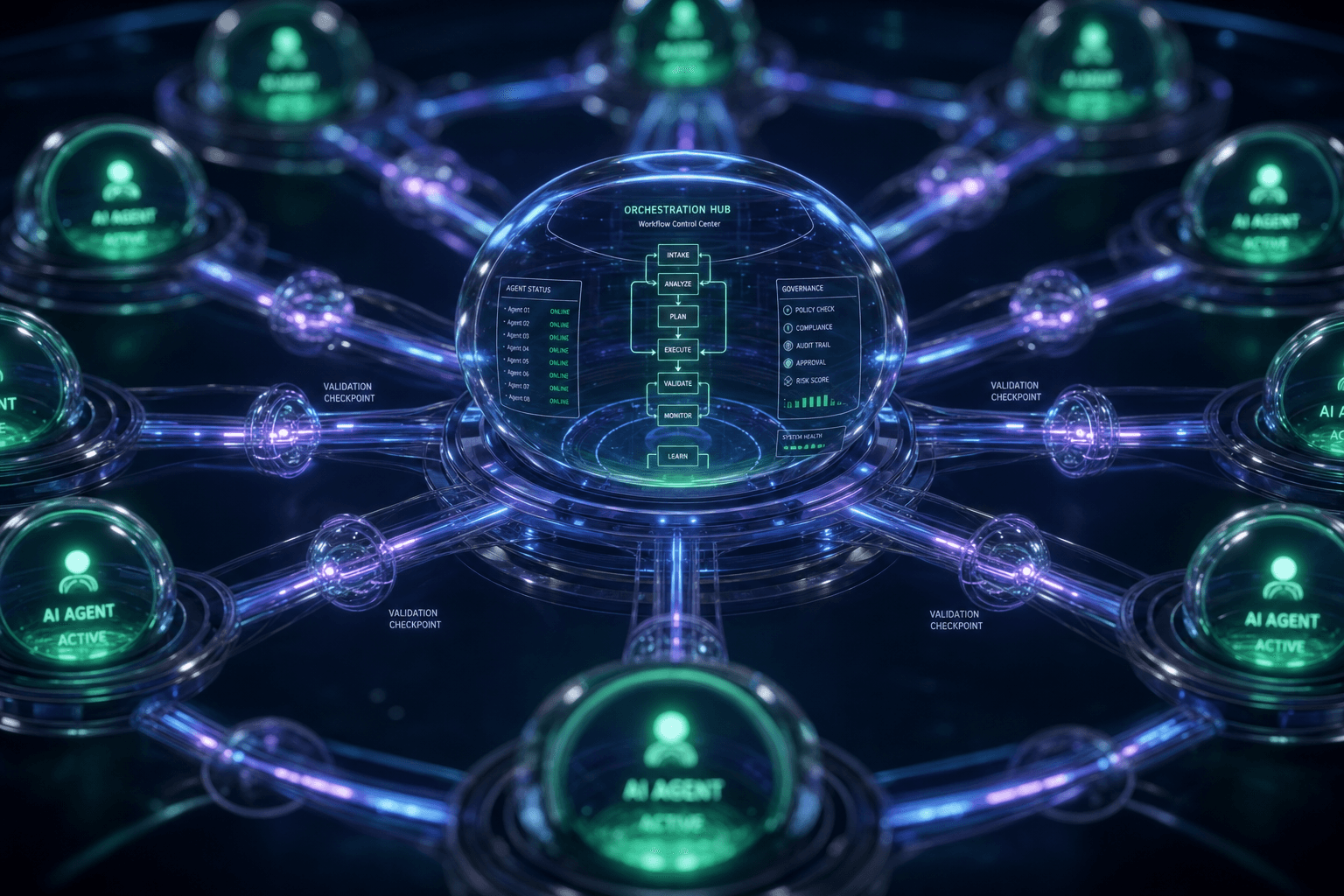
Key Takeaways
- Single AI agents are easy to build. Coordinating multiple agents with compliance oversight is the real challenge.
- Error rates compound across agent chains. Four agents at 95% accuracy deliver only 81% reliability together.
- Regulated industries need audit trails and human override points, not just autonomous decision-making.
- Orchestration patterns fail without validation gates, depth limits, and cost ceilings built into the architecture.
Most enterprises building AI agents in 2026 are solving the wrong problem. The bottleneck isn't making individual agents smarter—it's coordinating multiple agents and humans across regulated workflows without losing compliance, control, or audit trails.
BP3 Global appointed Richard Neish as CEO in October 2026 with one mandate: scale "agentic orchestration in regulated industries." His first public statement cut through the hype: "The hard part isn't building a single clever agent; it's coordinating agents and people together across business-critical processes, with a clear record of who—or what—made each decision, and why."
He's right. The industry spent two years obsessing over smarter models. But the companies actually deploying AI at scale hit a different wall: coordination.
The governance gap nobody talks about
Enterprise customers aren't abandoning 20 years of compliance infrastructure. They're extending it. CTOs ask: "How do I add autonomous decision-making while keeping audit trails, approval workflows, and human override capabilities?"
This creates a software problem orthogonal to model capability. Just as companies discovered that building individual microservices was trivial compared to coordinating them reliably, enterprises now learn that autonomous single agents are less valuable than multi-agent systems with clear decision ownership, audit trails, and rollback capabilities.
Building a clever chatbot is easy. Building a system where three agents hand off work, validate each other's outputs, catch errors before they become compliance violations, and generate an auditable trail that survives regulatory scrutiny—that's the actual work.
Four orchestration patterns that matter
Multi-agent orchestration comes in four architectures. Pick the wrong one and you'll waste months debugging circular delegation loops or explaining cost overruns to your CFO.
Pipeline: Fixed sequence
Design-time decisions. Best for document processing and validation chains.
Example: Form extraction → validation gate → CRM update.
Use when workflow stages are defined in requirements.
Supervisor: Central coordinator
Routes to specialists at runtime based on input. Best for complex requests with variable workflows.
Example: Customer inquiry → classifier → routing to refund agent, billing agent, or escalation.
Use when customer input determines routing (e.g., "I need a refund AND a billing correction" requires two parallel specialists).
Parallel with Reducer: Batch processing
Dispatcher fans identical work across workers; dedicated reducer combines results. Best for independent batch work.
Example: 1,000 contracts analyzed in parallel, then a summary agent identifies anomalies.
Use for batch processing at scale.
Blackboard: Emergent control
Agents read/write shared state without central orchestration. Most flexible, hardest to debug, riskiest for cost explosion.
Use only if the sequence is truly unknowable and you have hard safeguards (depth limits, cost ceilings).
Five failure modes that kill multi-agent systems
Error compounding
Four 95%-accurate agents chained = ~81% compound accuracy. Each handoff multiplies failure probability.
Context loss
Summarization between agents drops crucial compliance information. Agent A's detailed rationale becomes Agent B's three-word summary.
Circular delegation
Agents ping-pong indefinitely without hard depth limits. "Check with billing.""Billing says check with refunds." Loop.
Decision ambiguity
No clear trail of who authorized each action. When the regulator asks "why was this refund approved?" your system shrugs.
Cost explosions
Unmonitored orchestration spirals into infinite loops. One misconfigured supervisor pattern can burn through your monthly API budget in an afternoon.
When you actually need orchestration
This applies to enterprises with:
- Regulated workflows (finance, healthcare, legal)
- Multi-step processes involving multiple domain teams
- Compliance requirements for decision traceability
- Existing governance structures to preserve
It does not apply to simple, single-purpose agent deployments. Customer service bots, code generation, summarization—these remain single-agent problems. Optimize model performance and move on.
How to build orchestration that won't explode
Step 1: Count your decision-making agents
Pull up your architecture diagram. Count the agents. Count again—this time only agents that make decisions that change subsequent actions. That second number is usually 1–2.
If it's 3+, you need orchestration. If it's 1–2, optimize single-agent performance instead.
Step 2: Match pattern to workflow
Pipeline if workflow stages are defined in requirements (fixed sequence of forms, data validation, database update).
Supervisor if customer input determines routing. A request for "refund AND billing correction" needs two parallel specialists.
Parallel + Reducer for batch processing. Analyze 1,000 contracts for risk.
Blackboard only if the sequence is truly unknowable and you have hard safeguards.
Step 3: Build governance layers
Validation gates at every handoff between agents. Specify required fields explicitly, not by convention.
Structured state passing: Agent A outputs a signed JSON object with required fields; Agent B validates schema before proceeding.
Depth limits: Enforce maximum handoff depth (typically 5–7 steps) directly in orchestration code.
Cost ceilings: Set per-request and per-day API spend limits. Halt execution if breached.
Audit trail: Every agent action logged with timestamp, input, output, and decision rationale.
Human override: Agents run in "suggest" mode. Humans approve or reject before execution on production systems.
Step 4: Use declarative frameworks
Use Google AX, Promenaut, or n8n rather than custom code. Separate orchestration logic from domain agents. Monitor cost-per-workflow-instance. Optimize high-cost paths first.
Example workflow using Supervisor pattern for customer service:
Customer Request → Classification Agent
  ├─ Refund Request → Refund Validation Agent → Approval Gate → Execute Refund
  ├─ Billing Question → Billing Specialist Agent → Summary → Email Response
  └─ Escalation Signal → Route to Human + Context
Each handoff includes structured schema validation and audit logging.
The unglamorous moat
The companies winning with agentic AI in 2026+ are not the ones with the best models. They're the ones with the best operational discipline.
Orchestration, audit trails, and governance may feel unglamorous compared to fine-tuning a 70B parameter model. But they're where enterprises actually make money.
If you can route a customer request to three agents, validate their outputs, catch errors before they become compliance violations, and prove to an auditor exactly why a refund was approved, you've built something durable and defensible.
That's the real moat.
Need help mapping your orchestration risks? WrightyMedia's Agentic Orchestration Audit is a 4-week engagement to map your current multi-agent workflows, identify orchestration risks (error compounding, context loss, cost spirals), and design a governance framework aligned with your compliance requirements. You get an architecture blueprint, reference implementation, and runbook for handoff validation. Get in touch.
Start with a self-audit. Download our free Multi-Agent Orchestration Risk Checklist—15 questions to audit your current agent system for governance gaps, cost controls, and compliance risks. Download now.
Want more on
Enterprise Architecture?
Add this topic to your Custom Digest. Drop your email to get our deepest insights on this exact topic.
Ready to fast-track your business?
We combine enterprise-level technical strategy with your existing business to solve complex blockers and accelerate your growth. Let's build something remarkable.
Partner With UsUp Next
Continue your journey into Enterprise Architecture.

Why keeping full agent histories beat every compression strategy
Full context retention with prefix caching cuts agent token costs by 90% and outperforms every summarization strategy on recall.
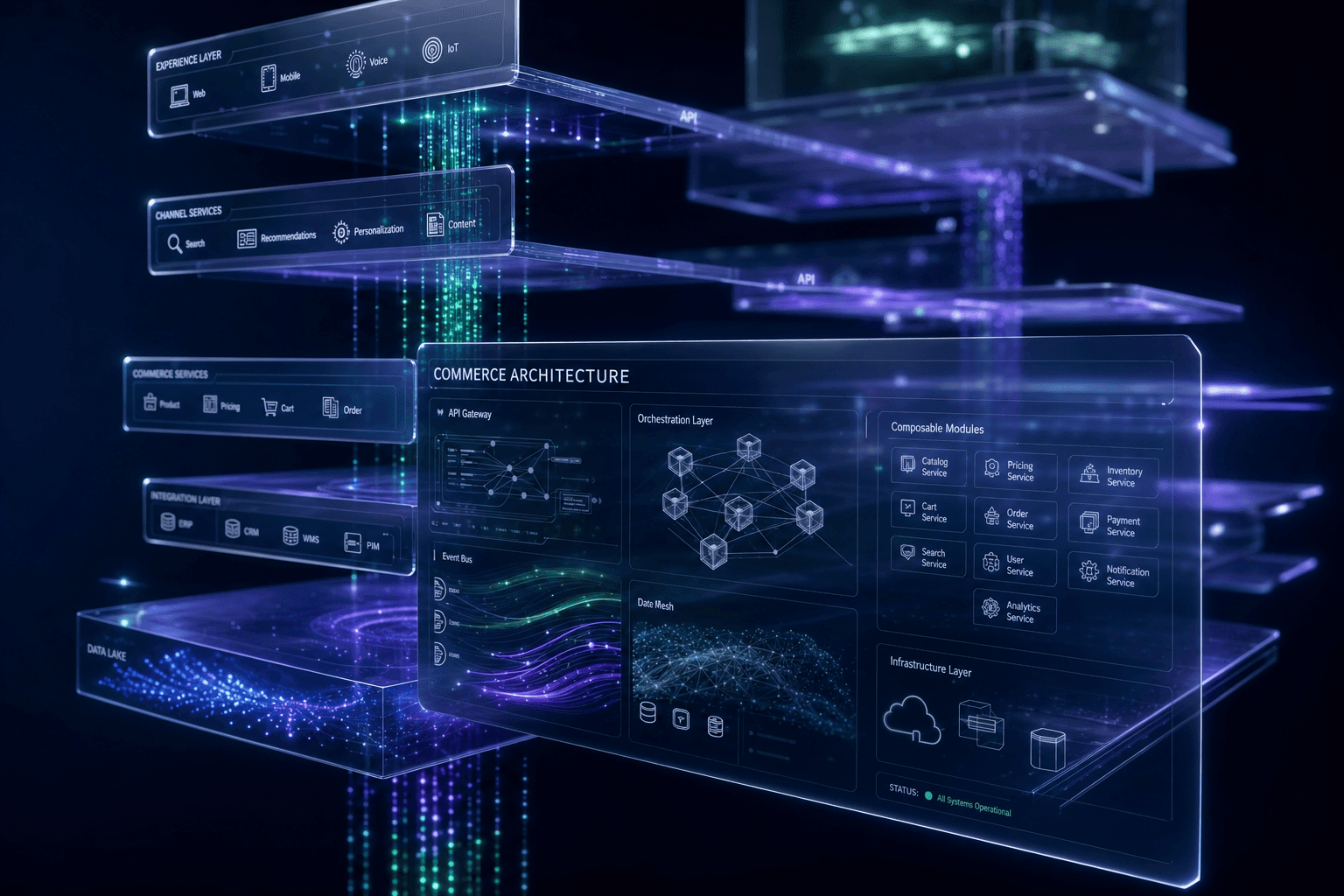
Building for composable commerce
Learn how decoupling your frontend from backend systems cuts IT debt, speeds releases, and breaks vendor lock-in.
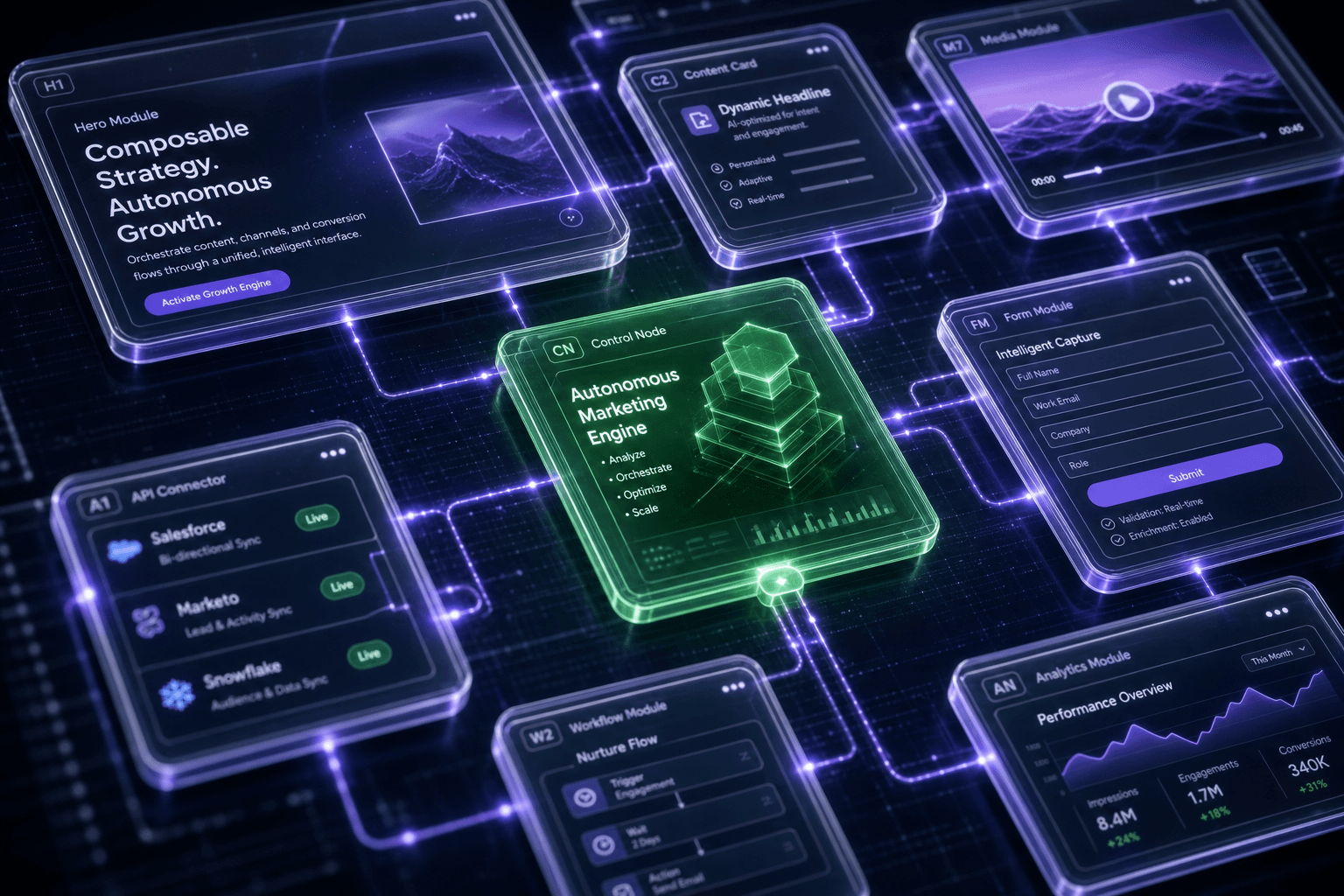
Empowering marketing teams
How API-first frontends let marketing teams launch campaigns without engineering tickets, cutting time-to-market by half.