
How private knowledge graphs secure internal AI models
Learn how private knowledge graphs give CTOs complete control over internal AI systems while eliminating data leakage and vendor dependency.

Key Takeaways
- Private knowledge graphs let you build internal AI models without exposing proprietary data to public cloud services.
- Self-hosted graph databases eliminate vendor lock-in and give you complete control over your enterprise's most valuable intelligence.
- Semantic ontologies turn fragmented internal data into machine-readable knowledge that powers faster, more accurate AI inference.
- This approach cuts compliance risks and accelerates AI development while protecting your competitive advantage through data sovereignty.
Most enterprise AI projects leak sensitive data to third-party vendors or public cloud LLMs. Private knowledge graphs let you build internal AI models that run entirely on your own infrastructure, using only proprietary data. You get secure, context-aware intelligence without exposing a single byte to external services.
Your CTO mandate is clear: deploy AI that transforms operations without exposing proprietary data. The problem? Most enterprise AI implementations leak sensitive information to public cloud providers, create compliance nightmares, and hand competitive intelligence to third parties.
Public LLM services and generic AI platforms force a dangerous trade-off. You gain capability but surrender control. Every API call sends your data into external infrastructure. Every query exposes patterns in your proprietary knowledge. Every integration creates another attack surface.
The scattered state of enterprise data makes this worse. Critical information sits trapped in dozens of disconnected systems. Sales data lives in your CRM. Product specifications hide in engineering wikis. Customer intelligence fragments across support tickets and email threads. This fragmentation prevents you from building truly intelligent systems while maintaining data sovereignty.
The shift to sovereign knowledge infrastructure
Private knowledge graphs represent a fundamental architectural change. You stop treating data as isolated records in separate databases. You start modeling it as a unified, semantically rich network of relationships.
A knowledge graph structures information the way your business actually operates. Entities (customers, products, transactions, employees) become nodes. Relationships (purchased, managed by, requires, supersedes) become edges. This creates a machine-readable map of your institutional knowledge.
The power comes from internal control. Your knowledge graph runs on your infrastructure. Your AI models query it without external API calls. Your sensitive data never touches vendor servers. You eliminate the attack surface that comes from dependencies on external AI services.
This approach breaks vendor lock-in for AI capabilities. Generic LLMs provide language understanding and generation. Your private knowledge graph provides the intelligence. The combination creates expert systems that reason over your proprietary data without exposing it.
Building your private knowledge graph
Design your semantic ontology
Start by modeling your critical business concepts. Identify the entities that matter: customers, products, projects, contracts, employees, locations, assets. Define the relationships between them: reports to, depends on, replaces, includes, authorizes.
Your ontology needs precision. Generic schemas fail because they can't capture your specific business logic. A "customer" in your enterprise has unique attributes and relationships that generic data models miss.
Document cardinality rules. Some relationships are one-to-many (a project has multiple tasks). Others are many-to-many (an employee works on multiple projects, a project has multiple employees). Your graph database needs these constraints to maintain data integrity.
Create a taxonomy for classification. Product categories, risk levels, priority tiers, approval stages. These controlled vocabularies let your AI models reason about your data consistently.
Build the graph infrastructure
Select a graph database that meets enterprise requirements. Neo4j provides mature graph capabilities with strong security features. Amazon Neptune offers AWS integration if you're already committed to that ecosystem. Apache Jena gives you open-source flexibility.
Deploy it on infrastructure you control. Self-hosted on-premises servers give maximum sovereignty. Private cloud instances provide more flexibility while maintaining data boundaries. Avoid multi-tenant graph database services that pool customer data.
Build data ingestion pipelines that normalize information from your existing systems. Extract customer data from your CRM. Pull product specifications from your engineering databases. Parse email and document repositories for unstructured knowledge.
Map everything to your ontology. Transform flat records into graph structures. A customer record becomes a customer node with edges to their orders, support tickets, account manager, and industry segment.
Implement versioning and audit trails. Your knowledge graph will evolve as your business changes. You need to track when entities were created, relationships modified, and attributes updated. This creates accountability and enables rollback if errors corrupt your data.
Connect your internal AI models
Develop a secure API layer between your knowledge graph and your AI systems. This interface should enforce access controls at a granular level. Different AI applications need different subsets of your knowledge.
Use graph query languages to extract relevant context. Cypher (for Neo4j) and SPARQL (for RDF graphs) let you traverse relationships efficiently. When your AI needs to answer a question about a customer, you can retrieve not just their record, but their purchase history, support interactions, and account relationships in a single query.
Implement embedding generation for semantic search. Transform your graph entities and relationships into vector representations. This lets your AI models find relevant knowledge based on conceptual similarity, not just keyword matching.
Create retrieval pipelines that augment LLM prompts with private context. When an internal chatbot receives a question, it queries your knowledge graph for relevant information, then injects that context into the prompt sent to your self-hosted language model. The LLM reasons over your proprietary data without that data ever being part of its training corpus.
Build feedback loops that improve your graph over time. When your AI systems surface knowledge gaps or relationship errors, capture those signals. Use them to refine your ontology and improve data quality.
The business return
This architecture cuts data leakage risk to near zero. Your sensitive information never leaves your infrastructure. Your AI models operate in complete isolation from external services. Compliance auditors can verify exactly where your data lives and how it flows.
Development velocity increases because your teams build on a unified knowledge layer. Data scientists don't waste weeks reconciling schemas across disconnected systems. Application developers query one graph API instead of integrating dozens of data sources. AI engineers train models on clean, structured, enterprise-specific datasets.
Vendor lock-in disappears for your most critical AI capabilities. You can swap language models without losing your institutional knowledge. You can migrate graph databases without rebuilding your entire intelligence infrastructure. Your competitive advantage lives in the knowledge graph you control, not the vendor services you rent.
Internal AI applications become more accurate because they reason over complete context. A sales forecasting model sees the full relationship network around each deal: the stakeholders involved, the competitive dynamics, the technical requirements, the historical patterns from similar opportunities. This depth of context is impossible when data remains fragmented.
Regulatory compliance becomes provable. When auditors ask where customer data lives, you point to specific infrastructure you control. When they ask how AI systems use that data, you show the query logs from your knowledge graph API. When they demand data deletion, you remove nodes from your graph and all dependent relationships automatically break.
The strategic value compounds over time. Each new data source you integrate makes your knowledge graph richer. Each new relationship you model gives your AI systems deeper reasoning capability. Each refinement to your ontology improves the precision of your internal intelligence.
Your enterprise builds a durable moat. Competitors can rent the same public LLMs. They can't replicate the structured knowledge you've accumulated about your customers, products, operations, and market. That private knowledge graph becomes the foundation for AI-driven advantages they can't copy.
Want more on
Enterprise Architecture?
Add this topic to your Custom Digest. Drop your email to get our deepest insights on this exact topic.
Ready to fast-track your business?
We combine enterprise-level technical strategy with your existing business to solve complex blockers and accelerate your growth. Let's build something remarkable.
Partner With UsUp Next
Continue your journey into Enterprise Architecture.
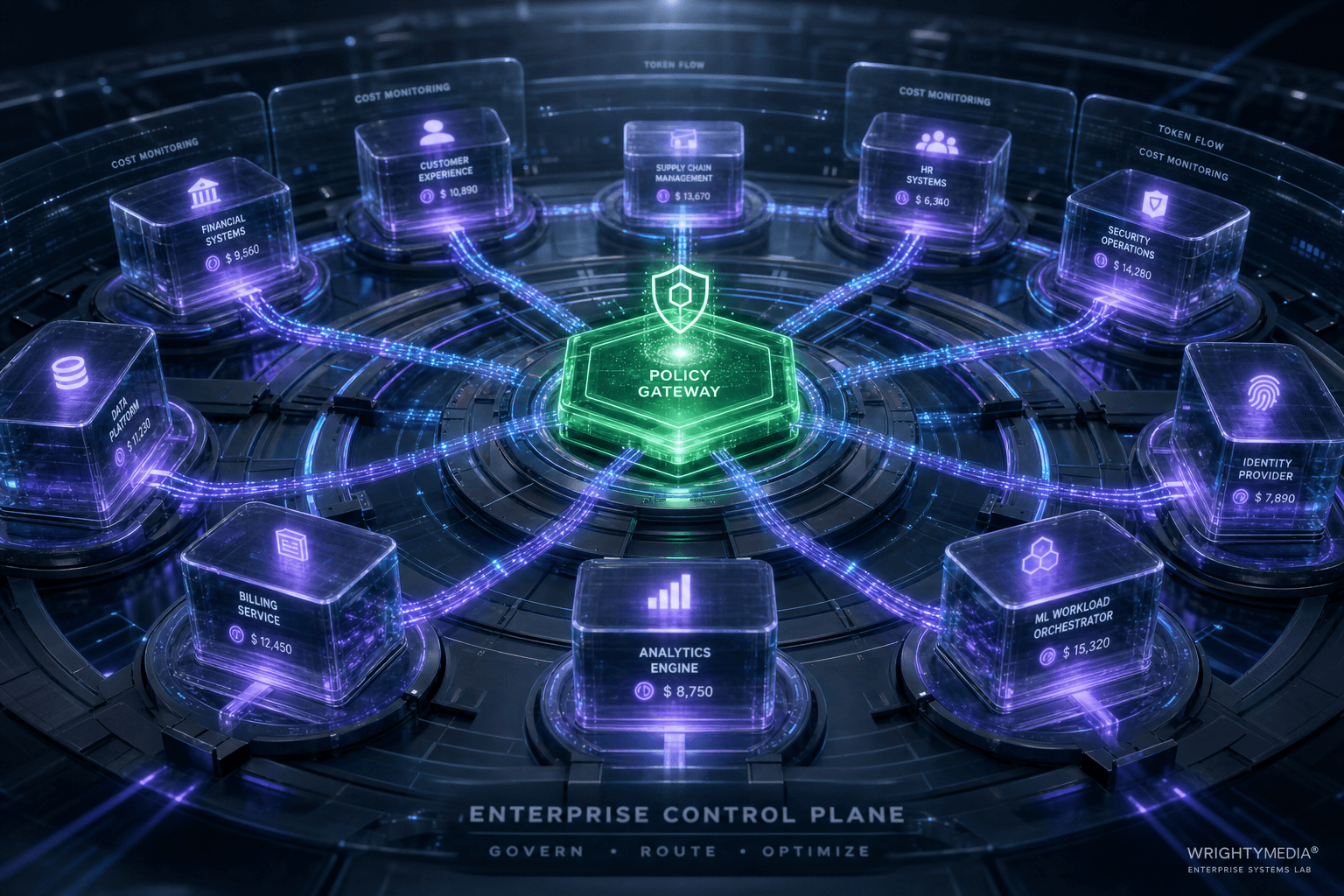
AI governance must move from finance to operations
AI spending is out of control because governance runs through finance instead of operations, where token costs happen in real time.

Small language models just became the cost-effective default
Enterprise AI bills grew 320% while token prices fell 280×. The fix: cost-aware routing cuts spend by 70–90%.

How content data models empower marketing SEO velocity
Learn how structured content data models let marketing teams ship SEO-optimised content faster without waiting on engineering resources.