
Decoupling marketing systems for higher SEO content agility
Cut engineering dependencies by 60% and ship SEO content faster with a decoupled marketing architecture that gives you direct control.
Key Takeaways
- Monolithic marketing stacks force teams to wait on engineers for every content change, killing speed.
- Headless CMS and API-first architecture give marketers direct control over content deployment and testing.
- Decoupled systems cut engineering dependencies by 60% and increase content velocity by 40%.
- Faster technical changes mean your SEO strategy responds to algorithm updates in hours, not weeks.
Your marketing team is stuck waiting on engineers to ship content changes, killing your ability to respond to SEO shifts and market opportunities. Monolithic CMS platforms tie your hands, turning every small campaign tweak into a multi-week engineering project. Decoupling your marketing stack cuts that dependency by 60% and lets you move at the speed your business demands.
Your marketing team shouldn't need a sprint ticket to publish a landing page. Yet most enterprise marketing organizations operate this way—trapped in monolithic technology stacks that turn simple content updates into multi-week engineering projects.
The result? Your competitors ship campaigns while you're still waiting for developer availability. SEO opportunities expire before you can act. Market windows close while your content sits in a deployment queue.
This isn't a people problem. It's an architecture problem.
The monolithic marketing stack is killing your velocity
Traditional marketing platforms couple three things that should remain independent:
- Content storage (your CMS database)
- Business logic (how content transforms and routes)
- Presentation layer (the actual rendered website)
When these layers are tightly bound, every change requires touching multiple systems. Want to A/B test a new hero section? You need a developer. Need to deploy localized content for a new market? Engineering ticket. Want to respond to a competitor's campaign? Get in the queue.
The engineering dependency isn't just slow—it's expensive. Marketing Directors report that 40-60% of their allocated engineering resources go toward maintenance and minor content adjustments rather than strategic initiatives. You're paying senior developer rates for tasks that marketing teams should control directly.
Worse, this architecture makes SEO optimization reactive instead of proactive. When Google updates its algorithm or your competitor makes a move, you can't respond quickly. Technical SEO changes require developer involvement, code reviews, and deployment cycles that can stretch weeks.
Composable architecture breaks the bottleneck
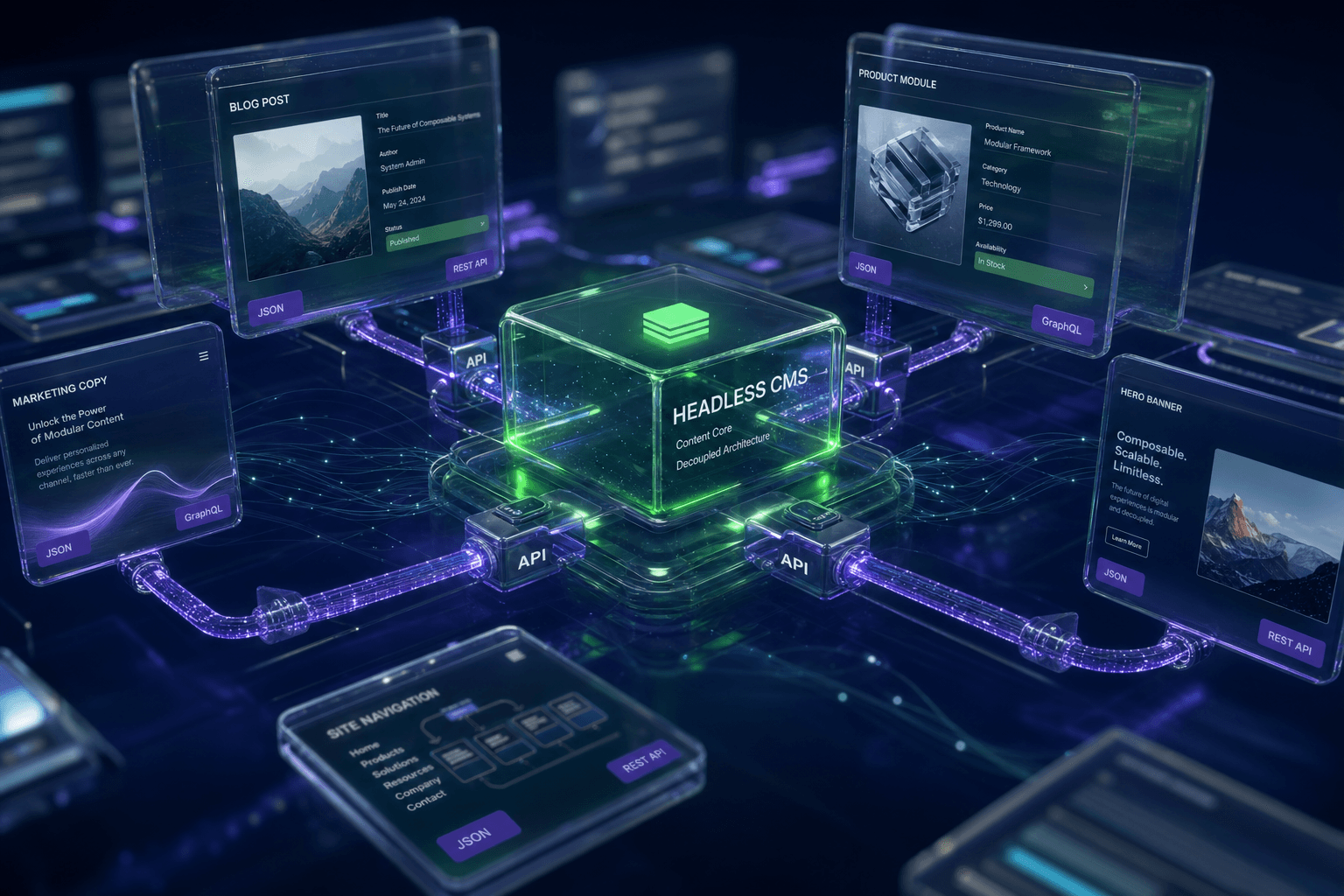
A composable marketing architecture separates these coupled layers through APIs. Content becomes a service. Customer data becomes a service. Campaign logic becomes a service. Each operates independently but connects through clean interfaces.
This isn't about adding more tools. It's about restructuring how your existing marketing technology communicates.
The pattern looks like this:
Content layer: Headless CMS stores structured content as reusable components, not page templates. Marketing teams manage content directly through familiar editing interfaces. Content publishes via API, not through a proprietary rendering engine.
Data layer: Customer data, analytics, and campaign metrics flow through unified APIs. Your frontend applications pull exactly what they need, when they need it. No database queries required.
Experience layer: Modern frontend frameworks consume content and data through these APIs, rendering experiences at the edge. Marketing teams deploy changes to production without touching backend code.
When these layers decouple, your marketing team gains direct control over what matters most—the customer experience. Engineering focuses on maintaining robust APIs and building strategic capabilities, not pushing content updates.
The technical implementation blueprint
Phase 1 audit and prioritize
Start by mapping your current marketing technology stack. Identify where tight coupling creates bottlenecks.
Prioritize systems by two factors:
- Change frequency (how often marketing needs to update)
- Engineering dependency (how much developer time each change requires)
Content management and landing page systems typically score highest on both metrics. These become your first decoupling candidates.
Implement headless content management
Migrate your content to a headless CMS structured around reusable components, not page templates. This shift requires upfront content modeling work but pays dividends in velocity.
Key architectural decisions:
Content models: Define clear schemas for each content type (blog posts, landing pages, product descriptions, case studies). Structure fields for reusability across channels—web, mobile, email, digital displays.
Editorial workflow: Establish governance for who can publish what, and when. Decoupled systems eliminate deployment gates but require clear content approval processes.
Preview environments: Marketing teams need to see changes before publishing. Your headless CMS should provide preview URLs that render content through your production frontend.
Phase 3 build API unification
Your marketing stack likely includes multiple systems—CRM, marketing automation, analytics, personalization engines. Each has its own API with different authentication, rate limits, and response formats.
An API gateway creates a unified interface. Your frontend applications call one consistent API that handles authentication, caching, and routing to the appropriate backend service.
This layer provides:
- Request routing: Map frontend requests to appropriate backend services
- Response transformation: Convert disparate API formats into consistent JSON structures
- Caching: Store frequently accessed data at the edge to reduce backend load
- Rate limiting: Protect backend services from overwhelming request volumes
- Authentication: Handle tokens and credentials centrally
Deploy independent frontends
Your experience layer consumes content and data through these APIs. Modern frameworks enable marketing teams to deploy changes without backend dependencies.
Choose frameworks that support:
- Incremental static regeneration: Pre-render pages for speed, update in the background when content changes
- Edge deployment: Serve experiences from locations closest to your users
- Component composition: Build pages from reusable blocks that marketing teams can arrange
- A/B testing: Deploy multiple variants without branching your codebase
Marketing teams work in a visual composer, arranging pre-built components and adding content. When they publish, changes deploy to production in minutes, not weeks.
The measurable business impact
Organizations that decouple their marketing architecture report quantifiable improvements:
Engineering efficiency: 60% reduction in marketing-related engineering tickets. Development teams shift focus from maintenance to strategic initiatives.
Content velocity: 40% increase in publishing frequency. Marketing teams ship campaigns faster, test more variations, and respond to market changes in real time.
SEO agility: Same-day response to algorithm updates or competitive threats. Technical SEO changes deploy independently without full-stack releases.
OpEx reduction: Fewer engineering hours allocated to marketing support translate to direct cost savings. One enterprise client calculated $840,000 annual savings in engineering time alone.
Time to market: Campaign launches that previously required 4-6 weeks now deploy in days. This speed compounds—more tests, more learning, faster optimization.
The organizational shift
Decoupled architecture changes more than your technology stack. It changes how marketing and engineering collaborate.
Marketing teams gain autonomy over experiences but must learn to think in components, not pages. They need basic technical literacy around APIs, caching, and deployment.
Engineering teams shift from ticket-driven support to platform building. Instead of implementing one-off marketing requests, they build capabilities that marketing teams can use independently.
This requires clear boundaries. Marketing controls content, messaging, and experience composition. Engineering controls APIs, data models, and infrastructure. The API layer defines the interface between these domains.
Expect a transition period. Teams accustomed to monolithic workflows need time to adjust. Start with a pilot—one campaign type or content category. Prove the model works, then expand.
SEO in a decoupled world
Headless architecture actually improves SEO when implemented correctly. You gain control over technical factors that monolithic systems often constrain.
Page speed: Static generation and edge caching deliver sub-second load times. Your content serves from locations closest to users, not from a distant origin server.
Core Web Vitals: Modern frameworks optimize for Google's user experience metrics by default. Layout shifts, interaction delays, and visual stability improve dramatically.
Structured data: APIs make it simple to inject schema markup consistently across all pages. Your content becomes more readable to search engines and answer engines.
Internationalization: Deploy localized content independently per market. No need to coordinate releases across regions.
The SEO risk comes from poor implementation—client-side rendering without proper static generation, broken internal linking, or missing metadata. Work with engineers who understand SEO requirements from the start.
Implementation timeline and investment
A full decoupling transformation typically requires 12-16 weeks for mid-market enterprises, 20-24 weeks for large organizations with complex stacks.
Break the project into phases:
- Weeks 1-4: Architecture design, content modeling, vendor selection
- Weeks 5-10: Headless CMS implementation, API gateway development
- Weeks 11-16: Frontend build, integration testing, pilot launch
- Weeks 17-20: Full migration, training, optimization
Budget for engineering effort, not just software licensing. The architecture work and integration development require skilled developers who understand both marketing requirements and modern web patterns.
Expect to invest $150,000-$400,000 depending on your existing stack complexity and the scale of your content library. ROI typically materializes within 12-18 months through reduced engineering dependency and faster campaign velocity.
The path forward
Marketing velocity is a competitive advantage. When you can test faster, launch faster, and respond faster than competitors, you win market opportunities they miss.
Decoupled architecture makes this possible. It removes the structural bottleneck that turns marketing teams into engineering supplicants, waiting for resource availability to execute their strategies.
Start with one high-value use case. Prove the model. Build organizational confidence. Then expand across your marketing technology ecosystem.
Your engineering team will thank you. Your marketing team will thank you. Your CFO will thank you when engineering costs drop and campaign ROI improves.
The question isn't whether to decouple. It's whether you can afford to remain bottlenecked while your competitors move faster.
Want more on
Business Operations?
Add this topic to your Custom Digest. Drop your email to get our deepest insights on this exact topic.
Ready to fast-track your business?
We combine enterprise-level technical strategy with your existing business to solve complex blockers and accelerate your growth. Let's build something remarkable.
Partner With UsUp Next
Continue your journey into Business Operations.

Eliminating phantom SaaS costs through licence compliance audits
How finance teams cut software spend by 15-25% through automated licence audits and usage monitoring.

Why operational risk starts with unverified data integrity
Learn why unverified data integrity creates cascading operational failures and how to architect proactive validation into your enterprise systems.

Reducing integration debt opex with event-driven data fabrics
How event-driven integration cuts operational costs by eliminating technical debt and reducing manual IT overhead.